
Lawmakers Monday settled on revenue targets that were at once “optimistic” and “conservative,” depending on who was talking about the numbers that will guide budget-setting in the coming months.
After a meandering discussion and some initial confusion about what they were voting on, the Joint Finance-Appropriations Committee (JFAC) unanimously voted to adopt revenue recommendations from the Economic Outlook and Revenue Assessment Committee (EORAC).
The targets are:
- $5.665 billion for fiscal year 2026, the current budget year.
- $5.817 billion for fiscal year 2027, next budget year.
The revenue targets project how much money the state will collect from taxes — key numbers as lawmakers consider agency budgets, including education budgets, and weigh policy bills such as tax cuts.
The approved targets are each more than $130 million higher than forecasts from the governor’s office. But they’re still “conservative,” considering state revenue showed signs of rebounding in December, said Rep. Josh Tanner, JFAC’s co-chairman.

Last month, the state collected $102.4 million more than projected, after corporate income tax filings “increased dramatically” compared to the previous quarter, according to a budget update from the Legislative Services Office.
“We’re sitting heavy,” said Tanner, R-Eagle.
JFAC’s decision to set the targets early this session is a return to normalcy after last year’s revenue drama. In 2025, the budget committee debated projections for weeks and didn’t agree on targets until early March, when the Legislature had already passed major tax cuts.
But Monday’s meeting also wasn’t a model of efficiency, nor was it devoid of drama.
JFAC members initially voted down a motion to “accept” a written report from EORAC explaining its recommendations. After a few JFAC members voiced confusion about what they were voting on, the committee unanimously voted to “adopt” EORAC’s recommendations.
The difference between “accepting” the EORAC report and “adopting” its revenue targets appeared to be merely symbolic, however. JFAC is moving forward with budget-setting armed with EORAC’s recommended revenue targets — $5.665 billion for this fiscal year and $5.817 billion for next fiscal year.

Rep. Rod Furniss, who serves on both JFAC and EORAC, said the numbers reflect confidence that Idaho’s economy will continue to “percolate” and boost state revenue.
“There’s a lot of uncertainty out there, but we had a record-setting December,” said Furniss, R-Rigby. “That boosted our revenues up quite a bit, and that gave us an optimistic outlook.”
Senate Minority Leader Melissa Wintrow expressed similar optimism, although with a tinge of sarcasm. Wintrow, D-Boise, said the bullish revenue targets suggest spending cuts won’t be necessary this session.
“I was a little nervous at first, but I think this is an indication that, ‘Hey, we don’t have to make these deep cuts that people are talking about,’” Wintrow said.
Senate Education begins work Tuesday, with a higher ed search bill
The Senate Education Committee will hold its first meeting Tuesday afternoon — and its first bill appears to be significant.
Senate Majority Leader Lori Den Hartog will present a bill “defining the process for presidents searches for the state institutions of higher education,” according to a meeting agenda posted Monday morning.
Committee agendas are often notoriously sketchy — and draft bills are not public record until a legislative committee discusses them in open session. But the State Board of Education’s search for a new Boise State University president has been on hold since October, and board members have complained about the state law that pertains to the process.
The law allows applicants to put their names in confidentially. However, the law requires the State Board to release a list of five finalists — candidates who then come to campus for public meetings with students, staff and the campus community.
Board members have said some applicants do not want to be publicly identified — and would rather withdraw from consideration.
In 2025, Utah passed a state law moving its presidential search process entirely behind closed doors.
Education committees off to a slow start — for now
The House and Senate education committees have gotten off to a sluggish start this year.
That’s not that unusual. Most committees meet sparingly during the opening week of the session. But on Monday, nine legislative committees had meetings on the calendar — including the budget-writing Joint Finance-Appropriations Committee, which met regularly last week.
Neither education committee met Monday.
The House Education Committee held a short organizational session Wednesday, which focused on committee introductions, including from the panel’s new chairman.
“I have a passion for the education that we’ve left behind, where our children learned how to think instead of what to think,” Rep. Dale Hawkins said. “That’s why I’m in this committee.”
When House Education does meet, it will be a new-look panel. As Hawkins, R-Fernwood, moves from vice chairman to chairman, the 14-member committee will have four new members: Vice Chairman Clay Handy, R-Burley; and Reps. Soñia Galaviz, D-Boise; Clint Hostetler, R-Twin Falls; and Michael Leman Veile, R-Soda Springs.
Senate Education’s membership is unchanged from 2025.
Teachers’ union hosts annual ‘Lobby Day’
Hundreds of public school teachers descended on the Capitol Monday for the Idaho Education Association’s (IEA) annual “Lobby Day.”
Members of the statewide teachers’ union met with lawmakers and shared their policy goals for the 2026 legislative session. The goals include defunding the $50 million Parental Choice Tax Credit, which launched last week, and fully funding special education in public schools, which faces an estimated $100 million shortfall.
Monday’s event had “record turnout,” with 225 teachers and IEA organizers attending, according to union spokesman Mike Journee. One attendee, Kelly Heil, is a sixth-grade history teacher from Pocatello who considered walking away from the classroom until she participated in an IEA Lobby Day a few years ago.
“It’s such an empowering thing for me, personally,” Heil said. “But then to also share the stories from my classroom … and bring what is important to my students and their families to our legislators is so powerful, and it’s so uplifting.”
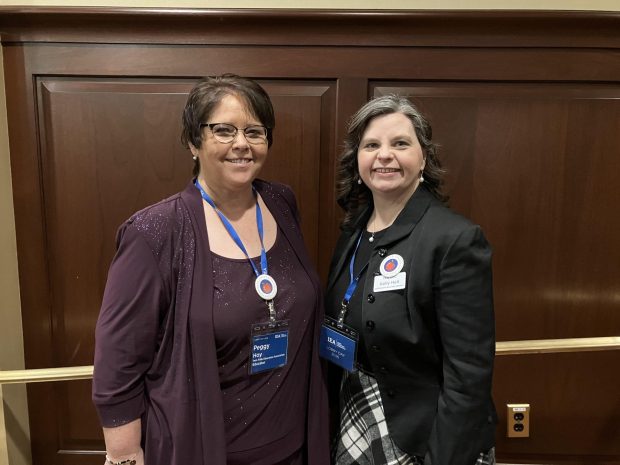
Peggy Hoy, an IEA organizer and former teacher and instructional coach from Twin Falls, seized an opportunity to invite lawmakers to visit public school classrooms. Hoy said she hoped to counter the narrative that public schools are “failing students.” Lawmakers from her district appeared receptive.
“We exchanged business cards, and we’ll see what happens,” she said.
According to a policy guide circulating in the Statehouse, IEA’s goals for the session also include:
- Ordering an adequacy study into K-12 funding.
- Ending “chronic underfunding” of public schools.
- Promoting educator respect.
- Increasing pay for paraprofessionals.
- Improving student wellbeing.
- Halting “fast-tracks” of teacher certification.
- Retaining workers’ rights.
Bill would allow Idaho to ‘go on offense’ against the feds
Legislative leadership would be able to hire outside counsel to file lawsuits, under a bill introduced Monday.
The House State Affairs Committee unanimously introduced the bill, sponsored by Rep. Bruce Skaug, R-Nampa.
Legislators frequently hire outside defense counsel. Skaug’s bill would allow legislative leadership to sue the federal government and outsource the legal work. “This allows us to go on offense,” Skaug said.
With a bit longer debate, the committee introduced a second bill from Skaug, which would require paid signature gatherers to identify who is paying them. Signature gatherers would have to add this information to their name tags.
Both bills could come back to House State Affairs for full hearings at a later date.
The committee also approved a nonbinding resolution for Idaho’s events marking America 250, and the signing of the Declaration of Independence. That resolution is headed straight to the House floor.

