
It was April 10 — just 21 days after Marlene Tromp had accepted the president’s job at the University of Vermont — and Lisa Grow was worried.
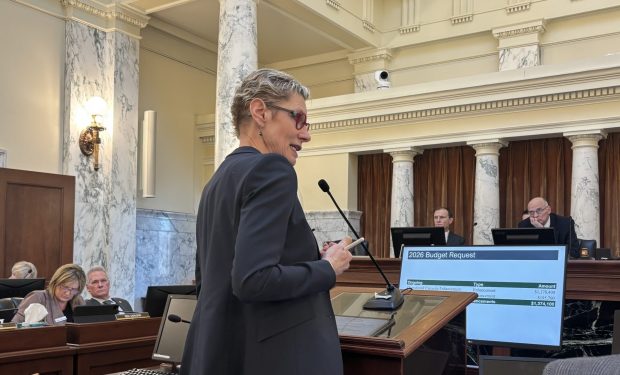
The Idaho Power CEO and Boise State University presidential search committee member had sat in on a campus listening session earlier that week. She heard an earful. Campus leaders were convinced the State Board of Education wanted to fast track the search for Tromp’s successor, bringing in presidential candidates for site visits during the summer break.
“They believe it will narrow the pool of candidates, the candidates will not get an accurate impression of the campus when school is not in session, and there is distrust in the process that is moving so quickly,” Grow said in an email to fellow search committee members.
State Board President and search committee member Kurt Liebich didn’t disagree. Timing, he quickly replied, is a “critical question.”
It all seems outdated now. Seven months later, the Boise State presidential search is on indefinite hold. No finalists, no site visits and no timetable to replace Tromp.
Publicly, the State Board has said little about the process of filling the most high-profile vacancy in Idaho higher education. The hire will affect the trajectory of a state university that continues to grow its enrollment, its endowment and its research profile — but continues to labor under harsh scrutiny from a skeptical Legislature.
To look more closely at the process, Idaho Education News filed a public records request for the State Board’s search-related emails. The documents reveal that several prominent Idahoans went to bat for candidates. The documents also show that the high-powered, volunteer committee has grappled to communicate with the campus community that has a direct stake in the search’s outcome.
The cast of characters
The search committee: In March, the State Board of Education named an eight-member presidential search committee: State Board member David Turnbull (chair); State Board President Kurt Liebich (vice chair); Lisa Growette Bostaph, criminal justice professor, Boise State University; Lisa Grow, chief executive officer, Idaho Power; Bobbi-Jo Meuleman, CEO, Boise Metro Chamber of Commerce; Bruce Mohr, chairman, Boise State Foundation; Mike Reynoldson, Blue Cross of Idaho; Jeremiah Shinn, Boise State interim president.
The search firm: The State Board hired New York-based Russell Reynolds Associates to work on the search. While the search is on hold, the firm continues to work, under a $155,280 state contract. The State Board has reached out to no other firms, spokeswoman Marissa Morrison said Wednesday.
Key milestones
- March 20: Boise State President Marlene Tromp accepts the president’s job at the University of Vermont.
- March 21: The State Board names seven members to a presidential search committee. The board adds an eighth member, Bostaph, on March 27.
- April 24: Shinn is named interim Boise State president, effective May 11.
- May 6: The State Board hires Russell Reynolds Associates.
- July 18: A “priority” application window closes, but the State Board keeps the search open. At this time, 42 people have applied for the job.
- Aug. 18-19: The search committee conducts semifinalists’ interviews at the Boise Airport. According to records obtained by EdNews, eight candidates make this cut.
- Oct. 2: The search is put on hold. The search committee says it does not have a list of five finalists to submit to the full State Board.
‘Just passing along this resume …’
Soon after Tromp took the Vermont job, the names started rolling in.
Christian Zimmerman, a spinal neurosurgeon in the Saint Alphonsus Health System, emailed Liebich on April 6, recommending a candidate. (This name, and all names of possible applicants, were redacted in the 158 pages of emails obtained by EdNews.)
The next day, Larry Williams emailed State Board member David Turnbull, the head of the search committee. Williams, a prolific conservative donor, has been just as prominent in Boise State politics; he helped bankroll Big City Coffee’s 2023 lawsuit against Boise State, yielding a $3.7 million verdict against the university.
“You’re the second person to recommend this gentleman,” Turnbull said to Williams.
“I am not recommending anybody, David, and won’t,” Williams replied. “Just passing along this résumé for a friend. … I’m a little short of friends right now, so I need to do all the favors I can.”
Terry Ryan — the CEO of Bluum, an Idaho nonprofit supporting charter schools — wrote Turnbull on April 28, on behalf of a friend and a previous finalist.
On June 6, State Board member Shawn Keough passed along a name. “I find the consulting firm screening processes to be frustrating at times, in terms of filtering out people who are worth interviewing, which is why I forward this,” she said in an email to Liebich.
In an EdNews interview, Keough declined to say who she had suggested to Liebich, and said she isn’t sure the person ever applied. But after serving on the University of Idaho presidential search committee in 2019, Keough knows the search committee’s job: taking a tall stack of resumes and making it shorter.
“I am hopeful that no qualified candidates fell through the cracks,” she said.
Details about the other exchanges are just as scarce.
“Because of my involvement with the Big City case I have intentionally stayed out of the search for the new president,” Williams said in an email to EdNews. “I may have passed on the résumé of a person that someone sent me, but (I’m) not even sure who that would be.”
“I wrote a letter of support,” Ryan said in an email. “As far as I know, he never got an interview.”
Zimmerman declined comment on his email to Liebich.
The suggestions went into the mix, but weren’t given any additional weight, State Board spokeswoman Marissa Morrison told EdNews in a written response.
“All recommendations were forwarded to our search consultants for appropriate consideration under the criteria identified in the job announcement; no suggestion received a different level of consideration or special treatment,” she said.
‘Angst and demoralization are in abundance’
On Thursday, May 8, Boise State’s spring semester was nearing its conclusion. Finals week would end the next day. Friends and families were arriving in Boise for commencement ceremonies two days later. That Saturday, May 10, would be Tromp’s final day on the job; she would preside over one last Boise State commencement, then turn over the reins to Interim President Jeremiah Shinn.

Turnbull and Liebich prepared an end-of-semester update to the campus community. They thanked everyone who took part in a listening session or filled out a survey about the search. They reported the hiring of a national search firm, Russell Reynolds Associates. And they said their work would continue.
“Over the summer, the search committee will continue our work to identify the best candidates to lead this thriving community. We are committed to keeping you updated as we work our way through this process.”
The email went out at 11:04 a.m.
At 12:25 p.m., criminal justice professor Lisa Growette Bostaph emailed her search committee colleagues, concerned the message hadn’t said enough. The campuswide email failed to allay a familiar fear: the concern that the State Board would name finalists over the summer, leaving no opportunity for site visits during fall semester. For a campus bracing for high-level turnover — and processing the implications of a new, far-reaching state law banning diversity, equity and inclusion programs — the message matters.
“In these tumultuous times, patience is in short supply and angst and demoralization are in abundance,” Bostaph wrote. “In the end, the process we use, and how we communicate about the process, will ultimately reflect on the next president as the outcome of this process.”
In a recent interview, Bostaph pointed out that she and Shinn are the only Boise State employees on the search committee. As a tenured professor, Bostaph is somewhat insulated from churn and transition. For staff members with no such job security, livelihoods and careers can be on the line.
Hence her email.
“I felt that I had kind of a greater duty … to the larger campus community,” she said.
And Bostaph says the search committee — comprised largely of business leaders — has been receptive to her concerns.
‘It is important to have one voice’
From the beginning, the search committee has hit against a fundamental tension.
On the one hand, hiring a president at the state’s largest university is an inherently public decision. The president will take over a university that is receiving $300.7 million from the state this budget year — including $134 million in tax dollars. The president will be the public face of an ever-growing blue-and-orange community: more than 28,000 full- and part-time students, more than 100,000 living alumni and an invested donor base that contributed a record $102 million last year.
But on the other hand, secrecy is built into the search. Applicants’ names are kept confidential, at least at the outset. Working under nondisclosure agreements — which the State Board says is standard practice — search committee members begin vetting applications behind closed doors.
Consequently, the committee and the State Board has struggled to find a voice.
In emails obtained by EdNews, State Board leaders debated their approach to media inquiries — including requests from EdNews.
“We had some discussion very early in the process that I would handle press requests, although I’m not fond of doing them,” Turnbull said in a May 30 email to Bostaph.
Two days later, State Board External Affairs and Strategy Officer Matthew Reiber suggested firming up a point of contact. “I think it is important to have one voice on this subject,” he said in an email to Turnbull and Liebich.
That week, Turnbull declined an EdNews interview request and instead sent a brief written statement.
Turnbull and Liebich also declined interview requests for this article, and the State Board asked EdNews to submit written questions.
EdNews asked about why the board has declined repeated interview requests.
“Our goal is to preserve the integrity of the search,” Morrison wrote in response. “Confidence and confidentiality in highly competitive presidential searches is essential, especially while the process is evolving. The board remains committed to a transparent process, timeline, and structure but cannot discuss specific candidates or internal deliberations.”
Airport interviews — and then, a holding pattern
The search took flight on Aug. 18 and 19. Search committee members spent two days at the Boise airport — a “neutral and accessible” venue, said Morrison — to interview semifinalists, 75 minutes at a time. The committee had planned to come out of these closed sessions with a list of five finalists. From there, the State Board would invite the final five to campus for town hall meetings, conduct the last round of interviews and name Boise State’s eighth president.
This plan never made it off the runway.
During a State Board meeting the next day, Turnbull and Liebich sent mixed signals. They said the Boise State job was highly attractive and drawing interest from a talented field of applicants. They also said candidates bristled at the one public aspect of the search — a law requiring the State Board to publicly announce five finalists, or release the entire list of applicants.
Some presidents at other institutions would rather withdraw their application than go public, Liebich suggested.
“You have a 20% chance of getting the job,” Liebich said. “Are you really going to put your current position at risk?”
It’s a valid concern, Bostaph said. Whenever she mentions the legal requirements to campus colleagues, the response is more or less the same.
“The immediate reaction is a gasp, an audible gasp,” she said. “You can’t place people’s careers in jeopardy.”
And on Oct. 2 — without five qualified candidates willing to go public — the search committee made a startling admission of defeat. The committee recommended putting the process on hold, allowing the State Board to review “both the approach and scope of the search.” A process that started on a fast track had hit an sudden slowdown.
Where do things go from here?
Consistent with most of this eight-month search, the current status and the future are unclear:
- What has happened since Oct. 2? Morrison offered few details Wednesday. “The board is exploring what is possible under the current legal and practical constraints.”
- Have any candidates pulled out since the state put the search on hold? Morrison wouldn’t say.
- Will the job remain vacant until next summer? Maybe, maybe not. Turnbull and Liebich have both hinted that the search could continue well into 2026 — which might work better for candidates who don’t want to move in the middle of an academic year. Morrison, however, said the board has no self-imposed deadlines, and the timetable “remains flexible.”
- Does the process hinge on a change in the law? Not necessarily. Even though the search committee struggled to compile a public short list of five finalists, the State Board “has no plans to carry legislation” to change this requirement, Morrison said. Even if a bill passes and becomes law, that wouldn’t happen until sometime in 2026.
Meanwhile, Boise State is dealing with turnover in the president’s office and beyond. The university is also looking for a provost, a chief financial officer and a chief information officer, among other top-level vacancies.
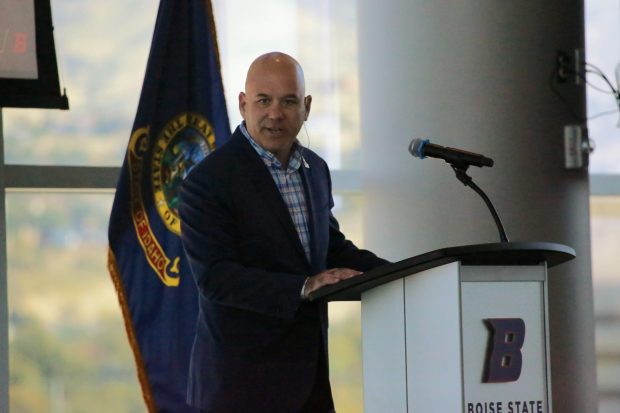
Boise State will begin working on the financial and information officers’ vacancies first, leaving the provost’s job open for now. This will allow the next president the chance to pick Boise State’s next chief academic officer, Shinn told EdNews in October.
This won’t change the State Board’s approach, Morrison said. “Naming the next president is a long-term decision for a critical university to the state, and we will not compromise on a deliberate, high-quality process.”
Bostaph isn’t sure what to expect when the State Board unpauses the search. She’s disappointed because, just a few months ago, everything seemed to be moving smoothly. The search committee was committed to the job at hand, she said, and the state had “a great pool of applicants.”
Now, with things on pause, she says she is confident in Boise State’s interim team.
“The search may be paused, but the university is not paused,” she said.
Disclosure: The J.A. and Kathryn Albertson Family Foundation funds both Idaho Education News and Bluum.