
The most consequential 11 weeks for education funding and policy starts Monday, as state lawmakers return to Boise for the annual legislative session.
The second session of the 68th Idaho Legislature kicks off Jan. 12 with the governor’s State of the State address, followed by roughly two-and-a-half months of budget and policy debates among lawmakers and advocates.
This year’s session is primed for drama: The state faces a revenue shortfall that could approach an estimated $1 billion, and lawmakers will have to figure out how to fill the gap — during an election year. All 105 legislative seats are up for grabs in this year’s May primary and November general elections.
As always, education will be a focus of the legislative session and the election. Funding for K-12 represents about half of the state’s budget, and lawmakers play an active role in local school policy, from curriculum standards to teacher credentials and classroom rules. Not to mention, the state governs and mostly funds public colleges and universities.
Here’s your guide to following education issues during the session, with key dates, committees to watch and ways you can participate in the lawmaking process:
Key legislative session dates
- Jan. 12 – Legislative session convenes. Governor delivers State of the State address.
- Jan. 19 – Idaho Education Association’s “Lobby Day.”
- Feb. 11 – Homeschool Idaho’s “Legislative Day” (a.k.a. “Pie Day”).
- Feb. 16 – Constitutional amendment deadline.
- Feb. 16-17 – Idaho School Boards Association’s “Day on the Hill.”
- Feb. 26 – Bill introduction deadline.
- March 6 – Transmittal deadline (the final date to move bills from the House to the Senate, and vice versa).
- March 12 – Target date for JFAC to complete budget-setting.
- March 27 – Target date for adjournment, sine die.
State of the State address
This year’s session commences with the State of the State address, when the governor reflects on the past year and lays out his priorities for 2026.
Republican Gov. Brad Little will deliver his eighth address to the Legislature since assuming office in 2019. In past speeches, Little has proposed major state investments — in school facilities and state infrastructure like roads and bridges, for instance — as the state welcomed revenue surpluses. But the projected deficit will dampen this year’s address.
Still, the address should exhibit its typical pageantry. The governor will be escorted from his second-floor Statehouse office to the House chambers on the third floor, where he’ll speak before a joint session of the House and Senate. Members of the Idaho Supreme Court and Little’s fellow constitutional officers, including State Superintendent of Public Instruction Debbie Critchfield, will also attend.
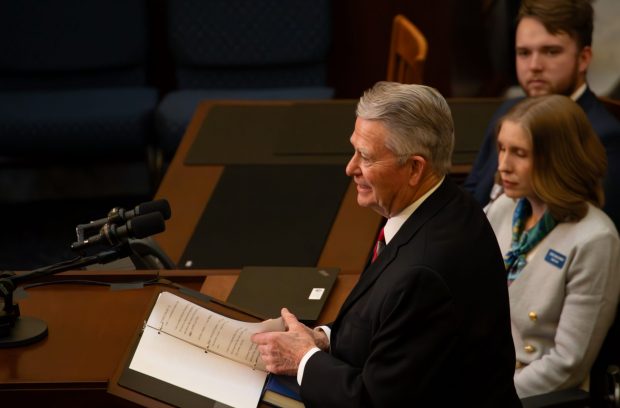
The address is scheduled to start at 1 p.m. MST. Idaho Public Television will broadcast the speech and Idaho In Session will stream it online.
Following the governor’s address, Idaho Public Television will host a live analysis by an expert panel that includes Idaho Education News Senior Reporter Kevin Richert.
The State of the State address is an opportunity for the governor to highlight his spending recommendations, but the state’s budget is largely up to …
JFAC
The Joint Finance-Appropriations Committee (JFAC) starts its work Jan. 13 with a review of the governor’s budget proposals.
The powerful 20-member committee is evenly represented by the House and Senate, and fulfills the Legislature’s primary constitutional mandates: balancing the budget and funding public schools.
Over the next two months, the committee will meet with agency directors to scrutinize their budget requests. JFAC is also responsible for statewide spending decisions, like setting a revenue target and distributing state employee raises, including teacher raises.
According to the committee’s calendar, key education-related budget hearings are scheduled for the week of Jan. 19-23, when JFAC will hear presentations from the Idaho State Board of Education and Idaho Department of Education.
JFAC’s leadership will look different in 2026. Former co-chair Rep. Wendy Horman, R-Idaho Falls, who resigned for a Trump administration post, will be replaced by Rep. Josh Tanner, an Eagle Republican who served as House assistant majority leader last session. Tanner will lead the committee with returning co-chair Sen. C. Scott Grow, R-Eagle.

JFAC’s target date to complete its work is March 12.
Unlike the Legislature’s policy committees, the budget-setting committee doesn’t invite the public to testify on the bills it crafts. But its meetings are streamed on Idaho In Session, and constituents can share their input directly with JFAC members.
Click here to see JFAC’s agendas, and to find out which legislators serve on the committee.
Click here for information on budgets.
Throughout the session, EdNews will provide regular coverage of JFAC, along with the …
Education committees
The Legislature has two policy committees — one in the Senate and one in the House — that focus on education and meet almost daily throughout most of the session.
Policy committees vet and vote on bills before they advance to the full House or Senate and eventually reach the governor’s desk for his signature or veto. Committees also host hearings that give the public an opportunity to share their view on a particular bill.
Last year, the Legislature introduced 790 bills, the highest number over the last seven legislative sessions, and 341 became law. Since 2019, an average of 337 bills have been signed into law each session.
Click here to learn about how a bill becomes a law.
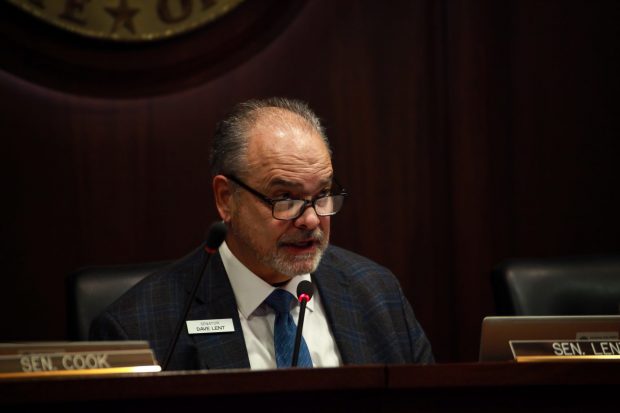
Committee meetings, including meetings of the education committees and others, are open to the public, and they’re streamed on Idaho In Session. Most committees also invite remote testimony for constitutions who can’t travel to Boise. Agendas are posted here, and recordings of past meetings are archived here.
Click here for information on testifying before the Senate Education Committee and here for information on testifying before the House Education Committee.
There are also opportunities to meet with lawmakers and advocate for education issues through organized efforts such as …
Lobby days
Advocacy groups representing teachers, school board trustees, home-schoolers and others host events each session that allow their members to meet with lawmakers and lobby for education-related issues.
These include, among others:
- Idaho Education Association’s “Lobby Day” – Jan. 19.
- Homeschool Idaho’s “Legislative Day” (a.k.a. “Pie Day”) – Feb. 11.
- Idaho School Boards Association’s “Day on the Hill” – Feb. 16-17.

There are also paid professionals who lobby lawmakers on a daily basis throughout the legislative session. The Idaho Secretary of State maintains a database of registered lobbyists, who are required to report their expenses.
Click here to track the top spenders.
Lawmakers can also be reached directly by email or phone. Click here to see the Senate members and here to see the House members.
Keep in mind that the lawmaking process can move fast, particularly in an …
Election year
A common conception among politicos is that election-year legislative sessions are shorter than others — because lawmakers want to get home and start campaigning.
There is some truth to this. Since 2016, election-year sessions have been seven working days shorter, on average, than sessions in non-election years. This is excluding the 311-day session in 2021 when the Legislature chose to recess for several months rather than adjourn.
Every legislator’s two-year term expires in 2026, and we’ll know which of the 70 representatives and 35 senators are running for reelection mid-session. The candidate filing period is Feb. 23-27.
Idaho’s seven constitutional officers — including the governor, state superintendent and attorney general — are also up for reelection this year.
The primary election is May 19.
Click here for voting information.
Key election dates
- Feb. 23-27 – Primary election filing period for federal and statewide offices (Idaho Legislature, U.S. House/Senate, governor, state superintendent, etc.).
- March 2-13 – Primary election filing period for partisan local offices (counties, community colleges, highway districts, etc.).
- March 13 – Deadline for voters to change party affiliation before the primary election.
- April 27 – Early voting begins.
- May 8 – Voter preregistration deadline and deadline to request an absentee ballot.
- May 15 – Early voting ends.
- May 19 – Primary election day.