(UPDATED, 5:12 p.m., with approval of a rebrand for the State Board of Education.)
State superintendent Debbie Critchfield is walking back her top legislative priority for 2026: a $50 million special education grant proposal.
The money simply won’t be available in a cash-strapped 2026-27 budget year, Critchfield told fellow State Board members Wednesday.
“We want to be careful, we want to be deliberate in what we ask,” Critchfield said. “The first priority for me is to maintain current budget levels.”
Gov. Brad Little has shielded Idaho’s K-12 system from budget cuts, so far. He cut 3% from most state agencies in August, but he exempted K-12. But the state still has a projected $40 million deficit for the budget year ending June 30. And for 2026-27, Idaho faces a $555.2 million gap between agency requests and projected revenue.
Special education remains a priority, Critchfield said. There is still an estimated $100 million gap between state and federal special education funding and the local special education expenses.
Critchfield proposed her $50 million special education block grant proposal to erase some of this shortfall. But the state budget situation has worsened since August, the deadline for Critchfield and fellow agency heads to turn in their 2026-27 spending proposals.
“You go with the information you have when you submit a budget,” Critchfield said.
Critchfield said she is revamping her budget proposal, consulting with the Legislative Services Office, which supports the Legislature, and Little’s budget-writing Division of Financial Management. Little will release his 2026-27 budget proposal on Jan. 12, the opening day of the legislative session.
Whatever form a special education budget request takes, it will go before a skeptical Legislature.
In 2025, the Legislature rejected a limited special education bill — a $3 million proposal to help school districts and charter schools cover the costs of serving high-needs students who require costly staff support, such as full-time American Sign Language interpreters. Critchfield said she hopes to find a way to “build a bridge” to a high-needs program.
Critchfield’s special education plan, the one big-ticket item in an otherwise hold-the-line budget, had gained some traction in education circles. Earlier this month, the Idaho School Boards Association highlighted special education funding as its top priority for the 2026 session.
U of I medical school partnership clears a first hurdle
In other business Wednesday, the State Board approved the first steps of a medical education partnership between the University of Idaho and the University of Utah.
The “bridge” agreement could bring a joint medical school campus in Idaho — perhaps to the U of I’s Water Center building in downtown Boise. In the long run, the universities hope the new campus will accept 30 Idaho students per year, for a total enrollment of 120.
But for now, the agreement calls for the U of I and Utah to start working on the medical school’s framework, such as curriculum design and planning. The universities will split the $1.2 million cost, with the U of I’s $600,000 coming from existing funds, U of I Chief of Staff Sunny Wallace told the State Board.
None of the money will go into facilities.
The U of I-Utah partnership is one of several moving parts, as Idaho looks for ways to attack its physicians’ shortage by expanding its medical education portfolio.
Since August, a state task force has been studying the medical education issue. The task force issued a report on Dec. 1, laying out Idaho’s medical education options, and the group will meet Friday to review public comments on the plan and put finishing touches on the report.
The State Board could sort out other pieces of the medical education puzzle in the coming months. That could include the Water Center campus proposal and medical lab upgrades at Idaho State University’s Meridian campus.
The upgrades are needed, Idaho State President Robert Wagner said Wednesday, to accommodate the growth of the adjacent Idaho College of Osteopathic Medicine, a private, for-profit medical school.
The Idaho State upgrades are on hold because the State Board was concerned about the prospect of using budget reserves for the project. A delay will give Idaho State time for a fundraising campaign or to explore a partnership with the U of I on the lab upgrades.
State Board approves new logo, rebrand
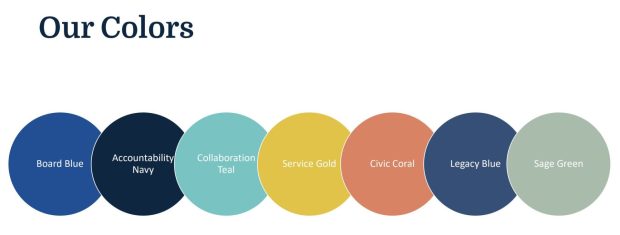
It’s not yet the new year, but the State Board of Education could head into 2026 with a new color scheme, a new logo and new messaging.
The State Board unanimously approved a rebranding plan for the agency.
On the way out, apparently, is the board’s old logo — built around a mortar board signifying a traditional ceremony. The new, abstract logo also is an attempt to capture changing, evolving student pathways.
“(We want) to have it more representative of the state of education in Idaho,” State Board Executive Director Jennifer White said of the makeover. “We’re excited about what this represents.”
The Idaho Division of Career Technical Education, an offshoot of the State Board, completed the rebranding work in-house. “It has been a no-cost process,” said Alison Henken, the State Board’s policy director.
However, according to a staff memo to State Board members, “There may be limited costs in rolling out the rebrand, primarily related to replacement of existing branding in physical locations.”
White downplayed the rollout costs, saying the board has limited paper or stationery bearing the old logo.
The rebrand now goes to Gov. Brad Little for his consideration.