
In an age when artificial intelligence is writing students’ resumes and sending them to thousands of hiring businesses, a panel of industry experts gave students a low-tech answer for winning the rat race: Build your network.
Around 200 students and dozens of tech industry professionals filled a lecture hall on Friday, Nov. 14, in the Micron Business and Economics building at Boise State University for a panel called “How to get hired in the age of AI” organized by the university’s School of Computing.
Five experienced tech industry professionals sat on a panel to answer students’ questions about finding employment in a time when artificial intelligence is inflicting change on so many jobs.
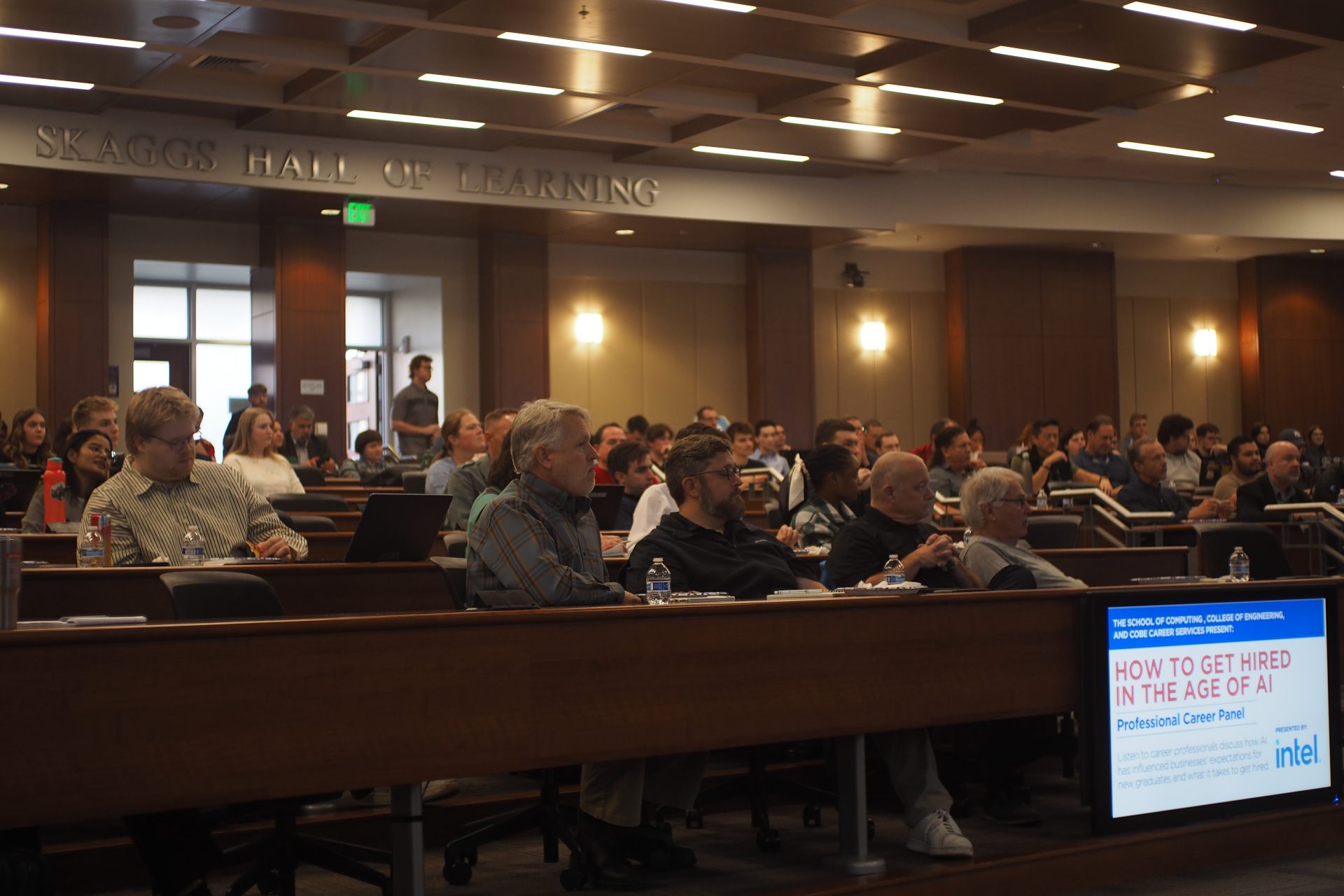
Students’ questions largely revolved around the resume application: AI tools that write your resume and send it to thousands of job openings have wreaked havoc on the job market, creating problems for employers and potential employees.
In response to the massive application volume, many employers implemented, or are implementing AI tools that automatically sift through resumes, usually searching for key words or terms to narrow applications down to a manageable number.
In some cases, companies ask applicants not to use AI, even if they are an AI company.
As one student attested to on Friday, this two-sided use of AI results in a situation where applicants can expect their resumes to be rejected if they don’t contain specific key words.
“My recommendation … you should use a hybrid model. Use the AI engine to comb out the key words,” said panelist Jason Dunn-Potter, a global architect and executive innovation designer for microprocessor manufacturer Intel.
Dunn-Potter suggested using AI to meet the resume-screening AI’s requirements, and mixing in personal tidbits that show aptitude. He told the story of a woman he hired because her resume mentioned she was a college weightlifting national champion.
Most questions students posed to the panel revolved around the AI resume rat race. Idaho Education News spoke with some students at the event, and they were worried about other things.
Jawadal Islam is studying for a master’s degree in business administration. He’s from Bangladesh, and it’s his first year in the United States. His biggest concern is not AI — in fact, he is working with a professor at the university to build an AI chatbot for entrepreneurs in the Bahamas.
“If they hire me, are they willing to sponsor me for a full-time job? Because I’m on a (student) visa,” said Islam, about getting a job in the U.S., where he’d need an employer to sponsor him for an H-1B visa.
He’s not worried about his qualifications, because he feels the job market is more competitive in Bangladesh and he had a job there.
Roger Johnston is a senior studying cybersecurity at Boise State.
“One pitfall I see people run into a lot is that they let the tool do the thinking for them, and that, I think, is asking for trouble,” Johnston said, speaking about AI.
“If someone writes an email and sends that off, that email has their name on it,” he said.
Earlier, panelist Andre Keys, a computer science instructor at Boise State, spoke about emails written with generative AI.
“It’s very frustrating to get an email that’s full of emojis with this nice list of things and next steps and action items and everything,” said Keys. “It just feels like I don’t want to read that.”
Angel Dang is a junior studying Applied Math and Economics. She’s concerned about checking all the boxes to be a good job candidate.
“It’s difficult, because I have to balance so many things at once… how do I make sure these people know me? How do I also make sure my resume stands out?”
Throughout the duration of the panel, Dunn-Potter reiterated a point many times: he does not find resumes very important, and believes the individual is their own, more important resume. He referred again to the woman he hired.
“Her resume stood out in a sea of resumes because she had a persona,” Dunn-Potter said.