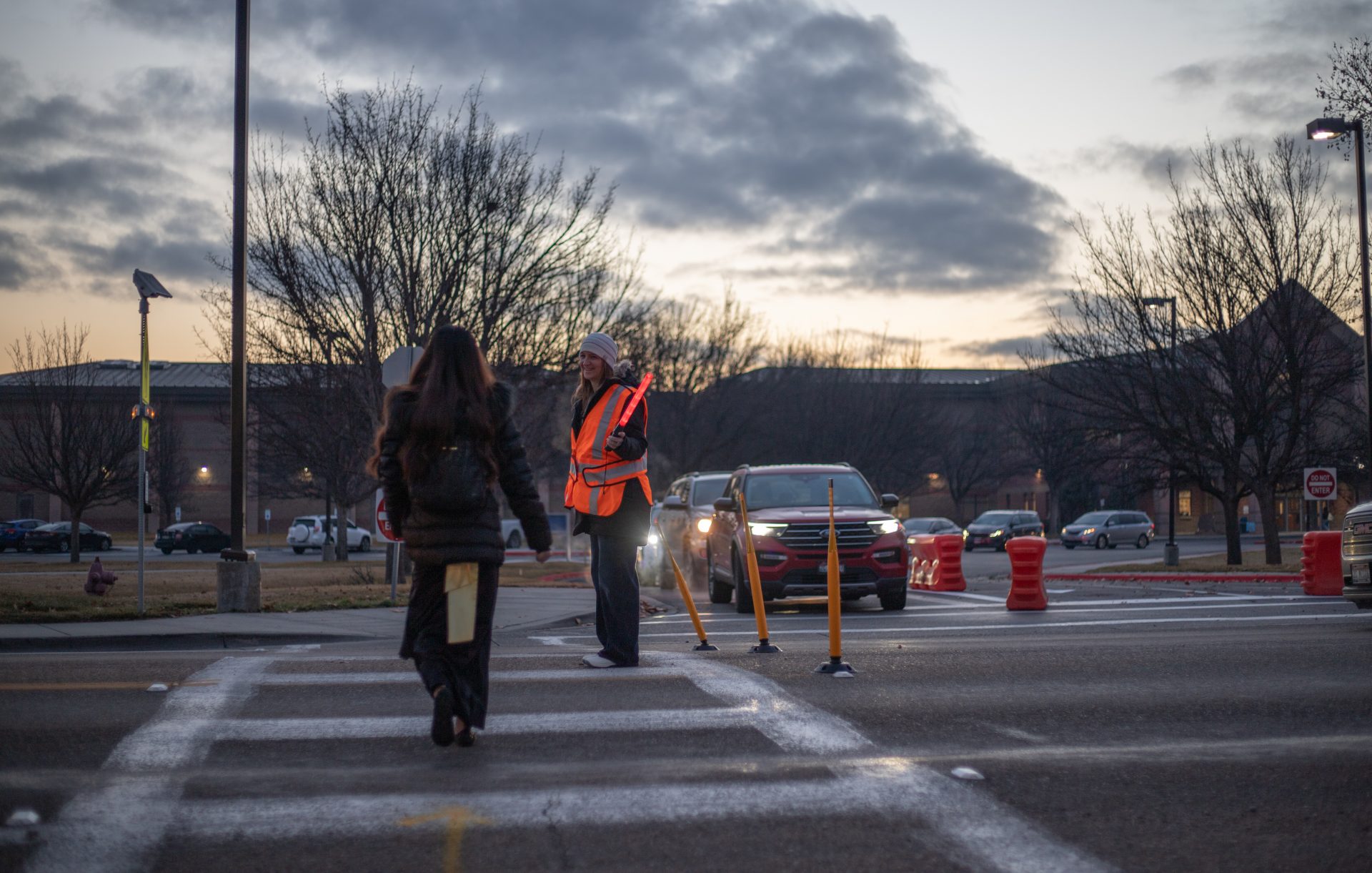
A high school student rolled his eyes on a school morning when Principal Chantel Kelly reminded him to use the pedestrian signal when crossing the road.
“Hit the button,” Kelly said. “No, go hit the button. Go hit the button. Go hit the button.”
The student reluctantly followed the order before crossing the intersection of Indiana Avenue and Fairoaks Drive as the sun rose behind Caldwell High School.
Kelly, wearing a high-visibility vest and waving a glowing red wand, was at that same intersection on the morning of Dec. 8. But instead of helping a student cross the road, she was comforting a teen who was struck by a vehicle while in the middle of the crosswalk.
“I can’t tell you how traumatic it is,” Kelly said. “When you see a kid that you know and you’ve seen every day for two to three years, and then you see them on the road, and they can’t move, and they’re — it is probably one of the hardest things I’ve ever had to go through.”
The next day, a second student was struck in the crosswalk near Syringa Middle School.
Then, on Jan. 22, Kelly was back on Indiana Avenue comforting another student who was struck by a vehicle. The student required seven hours of surgery and won’t walk for at least four months.
“It’s been heartbreaking,” Kelly told EdNews in an interview.
Three drivers hit three students in Caldwell School District crosswalks within 45 days.
The rash of incidents prompted district and city officials to collaborate on solutions.
Kelly’s crosswalk duty on Friday morning came at the end of a busy week. On Monday night, she spoke to the school board during a discussion on public safety. On Wednesday afternoon, she testified to the Idaho Legislature’s House Judiciary, Rules and Administration committee in favor of a bill to increase the penalty for speeding in school zones.
“I am asking you to keep our children safe,” Kelly told lawmakers.
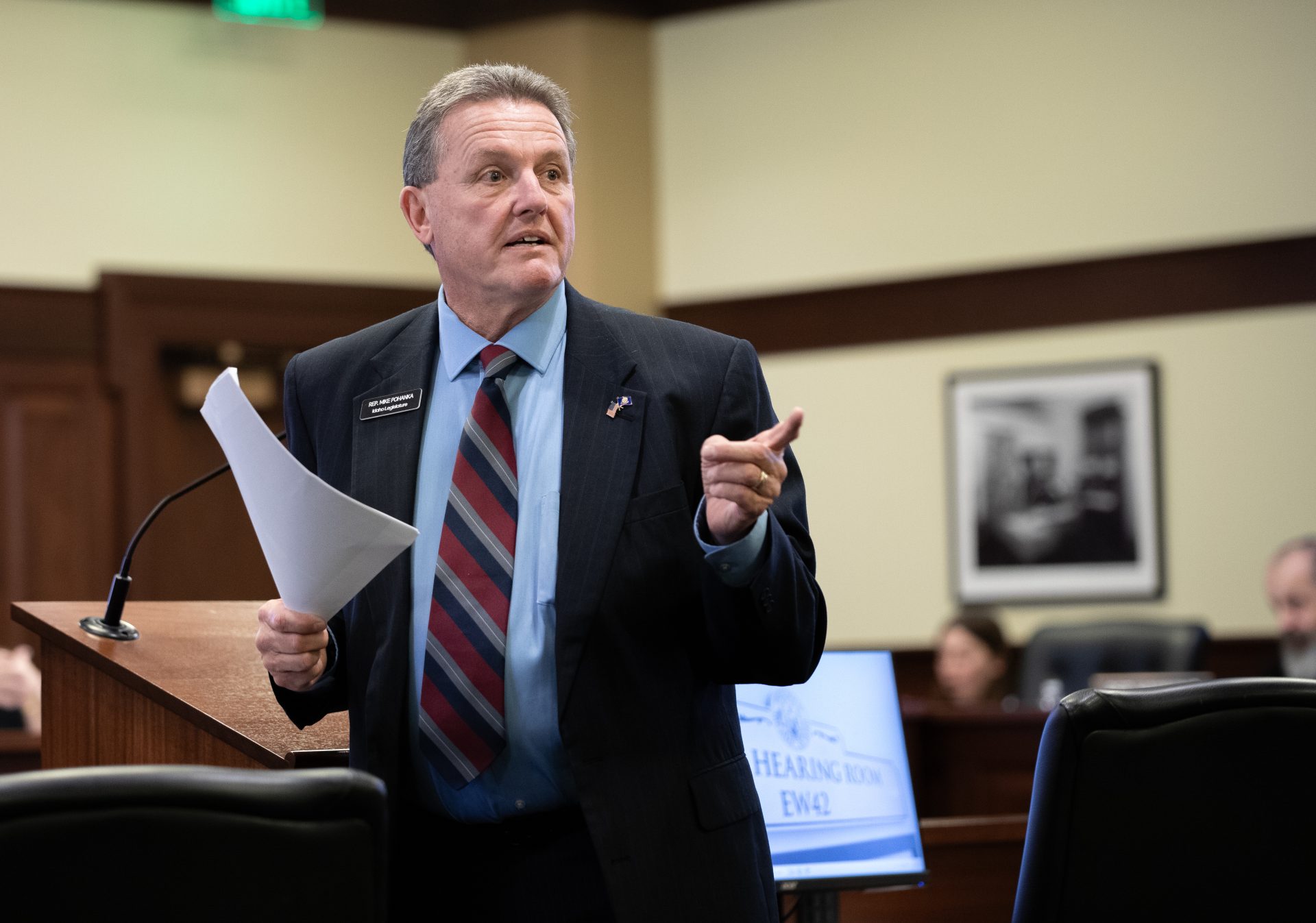
Rep. Mike Pohanka, R-Jerome, presented a bill to make speeding 20 mph over the speed limit in active school zones and construction zones count as misdemeanor reckless driving, punishable by up to six months in jail and a $1,000 fine.
“We have to be held accountable for our driving,” Pohanka told the committee. “There’s no doubt about it. And I think this will help make people more accountable.”
The bill was sent to the House floor for possible amendments.
But first, Pohanka and the other committee members listened to Kelly’s story and her plea for help.
“My heart goes out to principal Chantel,” Pohanka said.
It was also a busy week for Caldwell Police Chief Rex Ingram. Like Kelly, he addressed both the school board and House committee.
He told legislators the laws in the books are too lenient. Officers need to hold people accountable who are driving recklessly through these school zones, he said.
“This bill is extremely crucial for keeping children and construction workers safe,” Ingram said Wednesday.
While legislators are considering that bill, the city of Caldwell is also taking action.
Growing pains
Mayor Eric Phillips is a tall man.
When he was a kid, he grew one foot in a year. He said he had stretch marks and remembers how clumsy he was back then.
The same thing can happen to municipalities, he told EdNews on Friday from his office at City Hall.

Caldwell is one of the fastest growing cities in Idaho. Its population grew 184% from 2000 to 2024, from 25,720 to 73,088, according to the U.S. Census. More people means more drivers.
Indiana Avenue, outside of Caldwell High, was once a quiet residential road. Now it’s a major arterial.
“That section is woefully insufficient for the amount of traffic that comes through there,” Phillips said. “If we had the ability to widen that, that would create a lot more improvement.”
But widening a road is no easy feat. It requires traffic studies, planning and property acquisition before construction can begin.
“Could be years or could be never,” Phillips said. “But if you never try, you’ll never succeed.”
In the meantime, Phillips said the city is planning to install a HAWK beacon at the busy intersection of Indiana and Fairoaks outside of Caldwell High.
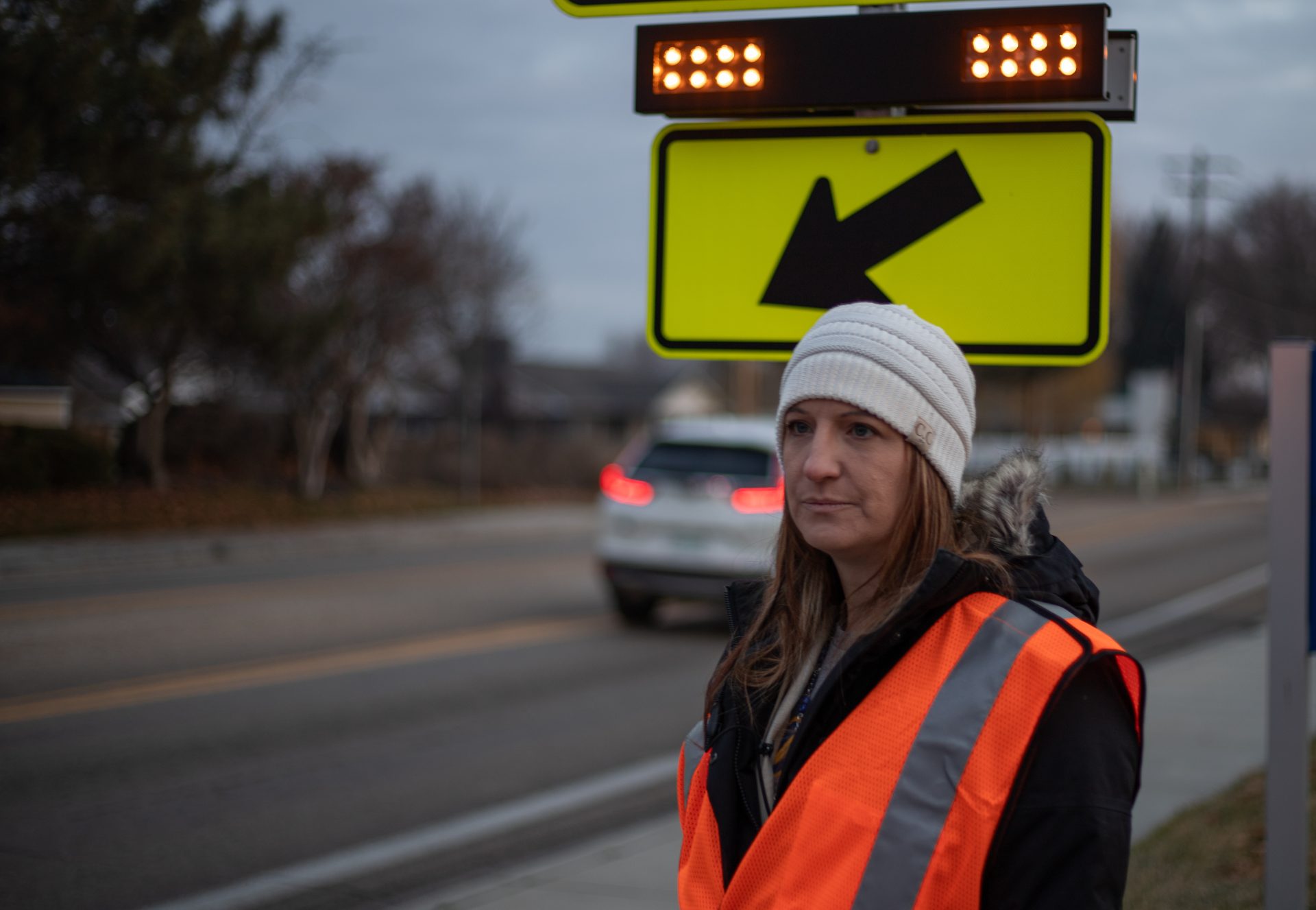
The reluctant student crossing the road on Friday morning pushed a button on a Rectangular Rapid Flashing Beacon, or RRFB. When activated, two yellow lights flash below a yellow rectangular pedestrian crossing sign.
A HAWK beacon provides another level of protection for students.
It stands for High Intensity Activated Crosswalk. When students push the button, a sequence begins. Red lights begin to flash for drivers, alerting them to a pedestrian. Once the red light is solid, pedestrians see a red hand change to a white pedestrian signal, like a typical crosswalk. Then they can cross safely.
While the RRFB costs about $9,000 and can use solar energy, the HAWK costs about $40,000 and requires a power connection.
“To me, it’s worth the investment,” Phillips said.
But these beacons only work if students press the button.
Staff at Caldwell High are working on educating students on how to safely cross the road.
Kelly said freshman health teachers include traffic safety in their lessons, crossing guards remind students to press the button and the district’s student resource officer is also pitching in.
Officer Eric Resendez, the district’s SRO, has spent time at every school. He’s noticed a big difference between elementary kids and high schoolers.
“My elementary students over at Wilson have it down pat,” Resendez said. “They are amazing.”
The little ones know to press the button, look both ways, wait for the drivers to stop and then cross. But it’s harder to convince a high school student to look up from their phone and press the button.
“They’re too cool for school and want to do what they want to do,” Resendez said. “And so it’s kind of weird seeing that mix and seeing my elementary students walking across and nailing it every single time.”
Of course, drivers also need to be educated and told to slow down in school zones. Resendez said he usually pulls over at least two drivers a day. He tells them to be aware of their surroundings and know that when they drive through a school zone, they should expect to see kids.
“Mind speeds, mind traffic laws, and get to where you’re going safely and make sure that other people around you are safe,” Resendez said.
A summit in March
At Monday night’s school board meeting, Chairman Travis Manning said improving safety for kids will take a collective, community effort.
For more than 90 minutes, several city staff members, parents and administrators spoke to trustees about problems and solutions.
Ingram, the police chief, told trustees about the “three E’s” of traffic safety: Engineering, education and enforcement.
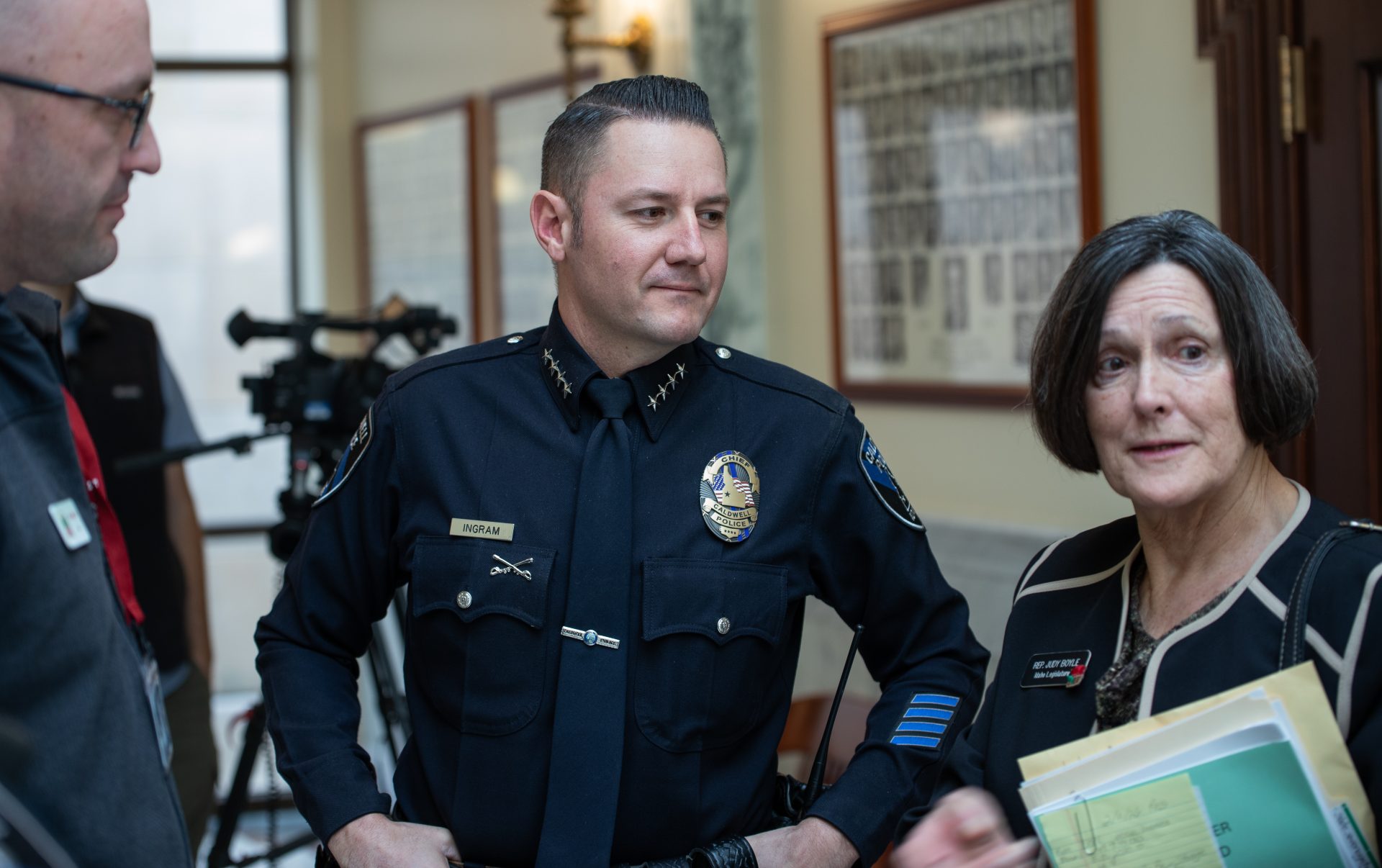
Engineers build the roads and law enforcement educates drivers with visibility and warnings. When that isn’t enough, they enforce the laws and hand out citations. It takes all three to keep kids safe.
“This is a community problem, this is not a law enforcement problem or an engineering problem or a school problem. This is a community problem. This is a holistic thing that we have to treat as a problem for our community,” Ingram said.
Collaboration with school districts, increased police presence outside of schools, social media campaigns and lobbying the Legislature are all happening at once in Caldwell.
“We are working on all cylinders,” Ingram said on Monday.
Mayor Phillips wants to strike while the iron is hot. He told trustees he is planning a summit in March with leaders from multiple school districts, charter schools and private schools. He told EdNews the meeting is slated for March 25.
“We’re all part of the same ecosystem,” Phillips said in an interview. “We’re just different entities.”
The goal is to avoid what everyone fears the most: a death.
From her office at Caldwell High, Kelly said everyone wants to do something to make the city safer, but it’s hard to figure out what that means.
“I would love for somebody to be able to definitely tell me how to make sure that it’s never going to happen again,” Kelly said.