
Idaho could be heading for a state budget crisis — largely of its own making.

After a five-year, $4.6 billion binge of tax cuts and tax breaks, and an additional $453 million serving this year, Idaho’s budget appears to be teetering on a tipping point. As Idaho Education News’ Ryan Suppe reported first this week, Gov. Brad Little wants state agency heads to turn in no-frills “maintenance” spending plans for the 2026-27 budget year. He also wants them to draw up scenarios for midyear budget cuts of 2%, 4% or 6%. The cuts could affect all of state government, including education.
But hey, don’t panic or anything.
The specter of the midyear budget cut, or “holdback,” comes up from time to time. During trying times.
Little himself ordered holdbacks in the spring of 2020 — including a $99 million cut to K-12, soon offset by federal COVID-19 aid. All of this unfolded, of course, as the coronavirus pandemic upended nearly every facet of public governance and private life.
Little’s predecessor, Gov. Butch Otter, ordered deep holdbacks and year-over-year cuts in K-12 spending, as the Great Recession torched the state and national economy.
And Gov. Dirk Kempthorne’s series of holdbacks were the first in state history to permanently impact education. His holdbacks began in 2001 — during an economic downturn that accelerated after the 9/11 terrorist attacks.
In other words, national and global events were the driving force behind Idaho’s last three rounds of holdbacks. They were the product of external pressure, and Idaho’s constitutional mandate to maintain a balanced budget.
In a May 29 memo to state agencies, Little’s budget director spoke of factors beyond Idaho’s control.
“We are asking all state agencies to internally prepare 2%, 4%, and 6% budget holdback scenarios to have in place as we continue to watch economic trends at the national level,” said Lori Wolff, administrator of the state’s Division of Financial Management.
To be fair, the national economy is not exactly a picture of stability. Everyone is on the same bumpy ride, and state government should be buckling in.
But Wolff’s memo also spoke some uncomfortable truths about this year’s $453 million tax relief free-for-all. “While we are confident this historic tax relief will help with out-year economic growth, it does result in less revenue than originally projected for FY 2027 (the state budget year beginning July 1, 2026).”
To make matters worse, the state is already experiencing cashflow problems. Over the past two months, state revenues have come in $141.5 million south of the Legislature’s projections, the Idaho Capital Sun reported last week. That isn’t enough to blow a hole in the budget; according to projections, Idaho will end this budget year on June 30 with $278.2 million on the balance sheet.
But this year’s tax cuts will require the state to operate on that much narrower a margin, which could be especially problematic if tax collections come up short. If Idaho heads into another round of budget holdbacks — during, paradoxically, a time of continued population growth — state leaders won’t be able to simply point the finger at someplace or something else.
If only Little could have seen this coming. Actually, he did.
He began the 2025 session proposing $100 million in tax cuts and $50 million for a private school choice program. Instead of doubling down, lawmakers tripled down. Little made no secret of his reservations, going public with them in a February question-and-answer session with reporters. But that didn’t stop Little from signing off on the whole package — and touting it in a series of post-session news conferences.
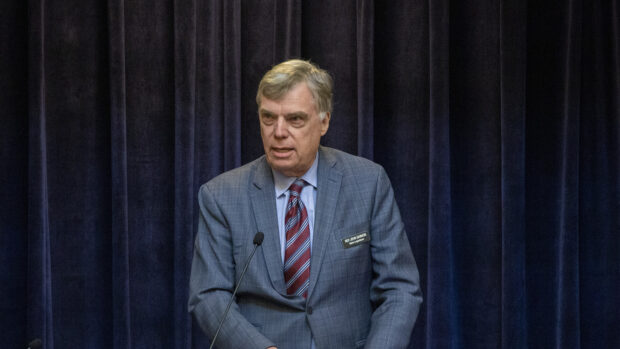
The second-guessing came quickly this week. The Idaho Democratic Party fired out a news release blasting “GOP Budget Chaos.” Said state party chair Lauren Necochea: “The Republican supermajority chose greed over good governance.” Rep. John Gannon of Boise, one of two Democrats on the House Revenue and Taxation Committee, called for reconsidering the private school tax credit law that squeaked through that committee in February.
That’s probably not going to happen.
But Gannon raises another point that could resonate, especially with education advocates. He questions why the state is even talking about budget holdbacks when it is sitting on $1.3 billion in budget reserves — a record, as Idaho Falls GOP Rep. Wendy Horman, co-chair of the Joint Finance-Appropriations Committee, pointed out in April. One of these reserves, earmarked just for K-12, sits at a projected $265 million.

For years, the state has been dutifully socking money away into its various “rainy-day funds.” If the budget picture gets worse before the 2026 session, the Statehouse will be thick with self-styled meteorologists, eager to debate what constitutes a rainy day.
Meanwhile, if things get tight by January, there also won’t be a shortage of starve-the-beast hardliners who would like nothing more than to use a budget crunch as an opportunity to turn the Statehouse into a DOGE-pound.
And even if there is a showdown over spending next session, that wouldn’t preclude another push for tax cuts. It will be, after all, an election year for all 105 legislators — and for Little, freshly endorsed by President Donald Trump and presumptively running for a third term. Since legislative tax hawks essentially imposed their will on Little in 2025, why wouldn’t they feel emboldened in 2026?
Even if additional tax cuts make it harder — not easier — to balance the state’s budget.
Idaho isn’t in a budget crisis yet, but Idaho is trending toward trouble.
And this time around, a lot of the problems started right here at home.
Kevin Richert writes a weekly analysis on education policy and education politics. Look for his stories each Thursday.