Idaho’s virtual schools are operating in the Wild West.
Will Idaho’s leaders cowboy up and lay down the law?
A stinging legislative report spells out a spate of problems at the massive Idaho Home Learning Academy — misspent taxpayer money, marginal test scores, lax controls over curriculum and a business model that allows teachers to also work for IHLA’s private vendors. The report also recommends several ways that the Legislature could tighten things up.
And at the end of a three-hour hearing Tuesday, several lawmakers seemed committed to cleaning up the rules for IHLA and the rest of the state’s growing online school sector. But lawmakers seemed committed earlier this year, too. And the 2025 legislative session came and went with no changes.
If that happens again in 2026, legislators can’t plead ignorance.
Not after the Office of Performance Evaluation’s report on IHLA, released Tuesday morning.
Copious in detail and exhaustive in scope, the 129-page report is a case study in what happens when a public program grows rapidly and with few sideboards. IHLA was ablaze during the COVID-19 pandemic, attracting engaged families who were dissatisfied with public schools, or seeking more structure than homeschooling. Enrollment has gone from 238 students to 7,600, holding more or less steady since the pandemic.
But with that growth comes problems.
And some of the biggest problems have to do with the “supplemental learning funds” IHLA’s vendors distribute to parents. At $1,700 to $1,800 per family, the payments add up quickly, coming to $12.6 million last year.
The questionable buys
The 129-page Office of Performance Evaluations report on the Idaho Home Learning Academy includes a one-page inventory of questionable, taxpayer-funded purchases. Parents received reimbursements from IHLA’s private vendors, even for some items that violated school guidelines.
Here’s a partial list from the report:
- Water park admissions.
- An Amazon Fire TV stick.
- MP3 players.
- A nail polish kit.
- A meat thermometer.
- Website domain names.
- Plush stuffed animals.
- Remote-controlled toy cars and planes.
Designed to offset educational expenses, some of the money covered a shopping list of questionable buys. At least $92,000 of taxpayer money went straight to private schools and private programs. IHLA’s three private vendors can write their own rules about what they’ll reimburse — leading to a conflicting set of guidelines — and school officials have no auditing system in place.
And there’s more. Parents can return the taxpayer-funded items they buy through the program and keep the refund. The state, meanwhile, has no way to collect any unspent supplemental learning funds; the vendors keep them.
In defense of IHLA — and the Oneida School District, which oversees the charter school — Oneida superintendent Dallan Rupp noted that the new report identified no wrongdoing. But that says only so much. As OPE Director Ryan Langrill noted at the start of Tuesday morning’s hearing, IHLA works within a “policy and legal gray area.” There’s nothing in the law that allows IHLA or other virtual schools to funnel state money, earmarked for teacher pay or staff benefits, and hand it to parents. But nothing in the law prohibits it, either.
Which brings us to the forward-facing section of the report: the recommendations.
OPE says the Legislature should set “parameters” for how and where supplemental learning funds can be spent. OPE also says the Legislature write up “a funding framework specific to virtual schools,” providing less wiggle room to move money to private vendors and into supplemental learning funds.
OPE’s recommendations should carry some weight. This agency is an arm of the Legislature, completing complicated and highly detailed research at the behest of lawmakers. A bipartisan group — including House Speaker Mike Moyle, Senate Minority Leader Melissa Wintrow and House Minority Leader Ilana Rubel — requested the IHLA report. While some Statehouse studies are doomed to gather dust from the get-go, this one isn’t likely to be among them.
This report should resonate with lawmakers — especially those who voted this year to mothball the Empowering Parents microgrant program, which was beset by similar purchasing and accounting headaches.
As for the virtual schools, most everybody is saying the right things about problem-solving.
Incoming IHLA executive director Hailey Sweeten, saying her sector is facing a “pivotal moment,” said new legislation would level the playing field for all virtual schools. But Sweeten also was quick to note that IHLA receives $6,150 per student, well below the state average of roughly $8,400. “We’re doing more with less.”

Senate Education Committee Chairman Dave Lent also sees an opportunity. In 2025, Lent co-sponsored a bill that would have brought the virtual charters under the jurisdiction of the state Public Charter School Commission. That bill stalled, but Lent thinks it sets the stage for passing something in 2026. “I think this helped us get to this point,” Lent, R-Idaho Falls, said near the conclusion of Tuesday’s hearing.
Gov. Brad Little weighed in as well — not at the hearing, but in a letter attached to the OPE’s final report.
“(I) strongly encourage the Legislature to address the loopholes in state statute,” Little wrote.
But IHLA has a statewide constituency. As Tuesday’s report noted, the school has students from 70% of Idaho’s zip codes. And maybe more important, IHLA has a dedicated fan base.
IHLA parents mobilized swiftly and effectively last spring, and helped derail Lent’s end-of-session virtual charters bill. IHLA parents packed a committee room for Tuesday’s hearing, forcing lawmakers to move across the hallway to the 200-seat Lincoln Auditorium.
Recently, Little saw IHLA’s grassroots lobby firsthand. Shortly before Thanksgiving, his office received a blitz of more than 225 phone calls and emails, running in support of IHLA, spokeswoman Joan Varsek said Wednesday.
Any legislative proposal won’t just slide through unnoticed.
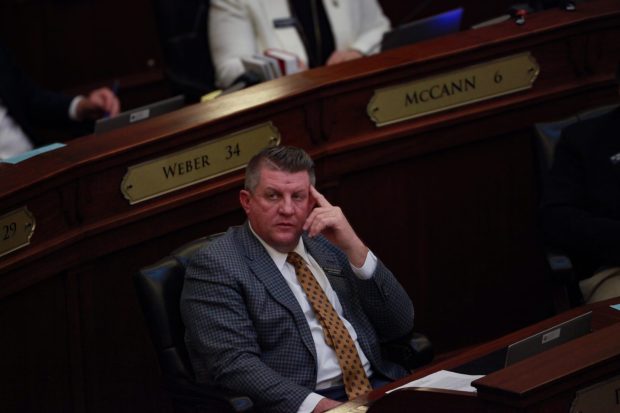
And House Education Committee Chairman Douglas Pickett is in no hurry. Pickett, a Republican from Oakley, also represents Oneida County, IHLA’s home base. At the end of Tuesday’s hearing, Pickett called virtual schools “pioneers of innovation,” and urged colleagues to move deliberately.
“There’s a reason these kids are choosing this, and I don’t think it’s because the parents are chasing the money,” Pickett told EdNews after Tuesday’s hearing.
Pickett might not be the only person in no hurry. On Tuesday, he told EdNews he has seen no bills addressing virtual schools. That’s not a definitive sign, but it could be an important one. The start of the session is less than five weeks away, and any virtual education bill would inevitably go through Pickett’s committee.
Still, the Statehouse climate has changed considerably in the past 11 months. In January, Pickett and Lent presided over tense education committee hearings about IHLA — as school administrators fumbled to answer questions about their finances, and lawmakers were left gobsmacked. On Tuesday, a bipartisan House-Senate oversight committee (which includes Lent and Pickett) spent three hours locked into the topic, and IHLA said it was committed to work with lawmakers.
If virtual schools are here to stay — and that was one point of consensus from Tuesday’s hearing — then the growing pains won’t magically go away either. That shouldn’t sneak up on lawmakers next session.
Kevin Richert writes a weekly analysis on education policy and education politics. Look for his stories each Thursday.