Overshadowed by the marathon debates and the torrent of public opposition over private school choice, there seems to be general agreement on another gnarly education topic.
It’s time to do something with Idaho’s convoluted and outmoded K-12 funding formula.
However, there’s no agreement about what a formula rewrite should look like, what it would do — and how to protect rural schools. So there’s no guarantee that this will be the year lawmakers actually get this done.
Sound familiar? It should.
For those with short memories or mediocre search skills, here’s a little history. Key legislators began talking about a funding formula rewrite in 2016. Back then, the funding formula was 22 years old and aging badly.
Now, the formula is 31 years old, and time has not treated it kindly.
A public lovefest in Senate Education
Senate Bill 1096, a funding formula reboot, sailed out of the Senate Education Committee last week, with unanimous support across party lines. Two bitter adversaries in the private school debate — Chris Cargill of the pro-school choice Mountain States Policy Center and Quinn Perry of the Idaho School Boards Association — joined the stakeholder choir singing the praises of this rewrite.
It was quite something, a stark contrast to this year’s private school choice showdown, and the long history of the school funding formula debate. The hearing also had elements of a group therapy session, with supporters talking about the meetings, models and proposals that led up to SB 1096.
“I guess I was one of the radicals that actually suggested, blow the whole thing up, start over and focus on getting the money to the schools and let the schools make determinations about how that money should be spent,” said Terry Ryan, speaking on behalf of the Idaho Charter School Network and the pro-charter school nonprofit Bluum. “I’ll admit I’m now grayer and a little heavier since those days.”
How SB 1096 works
The poorly kept secret and strategy is that SB 1096 doesn’t blow up the entire funding model. It doesn’t try to redistribute the $3.3 billion in annual funding that goes out to K-12. It focuses instead on about $400 million — the schools’ “discretionary” dollars.
SB 1096 attaches “weights” to the money that goes out per student. For a special education student, for instance, the weight increases per-pupil payments by 150%. On the lower end of the scale, the bill includes a 25% weight for English learners, gifted and talented students and economically disadvantaged students.
Here, the weighted funding concept overlaps with the debate over private school choice. The stakeholder groups who oppose siphoning public dollars into private education invariably argue that the public schools operate by a tougher set of rules. The Constitution requires public schools to take all students who arrive at their door, regardless of station or circumstance. By acknowledging that it costs more to serve some students, SB 1096 would give public schools some additional money for this purpose.
And for a kicker, state superintendent Debbie Critchfield argues that SB 1096 is DOGE-worthy — since it would give Idaho a better way to distribute federal dollars, should President Donald Trump eliminate the U.S. Department of Education. “We will have built the mechanism to take those block grant dollars in and use them in the ways they are intended,” she said last week.
The SB 1096 backlash
SB 1096 is running into resistance, for a reason as old as the funding formula debate itself. Any change to the formula, any redistribution of money, is inevitably a zero-sum game. Some districts and charters would get more money; others would get less. Those who stand to get less, understandably, are likely to be opposed.
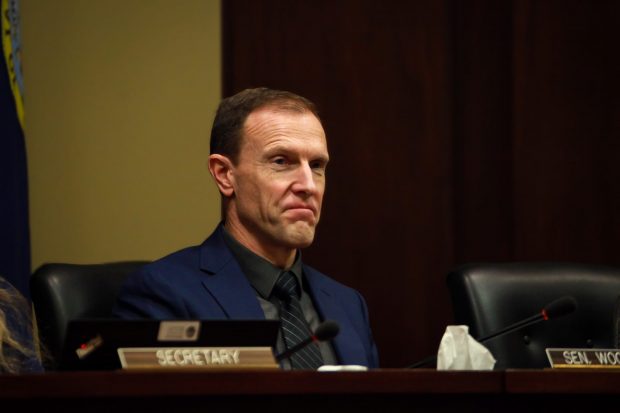
In an attempt to head off this criticism, SB 1096 has “hold-harmless” language; no district or charter would lose money for a full budget year. Critchfield and her lead sponsor, Sagle Republican Sen. Jim Woodward, also argue that SB 1096 is not a spending bill at all. “There are no dollar amounts,” Woodward told committee members. “This is how we divvy it up, not how much we’re divvying up.”
He’s right. But it’s simple math to take the policy components of SB 1096, crunch the numbers, and figure out who wins and who loses.
A spreadsheet from Critchfield’s office identifies a short list of potential losers: 12 of the state’s 190 districts and charters. But that list and the funding gaps are almost certainly larger.
Here’s why.
The spreadsheet compares the projected 2026 payments to the $334 million in discretionary payments that went out in 2024. Critchfield’s office used those older numbers because they are concrete, showing exactly how much each district and charter received, Critchfield fiscal officer Gideon Tolman said.
The 2025 discretionary payments still aren’t finalized, so there’s no way to know how much every district and charter will get, Tolman said. But there’s much more money in the pot. This year’s discretionary payments will come in at about $379 million statewide.
Comparing the projected 2026 numbers with those larger 2025 payments would expose new and larger funding gaps. Tolman acknowledges that the department’s spreadsheet is just a snapshot.
And what does all this mean, on the ground? Consider the Cambridge School District. The Critchfield spreadsheet projects a $2,200 gap — based on the $265,000 in discretionary money Cambridge received in 2024. Cambridge Superintendent Anthony Butler does the math differently; the district will receive $310,000 this year, and Butler pegs the district’s losses at about $70,000.
Butler testified against SB 1096 last week, and outlined his opposition in an Idaho EdNews guest opinion Wednesday. (Ririe Superintendent Jeff Gee also wrote an opinion piece in opposition to SB 1096, while American Falls Superintendent Randy Jensen and Cassia Joint School District Fiscal Director Chris James have written pieces endorsing SB 1096.)
‘Discontent under the hood’
The lovefest in Senate Education rang hollow to Rep. Wendy Horman, R-Idaho Falls, the powerful co-chair of the budget-writing Joint Finance-Appropriations Committee. ISBA members converged on the Statehouse for their annual lobbying trip this week, and Horman said most of the trustees and administrators she spoke to opposed SB 1096.

“There’s a lot of discontent under the hood that I’m trying to resolve,” Horman said in an interview Thursday.
Horman made her first move early Thursday morning — before the House Ways and Means Committee, the catchall, leadership-packed panel that hustles new bills into circulation. With little discussion, the committee printed Horman’s competing rewrite, House Bill 279.
HB 279 is considerably different from SB 1096, and Horman says that is by design.
- It essentially does one thing. It moves discretionary funding into a per-pupil formula, based on student attendance.
- Horman proposes no student weights, for now. But the bill calls for that change, at some point. “The per-student funding formula should be refined to encompass a weighted per-student funding formula.”
- The bill carries a $14.2 million pricetag, to protect rural districts that would lose money due to the shift to a per-pupil formula. Cambridge, for example, could receive more than $133,000.
Horman said she is taking a deliberately slow approach. She wants to move to a weighted model, but she doesn’t want to pay for it by carving into existing K-12 budgets.
“That existing money is already being spent on other things,” she said.
Here we go again?
This isn’t the first time political leaders have tried to tweak the funding formula, in the waning weeks of a legislative session. A year ago, Horman co-sponsored a bill much like this year’s HB 279 — a proposal to adopt a per-student model, and add funding weights down the road. But at that time, Horman and Critchfield were working together, along with Sen. Lori Den Hartog, R-Meridian, another veteran of the funding formula battle.
This year, the dynamics are different. Two competing bills, one in each house. That’s a potential recipe for gridlock, again.
While there is a lot of interest in doing something with the funding formula, there’s a chance the 2025 Legislature will wind up doing nothing.
Kevin Richert writes a weekly analysis on education policy and education politics. Look for his stories each Thursday.
Disclosure: Bluum receives funding from the J.A. and Kathryn Albertson Family Foundation, which also funds Idaho Education News.