
Legislative budget-writers are taking their own stab at spending cuts.
And higher education is their biggest target.

On Friday, the Joint Finance-Appropriations Committee is expected to vote on an omnibus bill to cut 1% or 2% from state budgets, this year and next. It sounds like an across-the board move. It’s not.
K-12 is off the table.
Same for Medicaid.
Same for the prisons.
Same for the Idaho State Police.
What’s left? Higher education, and no other state agency has more to lose. Higher ed would take nearly one-third of the proposed cuts. JFAC’s plan would take a disproportionate bite out of a growing college and university system that can ill afford it, making a tuition increase all but inevitable.
Even Lewis-Clark State College President Cynthia Pemberton — maybe the most unrelenting optimist in Idaho higher ed — acknowledges the cuts would have an impact. The campus mood is mixed, she said after a Senate committee hearing Wednesday: “solemn, committed, determined.”
The proposed cuts — and the big hit on higher ed
On Friday, legislative budget-writers will consider 1% or 2% cuts to some agency budgets — for the current budget year, which ends June 30, and the following budget year.
A 1% cut translates to $15.3 million per year in the state general fund — the part of the budget funded through sales, income and corporate taxes.
A 2% cut comes in at $28.9 million.
If lawmakers go with the 2% blueprint, the $28.9 million cut, Idaho’s four-year college and universities would lose $7.7 million. Community colleges would lose close to $1.4 million.
Put another way, the four-year schools would absorb 26.5% of the cut. This far exceeds their share of the general fund, which is 6.8%.
Community colleges would take 4.7% of the cut. They receive 1.2% of the general fund.
The cuts are not a done deal, and Friday’s JFAC votes would be only the first step. Both houses would need to pass a cost-cutting bill, which would then go to Gov. Brad Little.
The process began with highly public drama that unfolded last week. JFAC’s co-chairs — Sen. C. Scott Grow and Rep. Josh Tanner, both R-Eagle — directed state agencies to spell out how they would cut budgets by 1% and 2%, in 2026 and 2027. State superintendent Debbie Critchfield refused to turn in a budget-cutting plan for K-12 — essentially telling legislators to kick rocks, and fully flexing her prerogative as a state constitutional officer.
Having no such latitude, state agency heads turned in their plans Friday. And higher education leaders used the opportunity to give it the old college try, arguing that another round of cuts would hit students and staff alike. And hard.
A few examples:
- Two years of 2% cuts would force Boise State University to delay nine faculty hires in health sciences, engineering and education. “This further limits course offerings in these programs, delaying graduation, potentially causing students to incur additional debt, and delaying their entry to the job market.”
- The University of Idaho said it would need to cap enrollment in “high-cost, high-demand programs,” such as health professions, engineering and cybersecurity, and medical-related fields.”
- The College of Southern Idaho said it would need to cut an instructor in communications, a key area of general study, making it more difficult for students to schedule required classes — and, ultimately, graduate.
- The College of Eastern Idaho says it would need to cap its licensed practical nursing program, and cut faculty in high-demand energy systems and dental assistant’s programs.
There’s no ignoring the pattern.
The budget-cutting scenarios were pretty much what Tanner expected to see.
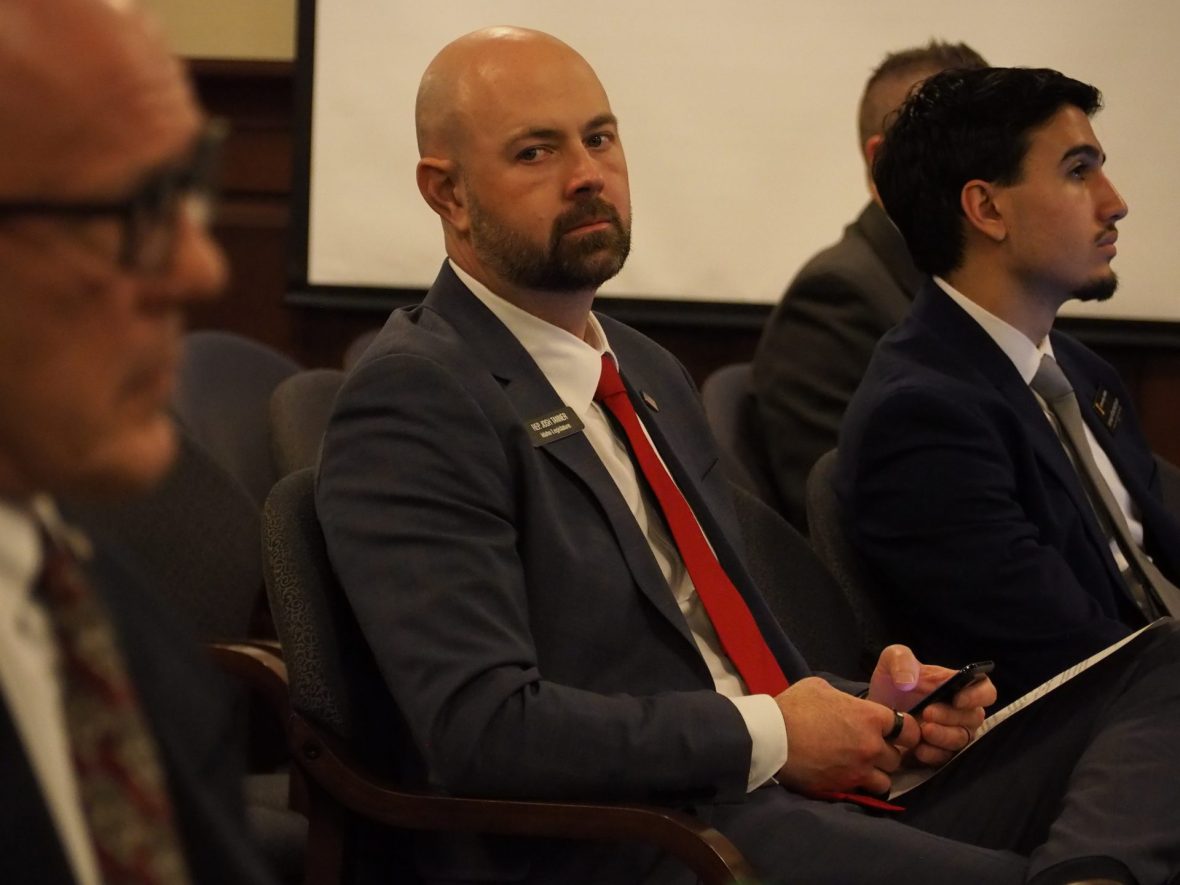
“Usually, the initial kneejerk reaction is … to show where the cuts could do the most damage,” he said in an interview Wednesday. “(It) doesn’t mean that’s where the cuts were going to be.”
JFAC will hash out a lot of those details behind the scenes.
First, JFAC will pass an omnibus spending cut bill — whatever that looks like — and a series of “maintenance” bills that essentially roll this year’s base funding into the new budget year. Then, JFAC will work on “enhancement” bills that could increase, or decrease, agency budgets.
The committee’s working groups will work on these enhancement budget bills in private, digging into the reports from the agencies. Tanner declined to say which of JFAC’s 20 members will work on higher education, but said he and Grow will not sit on any of the working groups.
Tanner sees this as a fiscal debate, not an ideological one.
A Boise State alum, Tanner has publicly criticized the higher ed system for pushing what he has called “the wrong ideology for America.” But on Wednesday, he said he believes the Legislature has reined in diversity, equity and inclusion programs. He now wants to find some breathing room. And this, in turn, would help the state immediately adopt the federal tax cuts in President Donald Trump’s One Big Beautiful Bill, at an estimated $155 million cost this year.
“(We’re) just trying to take a little bit off the top, to try to balance this thing out,” he said.
Whatever JFAC does, Idaho is going to try to balance the books on higher education. On a system that is attracting more students across the board — outpacing national enrollment trends — but will almost certainly have to increase student tuition and fees.

Whatever JFAC does, Little is already going after higher education. He has targeted a $9.5 million “enrollment workload adjustment” line item that is designed precisely to cover the costs that come with growth. The State Board of Education and the universities signed on to this cut, said Lori Wolff, the administrator of Little’s Division of Financial Management, and can withstand this move without “structural damage” to the system.
“I think anything beyond that is going to be problematic,” Wolff told reporters Tuesday.
It’s shaping up to be a higher education session, but not in a good way. It can’t be good news for students planning to enroll or stay in Idaho colleges. Or employees who work on the state’s campuses, when they could easily make more money in another state or in the private sector.
And it can’t be good news for anyone thinking about the biggest job vacancy in higher ed, the Boise State president’s vacancy. That job search is squarely on the Legislature’s radar: Without debate, the Senate voted unanimously Monday to move the presidential search process almost entirely behind closed doors — a bill written with the State Board’s help.
A lot of factors can contribute to a stalled presidential search, which is going nowhere, after 11 months. One such variable is unfolding, in real time, at the 2026 Legislature.
Kevin Richert writes a weekly analysis on education policy and education politics. Look for his stories each Thursday.