
Lt. Gov. Scott Bedke deliberately went off script eight days ago, when he addressed a roomful of legislators, lobbyists and assorted Statehouse power players.
“I just could not in good conscience give an all-is-well song-and-dance routine,” Bedke said in an interview Tuesday. “Because it isn’t.”
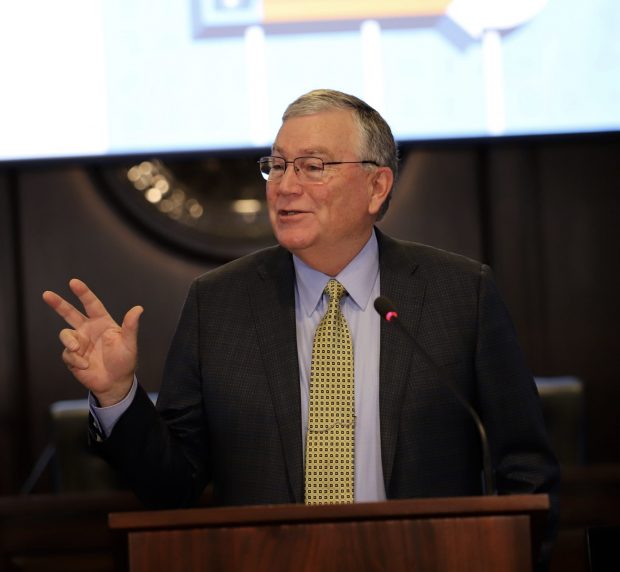
Bedke, who spent 22 years in the Legislature before he was elected to statewide office in 2022, used his podium to scold lawmakers for painting the state into a self-inflicted corner, passing budgets and slashing taxes without an idea of what they could afford. Legislators pushed for much larger tax cuts than Gov. Brad Little wanted, boxing him in as well. “The Legislature owns this,” Bedke says.
Bedke compared the whole practice to Washington, D.C., spending — which is like the moment in a professional wrestling match when one of the combatants comes flying in from the top turnbuckle. It’s one more sign that the 2026 Legislature is shaping up to be a rumble, with limited money available to fund schools and public health and prisons, and cover Trump-approved tax cuts.
Before we get into the free-for-all, here are the facts. Even though Idaho’s economy is humming along, Little in August imposed an $86 million midyear budget cut — the first such “holdback” since the pandemic. Idaho still faces a projected $58.3 million deficit for this budget year, which ends June 30. For the next budget year, agency requests could exceed projected revenues by a cool $555.2 million.
And yet there are two distinct camps. In one corner are those, like Bedke, who are sounding the alarm. In the other are those who believe Idaho’s budget issues are challenging but manageable.
The Venn diagram has some interesting overlaps.
On Monday, the Idaho Freedom Foundation unveiled its own blueprint for balancing the books. And Ron Nate — the former legislator who now heads the foundation — condemned the process that has put Idaho into its current predicament. The agencies’ budget proposals and the governor’s budget recommendations leave the Legislature to more or less rubber-stamp spending bills that have exploded since Idaho received a massive influx of federal COVID aid.

“Idaho does not have a budget problem. We have a budgeting problem,” Nate said during a news conference Monday. “The whole process is set to encourage expansion.”
To be clear, the libertarian-leaning Freedom Foundation is trying to use the budget crunch to achieve its own policy ends. The group is proposing to repeal Medicaid expansion, cutting $1.3 billion from the budget; extending the August budget holdbacks to K-12, cutting $83 million; and mothballing the Idaho Launch postsecondary aid program, cutting about $75 million.
The Freedom Foundation has been the loyal opposition to Medicaid expansion, even before voters approved it in 2018, and they have been trying to kill Launch since Little unveiled it in 2023. While unsurprising, the group’s wish list might well resonate with legislators who want to burnish their hardliner credentials ahead of the May GOP primary.
Bedke would, of course, take a different approach to the budget shortfall. Like Little, he has been an ardent supporter of Launch. Like Little, Bedke doesn’t rule out tapping the state’s $1.3 billion in rainy-day reserves to blot out the red ink, but he would hate to use that option, he added, since the economy isn’t in a rainy-day recession.
Bedke believes Idaho should conform with the federal tax cuts from Trump’s One Big Beautiful Bill Act — which would grow the state’s looming shortfalls — but prioritize the tax cuts that provide the most “bounce” for the Idaho economy.
Policy perspectives aside, the personalities are impossible to overlook. The 2022 legislative session wasn’t that long ago — and Nate, one of the House’s hardliners, spent much of the winter sparring with Bedke, the House’s speaker, with Nate calling a series of procedural votes in hopes of getting his grocery tax repeal bill onto the floor for a vote. To put it mildly, Bedke and Nate represent two sharply distinct factions in the Idaho GOP.
Asked about sounding an alarm about Idaho’s budget — just days before the Freedom Foundation raised similar concerns — Bedke paused at length before answering.
“This is not rocket science,” he finally said. “We’ve got to balance.”
Rep. Wendy Horman is at no such loss for words.
The co-chair of the Legislature’s budget-writing Joint Finance-Appropriations Committee was in attendance for Bedke’s off-the-cuff speech to the Associated Taxpayers of Idaho. She was surprised and unimpressed.
“It really was accusatory and scornful,” Horman, R-Idaho Falls, said in an interview Wednesday. “I’m just not really sure that was a smart political strategy.”

Fielding feedback from across the political spectrum, Horman has been trying to do some very intentional messaging. She adamantly refuses to call the current budget situation a “crisis,” even as JFAC’s two Senate Democrats, Melissa Wintrow and Janie Ward-Engelking, have leaned into the word. And Horman prefers what she’s hearing from Gov. Brad Little, who has steadfastly stopped short of describing the state’s shortfalls a rainy day.
“It’s not raining,” Horman said. “We’re just figuring what our new normal is post-COVID cash bubble and post-income tax cuts.”
Little did not comment directly on the remarks from Bedke, a close political ally, or from the Freedom Foundation, a reliable political adversary.
“As he has done each year of his administration, Gov. Little will present a budget recommendation in January that is structurally balanced and grounded in the most reliable revenue forecasts available from state and independent economists,” spokeswoman Joan Varsek said. “Idaho’s economy remains strong and competitive, and we continue to earn the highest credit ratings year after year, reflecting broad confidence in Idaho’s fiscal health and the responsible stewardship of taxpayer dollars.”
Words, a currency in politics, are never in short supply. But the real currency — cold hard cash — is not going to be nearly so abundant this winter.
This could inevitably affect K-12. If the state has to further reduce budgets, to balance the books this year or next, there may no way K-12 avoids the next round of cuts.
It will also affect higher education, which already has absorbed a permanent 3% budget cut.
It will also affect Launch, which enjoys bipartisan but fragile legislative support.
It could even affect Bedke’s $346,000 office budget, accounting for .006% of the overall general fund. After his remarks last week, Horman said, it’s “very fair” to say Bedke’s budget will get a little extra attention from legislators.
“We’re going to be looking at every agency budget … to rightsize spending.”
Let’s get ready to rumble.
Kevin Richert writes a weekly analysis on education policy and education politics. Look for his stories each Thursday.