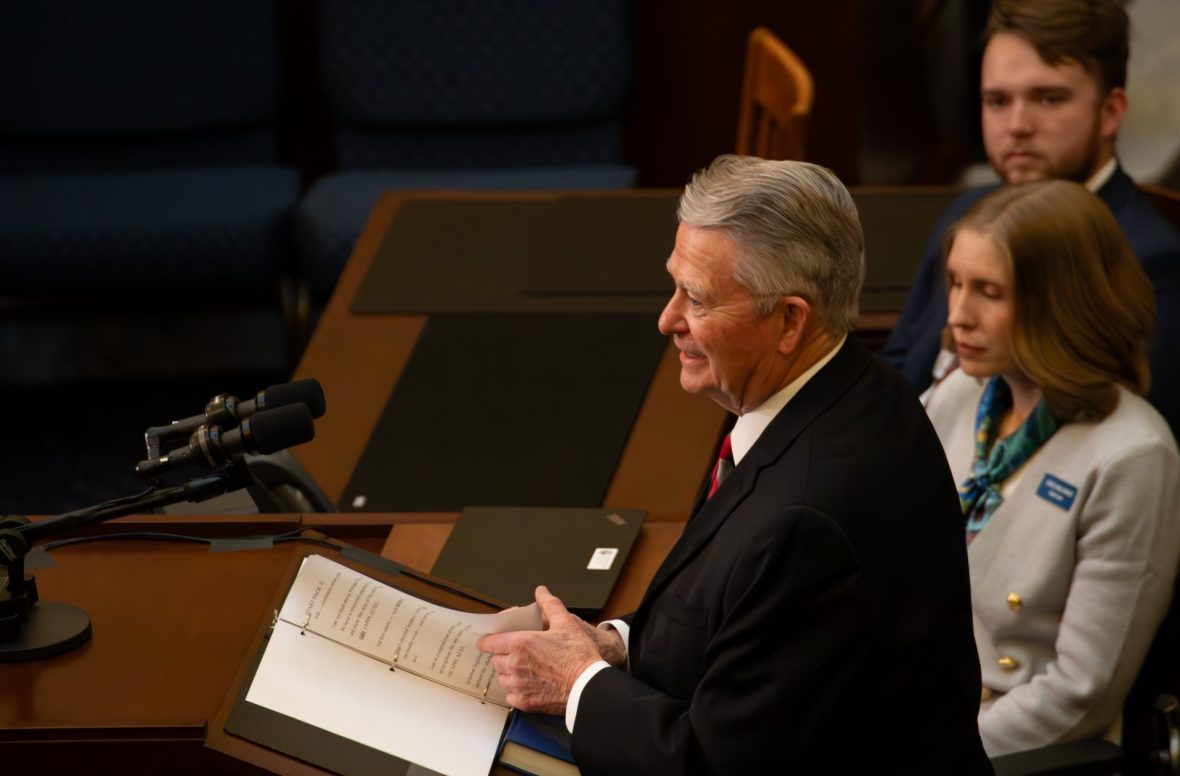
“The early response in the Empowering Parents grants this year blew past everyone’s expectations. The Empowering Parents grants fit into the wide array of abundant school choice options available to Idaho families, and the popularity of the program signals Idahoans’ support for continued learning outside the classroom.” Gov. Brad Little, Nov. 19, 2024.
“In Idaho, we routinely examine government programs to determine their usefulness. It is what good government is all about. Now that the pandemic is squarely in the rearview mirror and students have long been back in school, I agree with the Legislature that (Empowering Parents) served its purpose.” Little, April 14, 2025.
These quotes are accurate.
So are the dates.
And Gov. Brad Little is talking about the same program — although it’s hard to tell.
In November, after the state was flooded with 42,500 fresh Empowering Parents grant applications, Little was happy to run out a news release touting one of his pet education projects.
In April, Empowering Parents was a past-its-prime $30 million-a-year relic, and Little dashed off a letter explaining why he supported zeroing it out.
What happened here says a lot about education policy in the Statehouse — where attention spans are short, patience is scant, and shiny new objects are seductive.
It wasn’t that long ago that education microgrants were the shiny new object.
In 2020, as Idaho students and parents confronted the turmoil of a global pandemic, Little poured $50 million of federal COVID-19 money into Strong Families, Strong Students. Two years later, Little ran it back under a new name, Empowering Parents, tapping $30 million a year from state coffers.
Like its predecessor, Empowering Parents helped cover out-of-pocket education expenses, up to $1,000 per kid or $3,000 per family. And it too was a targeted program; families with an adjusted gross income of under $60,000 got the first shot at grants.
Empowering Parents got off to a ragged start in 2023, which we chronicled in detail. The State Board of Education flagged or denied questionable purchases — running the gamut from gift cards to a gun holster, TVs to a pickleball set. That prompted an in-house review that identified up to $180,000 in improper purchases, and an external audit, ordered by Little, that whittled the price tag of these problem purchases down to $41,000.
The decision to phase out Empowering Parents seemed unrelated to a rocky rollout from two years ago. Instead, it comes as Empowering Parents received high marks from users — suggesting the program might have been finding its stride.
About 83% of parents said they were satisfied with their Empowering Parents experience, and 94% of students said they found that the items or services they received from the program were helpful, according to an outside program evaluation, completed in June.
The review — conducted by the University of Idaho’s Center on Disabilities and Human Development — tried to draw connections between the grants and student performance. They found no hard proof; test scores remained steady.
However, parents self-reported a host of improvements: 58% said their purchases improved their kids’ grades, 81% said the program “positively impacted” their kids’ learning, and social-emotional metrics improved across the board. For special education students, the numbers were especially stark, with 91% of parents reporting improvement.
While anecdotal, the parent responses help explain the program’s popularity. But the U of I’s research didn’t seem to register in the debate over the repeal — which is peculiar, since legislators incorporated a third-party review into the 2022 law creating the program.
A second review, submitted to the State Board in December, offered a more detailed and nuanced look at how families have been spending their grants.
For a 12-month window ending Nov. 8, parents spent nearly $28.1 million in grants.
About $17.1 million went into computers — by far the largest breakout category in the report. But $1.9 million fell under the broad heading of “educational materials,” another $1.9 million went toward educational camps and after-school programs, $1.5 million went toward musical instruments and slightly more than $700,000 went into tutoring.
It’s certainly fair to ask, five years removed from COVID-19, how many more taxpayer-funded laptops the state needs to buy. But in pushing for repeal, Sen. Camille Blaylock, R-Caldwell, repeatedly dismissed Empowering Parents as a “technology slush fund” — a snippet that tells only a piece of the story.
The report to the State Board also dives into program demographics.
As envisioned, Empowering Parents has been helping lower-income households. A year ago, more than 80% of the grants went to families with an adjusted gross income of under $75,000.
And Empowering Parents has been reaching households, and kids, outside the traditional public school system. About 13% of the grants went to students in home school or private school. But as Rep. Soñia Galaviz, D-Boise, noted in floor debate this month, that also means that the bulk of the grants supported kids in public schools — kids who won’t get any help from Idaho’s new private school tax credits. Galaviz, who teaches at Boise’s Whittier Elementary School, said the repeal will hurt “the families that I serve, the parents that I love, the kids that I teach,” by cutting off access to tutoring and other services.
“It gives me real heartache that we didn’t attempt to rein this in and make it better,” she said.
Nonetheless, the Legislature couldn’t wait to kick Empowering Parents to the curb. And when lawmakers are in a hurry, the only numbers that matter are the vote counts. On April 3, the House passed the final version of the repeal bill by a 56-13 margin; Galaviz was the only lawmaker to debate. A day later, in the final hours of the session, the Senate followed suit, 33-0.
That leaves parents three years to spend any grants they already have — an estimated $40 million still available. Meanwhile, the State Board has the job of winding down a program — and trying to avoid the same problems that beset the Empowering Parents rollout. “It’s not a light switch that you can just off and on,” state superintendent Debbie Critchfield said last week.
But the Legislature’s last-minute repeal does zero out new money for Empowering Parents — the $30 million for 2025-26, which Little proposed and lawmakers approved earlier in the year. That $30 million will stay on hold until lawmakers reconvene in January, said Rep. Wendy Horman, R-Idaho Falls, the co-chair of the Joint Finance-Appropriations Committee.
Where it goes is open to debate. Last week, Audrey Dutton of ProPublica reported that the windfall could be used to bolster the state’s fledgling $50 million private school tax credit program. That’s a possibility. But given the Legislature’s perennial penchant for trimming income tax rates, that’s another possibility.
If Little has a preference, he isn’t saying. He will release his budget priorities at the start of the 2026 session in January, spokeswoman Joan Varsek said in a statement to Idaho Education News. The statement also shed no light on why Little soured so quickly on a program of his own making.
Some education initiatives are more politically insulated than others. Given the juice behind it at the Statehouse, and the national momentum behind private school choice, the new tax credit isn’t likely to go anywhere any time soon. But the Idaho Launch postsecondary aid program, Little’s shiny object from 2023, is never on safe ground in the Statehouse. And a three-year, $15 million literacy training program — one of Critchfield’s top priorities, which narrowly passed this year — may be vulnerable as well.
Nothing is permanent.
After all, five months ago, Little waxed enthusiastic about Empowering Parents.
Last week, he wrote its obituary.
Kevin Richert writes a weekly analysis on education policy and education politics. Look for his stories each Thursday.