
In his second year as Boise State University’s student body president, Isaac Celedon is accustomed to spending his winters with one eye on higher education politics.
He says his classmates are paying more attention this year. They’re worried about paying more for tuition, when they’re already paying more for rent and food. Celedon wants to see students get engaged; he just hopes they don’t blame university leaders or the State Board of Education for cost increases that appear almost inevitable.
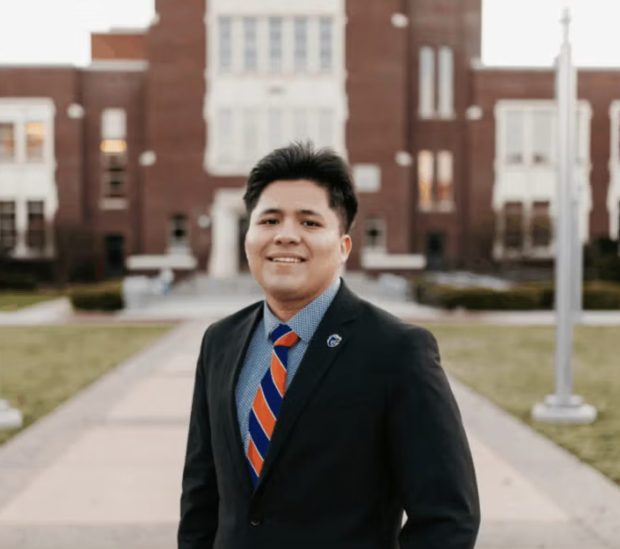
“Students are definitely paying attention to their costs, but I want them paying attention to who determines that in the end,” he said.
And that, he said, leads straight to the Legislature.
And proposed cuts that are feeding into a semester of campus uncertainty.
Higher ed’s budget picture could become clearer — and more grim — in the next few days.
The Senate is poised to vote on “The 2026 Idaho Rescissions Act,” an omnibus bill that would make cuts for the current budget year, which ends June 30. It incorporates the 3% cuts already made by Gov. Brad Little, a $116.2 million general fund reduction, and tacks on nearly $15.2 million in new cuts. But with K-12 exempt from Little’s cuts — and Medicaid, prisons and Idaho State Police shielded from the $15.2 million in legislative cuts — a disproportionate share of the hit falls on higher education.
Then comes next year’s budget, and possibly more of the same. Again, Little has proposed a 3% reduction in the budget base. The Legislature has proposed an additional 2% base cut. With the same carveouts in place — for K-12, Medicaid, prisons and ISP — the same pressure falls on higher ed. As Idaho EdNews has previously reported, the state’s two- and four-year schools could absorb more than 30% of the Legislature’s proposed cuts. Higher education receives only 8% of the state budget.
Will those cuts remain intact? Higher ed will have a better idea on Monday.
That’s when the Joint Finance-Appropriations Committee is scheduled to take a second look at higher education budgets. JFAC members could wind up voting on “enhancements” to the higher ed budgets, replacing money that they cut previously.
Gov. Brad Little’s office has been pressing legislators to reverse some of their 2% base cuts. In a Feb. 10 memo to JFAC, the head of Little’s Division of Financial Management listed community colleges as a top priority, along with career-technical education cuts that would also affect the two-year schools.
“Those are important to the governor, and I know they’re important to our workforce and our economy and business,” Division of Financial Management Administrator Lori Wolff told reporters Wednesday. “I hope they’re important to legislators. I know they will be considering them.”
Idaho Falls’ fast-growing College of Eastern Idaho is already facing the fallout.
CEI has already had to turn away 14 licensed practical nursing students, because the college couldn’t afford to hire a coordinator for the students’ clinical work. By the end of the school year, CEI will cut eight staff positions.

The would-be nursing students were highly qualified, President Lori Barber said, and the soon-to-be-former employees were dedicated.
“Of those eight people … that we let go, seven of them said, ‘This is the best place I have ever worked. Can I come back when times return to good?’” she told EdNews last week. “And seven of the eight asked if they could hug the people who had just fired them.”
It could be a while before “times return to good,” and that decision rests largely with the Legislature.
A fledgling community college, established in 2017, CEI gets about 61% of its money from the state. Increasing the property tax levy is “a long game,” Barber said, and expanding the community college district beyond Bonneville County isn’t a short-term option either.
The only immediate source of new revenue, college officials say, would be a tuition increase.
Meanwhile, CEI says it is reducing in-demand nursing, dental assistant and energy systems programs because there are no frills to cut. “We’re slowing the workflow pipeline, and that’s going to impact the entire community,” CFO Penny Lyon said.
As the session has unfolded, rumors and uncertainty have spread across campuses in tandem.
Barber held community meetings at CEI last week, after meeting with the staffers who are losing their jobs. Many employees had a recurring question: When CEI is growing (with a 55% increase in student headcount since 2021), why is it cutting staff? And could more cuts be on the way?
At Boise State — which reported an enrollment increase last fall, like every other college and university in Idaho — interim president Jeremiah Shinn has tried to reassure the campus community.
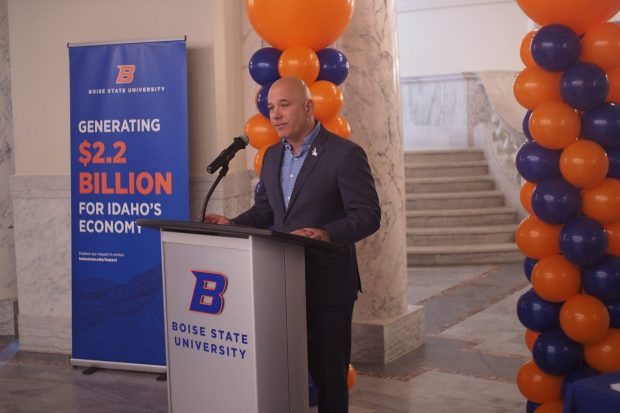
“As we navigate uncertainty around the FY 2026 and FY 2027 budgets, I acknowledge that the potential impacts of those cuts on the university will weigh on each of you,” Shinn wrote in an email to the campus community. The email went out on Jan. 30 — the same day all colleges and universities had to submit budget-cutting scenarios to the State Board, at the request of JFAC leadership.
Across the state, college and university leaders say the budget cuts will have an inevitable effect on staffing — through delayed hires or layoffs. Idaho State University is cutting 44 staff positions as administrators brace for whatever comes from the Statehouse. At the University of Idaho, a 5% budget cut next year could put up to 46 full-time jobs in jeopardy.
“We recognize that most state agencies are also making cuts,” the U of I said in a statement this week. “These cuts are not symbolic to any of us.”
For the 89,000 students in Idaho’s higher ed system, and students considering an Idaho college, the cuts would have immediate impacts, including enrollment caps in high-demand but costly programs and limited course selections, making it harder to graduate on time.
And, of course, a likely tuition increase. The State Board will probably make that decision in the spring, after the legislative session.
Celedon and his fellow student body presidents are focusing on affordability. Their top priority is protecting Idaho Launch — the embattled aid program that provides up to $8,000 to high school graduates. Another proposed budget cut would shift $20 million from the account for Launch, including a $10 million transfer that would limit awards for this year’s high school seniors.
Last year, more than 5,500 graduates used Launch money to attend a two- or four-year college or university, according to Idaho’s Workforce Development Council. (Meanwhile, more than 1,000 students used Launch money to pursue a short-term certificate or license.) It’s a personal issue for Celedon; his brother is using Launch money to study engineering.
An economics and political science major, Celedon is on pace to graduate in May. After a gap year, he hopes to attend law school in Michigan. Down the road, he wants to work in university relations — and hopes to do that at Boise State.
The politics of the moment, and the 2026 session, are his more immediate concern. The message from the Statehouse seems clear to him.
“The Legislature is definitely picking a target,” he said. “You’re chopping off limbs at this point.”
Kevin Richert writes a weekly analysis on education policy and education politics. Look for his stories each Thursday.