
When Jeremiah Shinn calls Boise State University a “rocket ship,” it’s only somewhat hyberbolic.
Increasing on-campus enrollment. Robust online programs reaching beyond Boise. A record-setting $102 million fundraising year. A growing research resume. A nationally prominent football program.
Factor in the national buzz about Boise — due in no small part to Boise State’s emergence — and there shouldn’t be a shortage of candidates for the university president’s job Shinn has held since May, on a short-term basis.
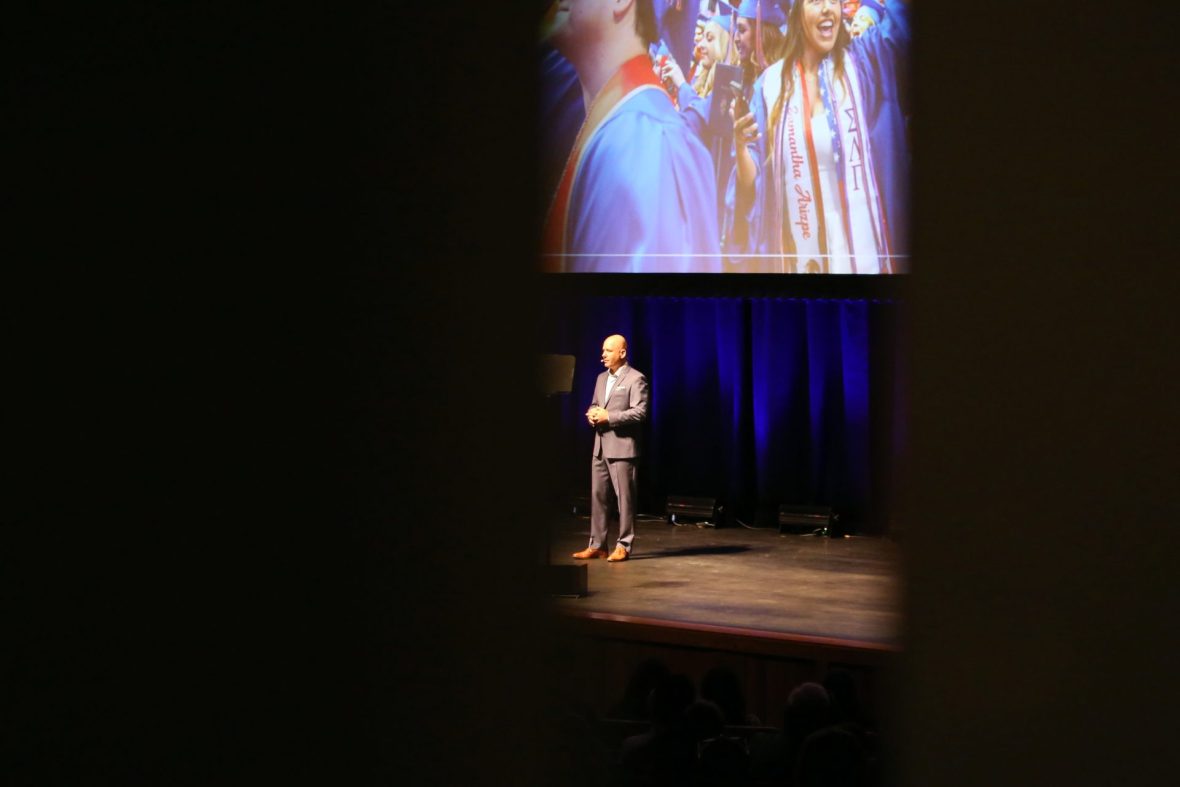
“I’m confident in the diligence of the search process,” Shinn said during a State of the University address Wednesday. “People want to join this team.”
But an attractive job isn’t necessarily an easy job. Boise State’s next president will face fiscal and political pressures that take some of the sparkle off of this job.
Let’s start with the budget, which is a very real problem. And there’s no way to sugarcoat it by simply downplaying it.
On Friday, Gov. Brad Little ordered a 3% budget holdback across most of state government, including higher education. On Wednesday — in a seven-minute Boise Metro Chamber of Commerce speech that put the little in Little — the governor couched the cuts as a mere matter of rightsizing. He correctly noted that he had spared K-12 from the holdback. Conveniently sidestepping the fact that higher education is taking its share of the 3% hit, Little touted the state’s record for tax cuts and investments in education. “We have proven that we can have it all.”
The holdbacks equate to $13.3 million across the higher education system, slightly more than $4 million at Boise State alone. Given the budget realities, it’s safe to assume Boise State’s next president will not be able to “have it all.”
If anything, the next president could arrive at Boise State just in time for a full-blown budget crisis. The Legislature’s budget analyst said Wednesday that this year’s state revenues will fall a startling $853.9 million below projections — a result of sluggish tax collections and the aforementioned string of tax cuts. Money figures to be tight this year and beyond, and higher education figures to be squarely on the hook.
And facing added scrutiny.
The State Board of Education Wednesday carved out a little more control over college and university budgets. The board gave its executive director, Jennifer White, the authority to rewrite higher ed budget requests before they go to Little’s desk. It might seem like a subtle change, a response to the 3% holdbacks imposed last week. But it also illustrates the political and policy making power the State Board exerts over the colleges and universities.
It isn’t just that the board — made up largely of gubernatorial appointees — will hire the next Boise State president and review his or her job performance. That is, of course, no small measure of control. But board policies have a profound impact on what presidents can, cannot and must do.
These board policies can be unmistakably political. In December, the board passed a resolution ordering colleges and universities to close student centers grounded in a diversity, equity or inclusion “ideology.” Before the vote, then-Boise State President Marlene Tromp fought back tears as she discussed the implications of the proposal. Emotions aside, Tromp had already preemptively closed Boise State student centers in favor of a more generic Student Connections and Support Center — in a Thanksgiving week change weeks before the State Board vote.
Such is the power of the State Board, and the political riptides facing higher ed.
Tromp spent her six years as president facing open scorn from conservative lawmakers who considered her far too woke and not nearly enough Idaho. The next president will be viewed against that backdrop.
Idaho Republican Party Chair Dorothy Moon made that abundantly clear, in an op-ed last week. Moon played to her party base by pointing to the Big City Coffee trial — and the millions of dollars Boise State could wind up paying out to Sarah Jo Fendley, who claims she was forced off campus because of her pro-law enforcement beliefs. Moon also used a bingo card’s worth of buzzwords to tell the State Board how to approach the vacancy.
“We don’t need another leftist ideologue preaching Marxism and globalism to the next generation, someone who believes all Trump supporters are racists and misogynists, and who gives cover and support to the most extreme elements of the left,” Moon wrote.
Moon may have a more outsized voice than usual here — simply because the State Board is saying so little. The president’s search has unfolded behind closed doors and under the cloak of nondisclosure agreements, and has been discussed publicly in only the most general terms.
On Wednesday, State Board member David Turnbull said he had spent two days interviewing potential finalists. Board President Kurt Liebich joined in on the interviews and said the job is getting interest from a strong field of applicants, including presidents at other institutions.
“The university has been performing so well that it’s a really attractive position,” Liebich said.
Then Liebich and White grumbled about the phase of the process that actually will be open — when the board announces a list of five finalists and schedules campus visits, likely this fall. State law requires the board to publicly announce five finalists, and Liebich said some sitting presidents and potential finalists might withdraw their Boise State application instead of taking part in the open process.
Would this board prefer to follow Vermont’s lead?
On March 17, the University of Vermont announced that Tromp was the sole finalist to head the public, land-grant institution. Tromp was hired three days later, after a site visit that seems, in retrospect, more like a formality. Idaho’s process — the one that seems too open for the State Board’s tastes — isn’t completely transparent. But vetting five finalists is far better than coronating one.
And a better way to fill the attractive but high-pressure job of driving the “rocket ship” at Boise State.
Kevin Richert writes a weekly analysis on education policy and education politics. Look for his stories each Thursday.