So much for bedside manner.
Doctors, students and college officials have definite ideas about how the state should train its next generation of physicians — and where the state should invest its money. And they didn’t mix their opinions in with a spoonful of sugar.
The written comments to Idaho’s medical education task force get at the unavoidable politics of the issue. If the state puts more money into subsidized medical school seats, there will be winners and losers. The task force sidestepped the question of who could win and who could lose, issuing a report on Dec. 1 that spelled out the options but made few recommendations.
Idaho’s medical education plan working group is scheduled to meet Friday to discuss the proposed plan — and the public comments. The meeting is scheduled for 1 p.m. at the State Board of Education office, 650 W. State St., and will be streamed. (Details here.)
The State Board of Education’s two-week public comment period ended Friday, and the board provided the 72 pages of comments to Idaho Education News Monday. Here are a few recurring themes:
It’s a high-stakes sweepstakes. And no surprise: College and university officials know it.
Brian Atkinson, chief information officer at the Idaho College of Osteopathic Medicine, praised the task force’s push for subsidizing additional medical school seats. “This is a crucial near-term step in expanding opportunity for Idaho-resident students.” Atkinson touted one option in particular: subsidizing students at ICOM, a private, for-profit medical school in Meridian.
University of Idaho President C. Scott Green called out the two options with a U of I connection. The first is a partnership with the University of Utah, with programs located at U of I’s downtown Boise building. The second is maintaining, or growing, the U of I’s affiliation with the University of Washington’s medical school and its WWAMI program. program. “The state of Idaho and the University of Idaho have invested over a half century in developing an undergraduate medical education program that WORKS for Idaho.”
Washington and WWAMI officials pushed for at least holding the line on a program that takes 40 Idaho students per year.
It’s parochial, and it’s personal. Especially for students and alumni with ties to a program.
Jo Elsbury, a retired physician and “proud graduate” of WWAMI, said that her alma mater provides Idaho a “stellar” return on investment. For every 40 students in an Idaho cohort, she noted, the state attracts about 28 practicing physicians from WWAMI’s member states of Washington, Wyoming, Alaska, Montana and Idaho.
“We should only invest our scarce tax dollars in schools that are prepared to create programs that meet or exceed WWAMI’s performance, and provide us the ongoing data to prove it,” she wrote.
Jett Murray, a Preston native and 2025 ICOM grad, urged the state to invest in his alma mater. After graduating from the U of I, Murray said he chose ICOM because he wanted to get in on the ground floor with a new college that could address rural Idaho’s physician shortage.
Idaho needs to partner with ICOM, he said, or risk the consequences. “If the state of Idaho is unable to support medical students with taxpayer dollars to subsidize medical school tuition, then other organizations will. As a result, there will continue to be a physician ‘brain drain’ in Idaho.”
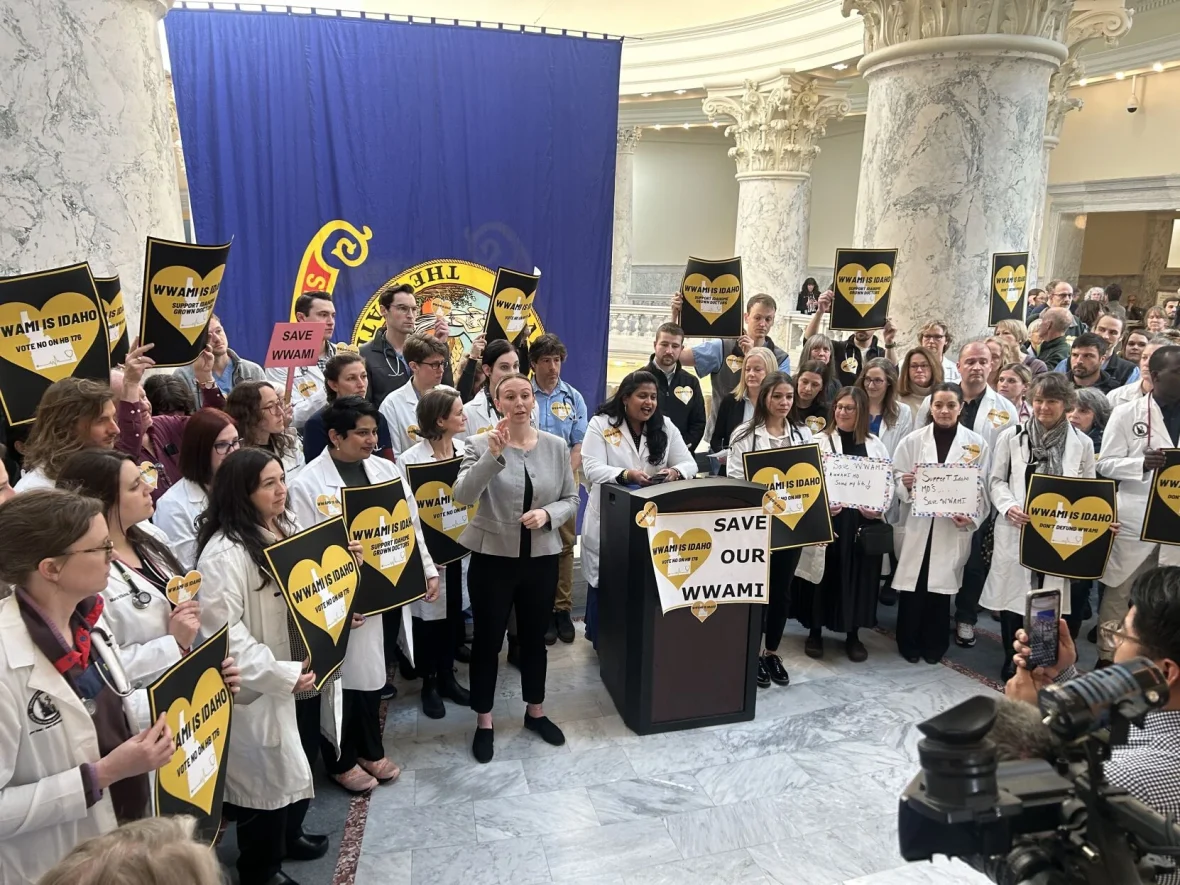
WWAMI brand loyalty runs deep. The public comment period is an echo from the 2025 session — when WWAMI supporters rallied against a bill that would have severed Idaho’s partnership with the program. That proposal stalled. In its place came a law that calls for expanding Idaho’s partnerships with other medical schools — and possibly cutting back Idaho’s WWAMI enrollment.
Undeterred, several commenters urged Idaho to buy up more seats with WWAMI. Even though the 2025 law calls for Idaho to fund non-WWAMI seats. And even though the medical education task force’s co-chair, Rep. Dustin Manwaring, R-Pocatello, doesn’t think it’s likely the Legislature will budge on this issue.
Dr. A. Patrice Burgess, a Boise family medicine physician, didn’t call for growing WWAMI — but she did call the program a win-win for Idaho students who can get much of their training in-state. “WWAMI is Idaho’s medical school.”
Former U of I President Chuck Staben was brutally blunt. Walking away from WWAMI, in favor of ICOM or the University of Utah, is “stupidity.”
ICOM is polarizing. There’s no middle ground when it comes to the newest player in Idaho’s medical school debate — which opened in 2018, in partnership with Idaho State University.
“I find the quality, compassion, and dedication of the ICOM students to be outstanding,” said Dr. Stephen DeNagy, an ICOM assistant professor of psychiatry. “I see absolutely no difference between them and medical students from any other university.”
Dr. Travis Marshall — an emergency medicine director with the Saint Alphonsus health system, and a WWAMI alum — dismissed ICOM as a for-profit entity that saddles its students with “extreme” debt.
“They put Idaho in their name but they are here for themselves, not here for Idaho,” he wrote.
And no commenter embraced a costly long-term option on Idaho’s menu: buying ICOM. Idaho State has made no secret of its interest in a purchase, and a consultant working for the university has endorsed the idea. But ICOM remains off the market, for now, and the potential price tag is unknown.
Buying ICOM “is not economically feasible and would misallocate critical public funds away from essential public medical education initiatives,” said the Idaho Academy of Family Physicians.
Dan Schmidt, a former state senator from Moscow, astutely read between the lines of the task force’s 41-page report. Said Schmidt, a retired physician, “You all are trying to tiptoe between the competing entities.”
It’s a fair assessment. Rightly or wrongly, the task force is letting the Legislature figure out where to spend the limited taxpayer dollars that will be available for medical education.
Lawmakers won’t be able to tiptoe around the politics for very long.
Kevin Richert writes a weekly analysis on education policy and education politics.