No matter how you keep score, it was a bad legislative session for higher education.
On the spending side, lawmakers whacked $2 million apiece off the budget for Boise State University and the University of Idaho — political payback masquerading as fiscal conservatism.
On the policy end, the Legislature passed a far-reaching anti-DEI bill. The bill doesn’t merely outlaw diversity, equity and inclusion programs. It also exposes the colleges and universities to civil damages and more politically driven budget cuts.
And things could have been even worse for higher ed.
In the session’s final fever-dream days — and the flurry that included the floor votes on the higher ed budget and the DEI bill — legislators also came close to making huge changes to the Idaho Launch postsecondary aid program. The makeover would have come at higher ed’s expense. And it would have cost the colleges and universities much more than the $4 million Boise State and the U of I lost to the budget reaper.
Idaho Launch: By the numbers
As of Tuesday, 12,977 high school seniors have applied for this year’s Idaho Launch grants, said Wendi Secrist, executive director of the Workforce Development Council, the state agency that administers Launch.
That’s down slightly from a year ago, when 13,264 seniors had applied.
Applications don’t necessarily pan out into awards. Last year, the state awarded about 6,500 Launch grants to high school graduates, worth about $52.3 million. That left the program with about $20 million in leftover money. Much of that money went into Launch grants for adults, grant extensions for 2024 graduates, and grants for early graduates or students receiving a GED this year.
Launch remains intact, for now. But the sentiment around the Statehouse — an open, unapologetic skepticism directed at higher education — shows no sign of softening.

Rep. Steve Miller was clear about what he wanted to do with Launch, and why.
The Fairfield Republican says he isn’t too worried about high school kids who already have their sights sets on college. Things tend to work out just fine for them, he says. Miller is more worried about kids who aren’t college-bound, making sure they have a path to a good-paying job.
And so Miller co-sponsored House Bill 461, the Launch makeover. The bill would have drilled down the program, emphasizing associate’s degrees, apprenticeships and job training that can be completed within two years. The idea, said Miller and his allies, is to get Launch back to the program that lawmakers say they were promised two years ago: an incentive program to give high school graduates a fast path to in-demand careers.
But the simple fact is, Launch is playing out in a fundamentally different way. Students have different ideas about how they want to spend their piece of the money.
Last fall, the first class of Launch recipients began their studies: 6,495 high school grads in all.
- In all, 3,255 students spent their Launch money at one of Idaho’s four-year schools: Boise State, the U of I, Idaho State University or Lewis-Clark State College — fueling a fall enrollment boost that defied national trends.
- Another 867 students used Launch to attend a private four-year school: Brigham Young University-Idaho, The College of Idaho or Northwest Nazarene University.
To sum it up, about two-thirds of the Launch awards went to students in four-year schools — which HB 461 would have discouraged.
It doesn’t take an advanced degree in math to see how damaging HB 461 would have been to the four-year schools.
Boise State had 1,285 Launch recipients this year, the U of I had 785. Launch awards top out at $8,000 per student. That means Launch awards were worth up to $10 million for Boise State students and $6.3 million for U of I students — far eclipsing the budget cuts at the two universities.
HB 461 passed the House quickly and easily. But it never got a hearing in the Senate in the final week of the session, so it died there.
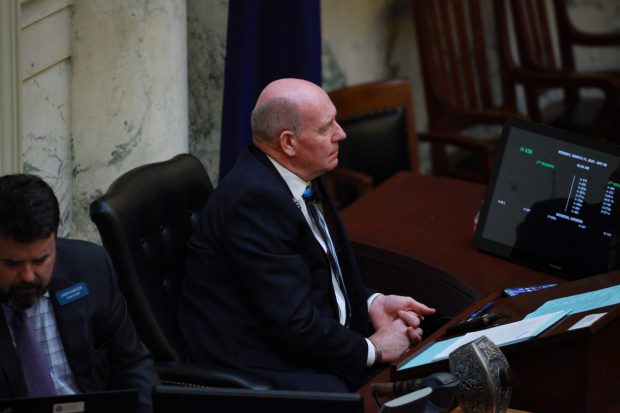
“I had hoped that we had a path forward on that,” said House Speaker Mike Moyle, R-Star, during an end-of-session news conference last week. “We’ll try it again next year. I don’t think that issue will go away. … Hopefully next year, we’ll start a little earlier and have a resolution sooner.”
Rep. Wendy Horman also expects the bill to come back in 2026.
“I think there’s still room for refinement in the program,” said Horman, R-Idaho Falls.
The idea of a Launch reboot has powerful friends, especially on the House side of the Statehouse Rotunda. Moyle, who has made no secret of his Launch skepticism, is probably the single most powerful member of the Legislature. Horman co-chairs the Joint Finance-Appropriations Committee, the Legislature’s influential budget-writing committee. Miller is JFAC’s House vice chair. HB 461’s co-sponsor, Rep. Lance Clow, R-Twin Falls, is a seven-term lawmaker and former House Education Committee chairman.
That’s often enough critical mass to push through a last-minute proposal like HB 461. If anything, it just feels like higher ed dodged a bullet on the Launch bill.
During the Democrats’ end-of-session news conference, Senate Minority Leader Melissa Wintrow of Boise was in no mood to celebrate near-misses.

“I don’t think higher education is faring too well,” said Wintrow, a former Boise State employee.
Wintrow may have a point.
If there’s one thing about Idaho’s higher education debates, it’s that the issues never really go away.
Conservative lawmakers have been looking to kill Launch since Gov. Brad Little first proposed it in 2023. Conservatives have tried to cut higher ed budgets for years, and this wasn’t the first time they succeeded. The DEI bill might have been the product of a House-Senate work group that began meeting last fall, but in truth, some lawmakers have been looking for a DEI kill shot for years.
Asked if the DEI issue is resolved, Moyle said he isn’t sure.
“I hope that this drives a nail in it, and we’re done with it,” he said. “But I’m not going to say that it really does, because we just won’t know until we see what the universities do.”
Which doesn’t foreshadow an easy 2026 session for higher ed.
Kevin Richert writes a weekly analysis on education policy and education politics. Look for his stories each Thursday.