
Republicans on the Senate State Affairs committee overwhelmingly supported an anti-DEI bill Friday, sending the proposal to the full Senate.
Senate Bill 1198 would bar colleges and universities from opening diversity, equity and inclusion offices, hiring DEI officers or requiring DEI-related coursework, unless it’s part of a chosen degree program. Colleges and universities that violate these provisions, and decline to “cure” violations, could face financial penalties — a 2% cut in “operating expenses for the offending division, office, center or unit … where the violation occurred.”
The committee voted 7-2 to advance the bill, which is sponsored by Sen. Ben Toews, R-Coeur d’Alene, and Rep. Judy Boyle, R-Midvale. It’s an updated version of a bill that a legislative task force on DEI endorsed in January.
Sen. Brandon Shippy, a Republican from New Plymouth who supported SB 1198, said it’s “an issue of justice,” and it shows that “we stand on merit” rather than “partiality.”
During a public hearing Friday, opponents argued that it would undermine academic freedom and campus services for women and veterans.
“It is mean-spirited, overreaching and advocates excessive government control,” said Bonnie Pfaff of Boise. “This bill opens the door for constant attacks on our institutions with excessive penalties. It creates fear and stifles academic freedom.”
Toews said the bill would not affect women’s rights or veterans centers on campuses. The bill prohibits activities that promote “differential treatment” of individuals on the basis of “race, color, ethnicity, sex, disability or religion.”
Representatives of the Ada County Republican Party, Idaho Freedom Foundation (IFF) and Idaho Family Policy Center (IFPC) spoke in support of the bill. IFPC policy assistant Edward Clark pointed to polling sanctioned by the Christian advocacy group that showed public opposition for DEI programs, “which provide preferential treatment for politically favored groups based on race, gender and sexual orientation.”
“The foundational principles of DEI are clearly viewed by God as sinful and corrupt, undermining justice to satisfy a twisted understanding of equality,” Clark told the committee, after quoting from the Bible.
IFF has described DEI as a “pernicious ideology.” During a testy exchange with Samuel Lair, director of IFF’s Center for American Education, Sen. James Ruchti asked whether he considered a University of Idaho statement that “unconditionally” rejects “every form of bigotry, discrimination, hateful rhetoric and hateful action” as an example of “pernicious ideology.”
The U of I statement is modeled on the 1964 Civil Rights Act, Lair said, but that’s “no longer the spirit” on university campuses. Instead, dog whistles framed as “liberal toleration” actually convey critical theory, an ideology that’s “inherently political and divisive,” he argued. “It speaks about power structures, and its sole goal is to create agents of social change in order to deconstruct these systems of oppression.”
Ruchti responded that he’s familiar with dog whistles, and “I’m seeing a lot of them in this legislation.” Ruchti, a Democrat from Pocatello, said the anti-DEI bill would lead to more controversies like the West Ada School District’s order to remove a classroom sign that welcomed students of all races.
“You get a school district that says ‘all children are welcome here’ is an opinion, and it is not a fact,” Ruchti said. “I don’t know what that means, but we’re going to get comparatively or equally silly responses coming out of our universities as they try to figure out how to navigate all this.”
Ruchti and Sen. Jim Guthrie, R-McCammon, opposed a motion to advance the bill. Among committee members who supported the motion, only Shippy and Toews argued in favor of it.
Moving quickly, House approves Launch rewrite
The House passed a fast-tracked bill to revamp the Idaho Launch program.
The 51-16 vote came just one day after the House Education Committee introduced House Bill 461. The rapid pace signals that a Launch overhaul is a high priority — particularly for conservatives who have never supported the postsecondary grant program.
“I think this is a big improvement in the Launch policy,” said Rep. Lance Clow, R-Twin Falls, who is co-sponsoring HB 461 with Rep. Steve Miller, R-Fairfield.
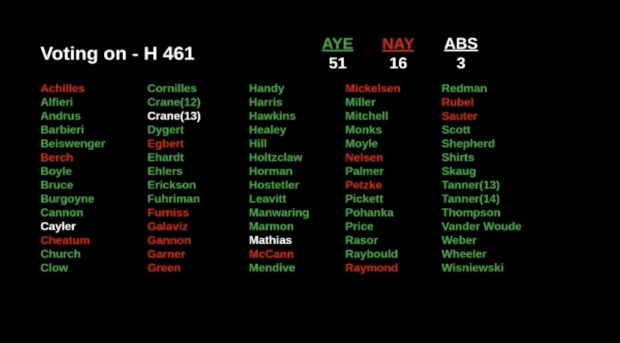 Launch provides up to $8,000 for high school graduates who want to pursue college or job training programs. But the $70 million-a-year program has been controversial since Gov. Brad Little unveiled it two years ago, and HB 461 appears to be an attempt to defuse this opposition.
HB 461 would route Launch grants toward two-year degrees and short-term job training, rather than bachelor’s degrees. However, it would allow students to use any leftover funding for graduate programs in health care.
It would also give legislators a greater say in the program.
Currently, the 31-member Workforce Development Council determines the state’s list of in-demand careers — and the studies that qualify for Launch grants. HB 461 would turn this task over to a new nine-member panel, including six legislators.
Friday’s House debate focused largely on this section of the bill.
“It gives us as legislators better oversight and better direction,” said Rep. Josh Tanner, R-Eagle, an HB 461 supporter.
“We’re politicizing what we’re doing,” said Rep. Rick Cheatum, R-Pocatello, a Launch supporter who opposed HB 461.
It’s been a fast-moving week on Launch.
On Tuesday, the House Ways and Means Committee quickly printed the first version of a Launch revamp.
On Wednesday, House Education voted it down.
On Thursday, House Education voted to introduce HB 461, sending it to the floor. That happened after three Launch opponents — Republican Reps. Kent Marmon of Caldwell, Steve Tanner of Nampa and Tony Wisniewski of Post Falls — flipped their votes and supported HB 461.
This bill now heads to the Senate.
JFAC looks to salvage pieces of education budget bills
Legislative budget-writers were in salvage mode Friday — rewriting and paring two education spending bills that died on the House floor this week.
But they weren’t happy about it.
“The word ‘pragmatic’ comes into play here,” said Rep. Wendy Horman, the Joint Finance-Appropriations Committee’s co-chair, during a brief committee hearing.
Here’s what made the cut, and what didn’t.
State Board of Education. The new budget bill seeks to rescue $360,700 of miscellaneous line item requests. The largest of the bunch is a $144,200 line item for a new, full-time database engineer.
But JFAC talked much more about what is missing in this State Board “enhancement” budget: $5 million in grants to beef up workforce training programs. That was the centerpiece of the State Board budget that the House killed on a 33-37 vote.
And the $5 million represented a compromise: Gov. Brad Little had originally proposed $15 million for the public-private partnerships. “I think it’s extremely unfortunate that this is being removed entirely,” said Rep. James Petzke, R-Meridian.
Sen. Melissa Wintrow was even more critical. “I just think this is a travesty,” said Wintrow, D-Boise, lamenting the long waitlists for career-technical courses across the state.
Horman, R-Idaho Falls, noted that a different budget bill includes Little’s $10 million request for expansion at Idaho’s community and technical colleges. And CTE programs can still seek private donations for expansions, as Little had proposed.
“I believe this is something we can move (through the Legislature), and they can get by with for a year,” she said.
The budget passed on a 17-3 vote, with opposition from Wintrow, Sen. Janie Ward-Engelking, D-Boise, and Sen. Glenneda Zuiderveld, R-Twin Falls, a conservative hardliner.
Public schools. JFAC took a second whack at a budget that would allow schools to try out new tracking software for buses.
The new budget bill would provide $600,000 for the pilot program. The Idaho Department of Education and Little had requested $5 million. JFAC pared this request to $2.2 million, but on Wednesday, this budget failed on a 32-33 House vote.
The software uses GPS routing, and supporters say it should help districts save on gas and transportation paperwork.
The software costs $1,500 per bus, so the new budget would bankroll a pilot on 400 buses statewide, said Jared Tatro, a budget analyst for the Legislative Services Office.
Language in the budget bill would require pilot schools to file reports with the state, “to demonstrate the effectiveness of the program including costs and savings, if any.” The first report would be due Dec. 15.
This budget passed on a 15-5 vote.
Both budget bills would still have to pass the House and the Senate.

