Each year, Medicaid covers $50 million to $60 million of Idaho’s special education costs.
But despite this federal money, the Idaho Department of Education says the state is still facing a $100 million special education shortfall — a gap between local special education costs, and state and local funding. State superintendent Debbie Critchfield has made the special education gap her top priority for the 2026 legislative session; she is requesting a $50 million increase.
As lawmakers again look at Idaho’s special education funding crisis, Medicaid is likely to be a part of the discussion. How does Medicaid fit into the special education funding puzzle? And how do districts and charters use the school-based Medicaid program to pay for special education programs?
Here’s a closer look.
First, the special education math
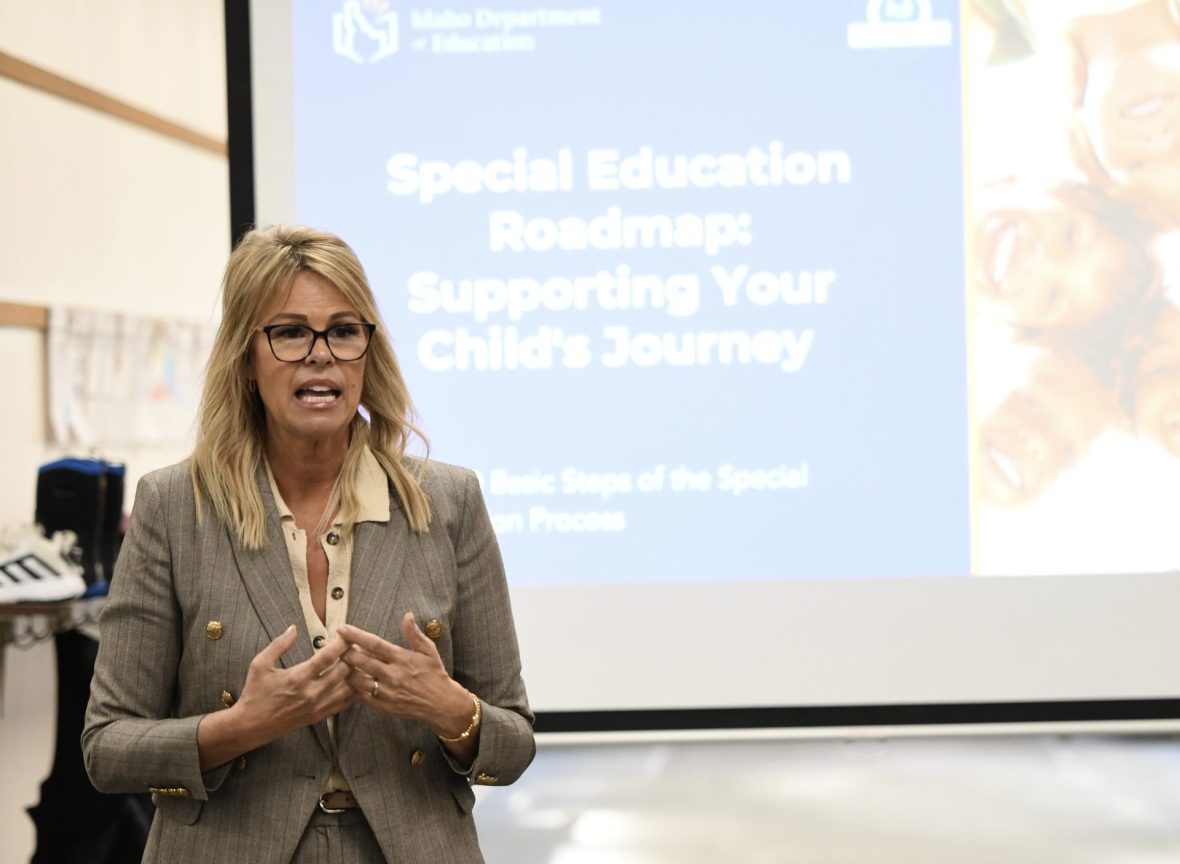
Laying the groundwork for her special education request, Critchfield has spent a lot of time talking in recent months about the funding gap.
The problem is an old one — predating the uncertainty that now surrounds the federal special education program. The feds have only paid a fraction of local special education costs.
Keeping the numbers straight
$400 million: Idaho’s annual special education costs.
$120 million to $130 million: What the federal government provides for special education in Idaho each year. This includes $50 million to $60 million from Medicaid.
$100 million: Idaho’s special education gap — the difference between local costs and federal and state funding.
$82.2 million: The amount of money local schools spent on special education in 2023, according to an Office of Performance Evaluations report. This is an incomplete number. It doesn’t include what districts and charters put up as matching money, in order to receive larger payments from Medicaid.
$50 million: State superintendent Debbie Critchfield has proposed a grant program to increase special education funding. She will take this request to the 2026 Legislature.
The Individuals With Disabilities Education Act, or IDEA, is the main source of federal education funding for states. Idaho receives about $71 million from IDEA each year.
Add in the Medicaid money, and the feds pick up about $120 million to $130 million for Idaho special education.
But special education costs exceed $400 million per year, says Lisa Pofelski-Rosa, the state department’s special education funding and accountability coordinator. That leaves the state — and in the end, districts and charters — to cover the balance.
“The estimated $100 million statewide shortfall reflects the remaining gap after both federal IDEA allocations and available Medicaid reimbursements have been applied toward special education expenses,” Critchfield spokeswoman Andrea Dearden said in an email to EdNews.
The special education funding gap received increased attention in March, when the Legislature’s auditing arm issued a report on the situation. Based on 2023 numbers, the Office of Performance Evaluations estimated the special education funding gap at $82.2 million.
The OPE did not factor in federal special education funding, including school-based Medicaid, Director Ryan Langrill said. Auditors tried to look at Medicaid, he said, but they found that districts track the program differently. As a result, there was no way to calculate the local match districts must put up in order to receive federal Medicaid dollars.
So the $82.2 million gap reflects some local school spending on special education, but not including the Medicaid match.
“The $82.2 million amount is smaller than it would be if we could account for what schools paid for their Medicaid costs,” Langrill wrote in an email to Idaho EdNews.
But in the end, districts and charters will collect more from federal Medicaid payments than they pay in upfront matching funds. The program increases the amount of money local schools spend on special education, but the federal payments more than make up for it.
Next, the Medicaid process
But it isn’t easy money for local schools.
In a nutshell, the school-based Medicaid process is complicated and cumbersome. And in the end, it never fully covers a district or charter’s special education costs.
“I call it a bad rebate coupon program,” Pofelski-Rosa said in an interview.
Before we get to the rebates, there are the ground rules. There are a number of obstacles to using school-based Medicaid to cover special education.
First off, a student must be eligible for Medicaid, and the feds’ rules are changing. “We are seeing that it’s harder to qualify or requalify,” Pofelski-Rosa said.
Even if a child qualifies, state and federal law requires parents to opt into Medicaid, and they can withdraw at any time.
And school-based Medicaid doesn’t cover everything. Idaho has a “pretty robust” plan that covers a list of 19 health services, Pofelski-Rosa said. But some costly services — such as sign-language interpreters who are assigned to a student full-time — are considered “instructional services” that fall outside the scope of Medicaid.
Then comes the payment process.
Districts and charters must pay for special education services up front, before they can seek Medicaid payments. Medicaid doesn’t offer reimbursement; it pays fees that can often fall well short of a school’s expenses. The district or charter also must cough up matching funds before they receive the feds’ money.
The process is burdensome enough to dissuade some local schools. A district or charter has to assign staff to handle the billing, and since Medicaid won’t cover this cost, local officials have to decide whether they have enough eligible students to justify the expense. “It may not be worth it and they may not bill Medicaid,” Pofelski-Rosa said.
Despite the hurdles, the state could require schools to pursue Medicaid money.
A 2025 special education bill — which would have created a $3 million high-needs student fund — would have required local schools to seek Medicaid funding before applying for state dollars.
Critchfield’s $50 million proposal could include similar language.
“(It’s) definitely part of the conversation,” said Gideon Tolman, Critchfield’s chief financial officer.