
Step onto the North Idaho College campus near downtown Coeur d’Alene, and it’s easy to catch a whiff of the culinary students’ work at Emery’s restaurant.
The culinary arts program has been a success for the college for years. But the time commitment — six-hour lab sessions, three days a week for two years — isn’t realistic for all students, said professor Hillary Faeta-Ginepra.
“It’s a lot for someone who needs to work, which is pretty much everyone at this point,” Faeta-Ginepra said. “So we wanted to touch another segment of the population.”
So, she created the Culinary Arts Sous Chef Apprenticeship, set to launch this fall, which aims to reach students who need to work by providing them a job in the food service industry as part of the program.
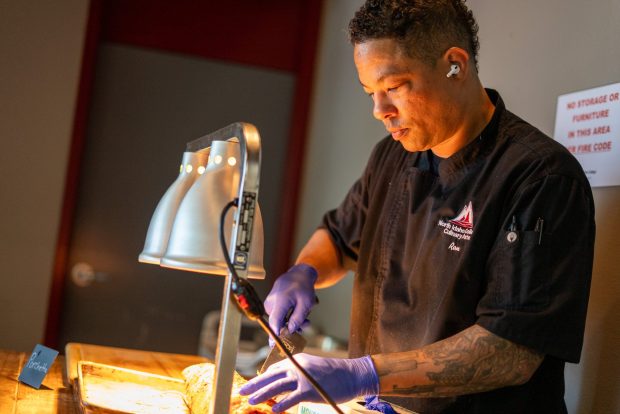
Students in the new apprenticeship will come into NIC’s lab one day a week from noon to 6 p.m. and the rest of their classes will be online. Students will carry a small course load, about 10 credits, throughout the three-year program, allowing them to work up to full-time hours at one of NIC’s partner employers.
“I’m thinking in terms of what the industry is like right now,”Faeta-Ginepra said. “There are so many incredible opportunities and it’s very difficult for people to balance doing work and school.”
The Coeur d’Alene Resort and the Coeur d’Alene Casino have already signed on to provide students with paying jobs, along with some restaurants in Washington. Students will have the summer off from classes, coinciding with both businesses’ busy season, allowing them to pick up extra hours. As students gain skills through the program and their work, Faeta-Ginepra said, their pay is also expected to increase.
“This is really opening up the ability to get professional certification and associates, and to be able to work,” she said. “It’s a win-win-win for everybody; for students, for the industry and clearly for us as well.”
For the CDA Casino the program is a great fit providing new talent but also giving varied opportunities to learn across the casino’s large scale operation, said Alex Santos-Cucalon, executive chef.
“One of the biggest challenges facing the foodservice industry today is finding qualified, work-ready individuals. The ACF apprenticeship program directly addresses this by offering a structured, hands-on learning pathway that combines real-world kitchen experience with academic instruction,” Santos-Cucalon, said. “It produces job-ready individuals who are trained to meet industry standards from day one.”
Other areas in the Northwest, like Seattle and Portland, have more tourism, making it easier to get talent, said Justin Lee, executive chef at the CDA Resort. Lee hopes the apprenticeship will grow talent in Idaho.
“Really giving back to the community and building talent is one of our main focuses here,” Lee said.
The program fills a gap in the region, Faeta-Ginepra said. There isn’t a program like it in eastern Washington, Montana or Idaho. She spoke to staff and Renton Technical College in western Washington, the closest school to have a similar program.
“I would say that program is going to be so beneficial to this area because there’s really nothing like it anywhere,” Lee said. “There’s so many schools out there that they don’t really give the students the opportunity to work. With the cost of living and everything these days, work has to take the precedence over school.”
The apprenticeship is designed for people who already have some experience in the food service industry, Faeta-Ginepra said. Applicants must have a high school diploma or GED and six months of experience in food service.
“This is for people who are very serious and ready to go down that career path and already kind of know what the industry is like,” she said.
Food service is also a growing industry, Faeta-Ginepra said. Her phone rings off the hook with employers looking for qualified employees, although not always sous chef level.
“I mean food is everywhere it’s not just restaurants and catering it’s non-commercial segments of the industry you know schools, hospitals,” she said. “It’s really, really big.”
Lee has spent the last decade coaching high school culinary teams. He said the program is a huge boon for his students.
Program details:
Students pay NIC tuition along with a $675 one-time fee for their uniform, tools, and the American Culinary Federation membership and exam.
Each semester students also pay a $350 lab fee. The deadline to apply for the program is July 1 but Faeta-Ginepra plans to be flexible with hopes of getting at least 10 students in the first cohort.
Learn more about the program and requirements here.

