
Kellogg Superintendent Lance Pearson learned a lesson from the district’s first failed supplemental levy in 15 years: “Facts don’t change people’s minds.”
Pearson has tried to share what he sees as facts about the district’s budget, including if the levy fails again in May there will be cuts to athletics, a popular Marine ROTC program and classes like PE, art and music. About 70 people would lose their jobs, he said.
And property taxes in the district would still go down if the levy passes because the district paid off its bond earlier than planned in December, Pearson said.
Still, 52% of voters in November opposed the $7 million two-year levy.
Kellogg leaders are searching for answers but worry the struggle to gain voter approval is a larger pattern. For districts like Kellogg, where local levies fund nearly a third of the budget, the issue carries high stakes.
Leaders see another failed levy in May as a long-term hit for the district.
“We would never recover,” trustee Alexa Griffin said.
Searching for answers
Pearson and the Kellogg School Board were surprised by the failure in November but acknowledge that maybe they got complacent after more than a decade of easy levy passage.
Now, they’re trying to appeal emotionally to their community.
Last month about 50 people crowded into the Kellogg Middle School Library to learn about the supplemental levy, which trustees plan to put on the ballot again in May.
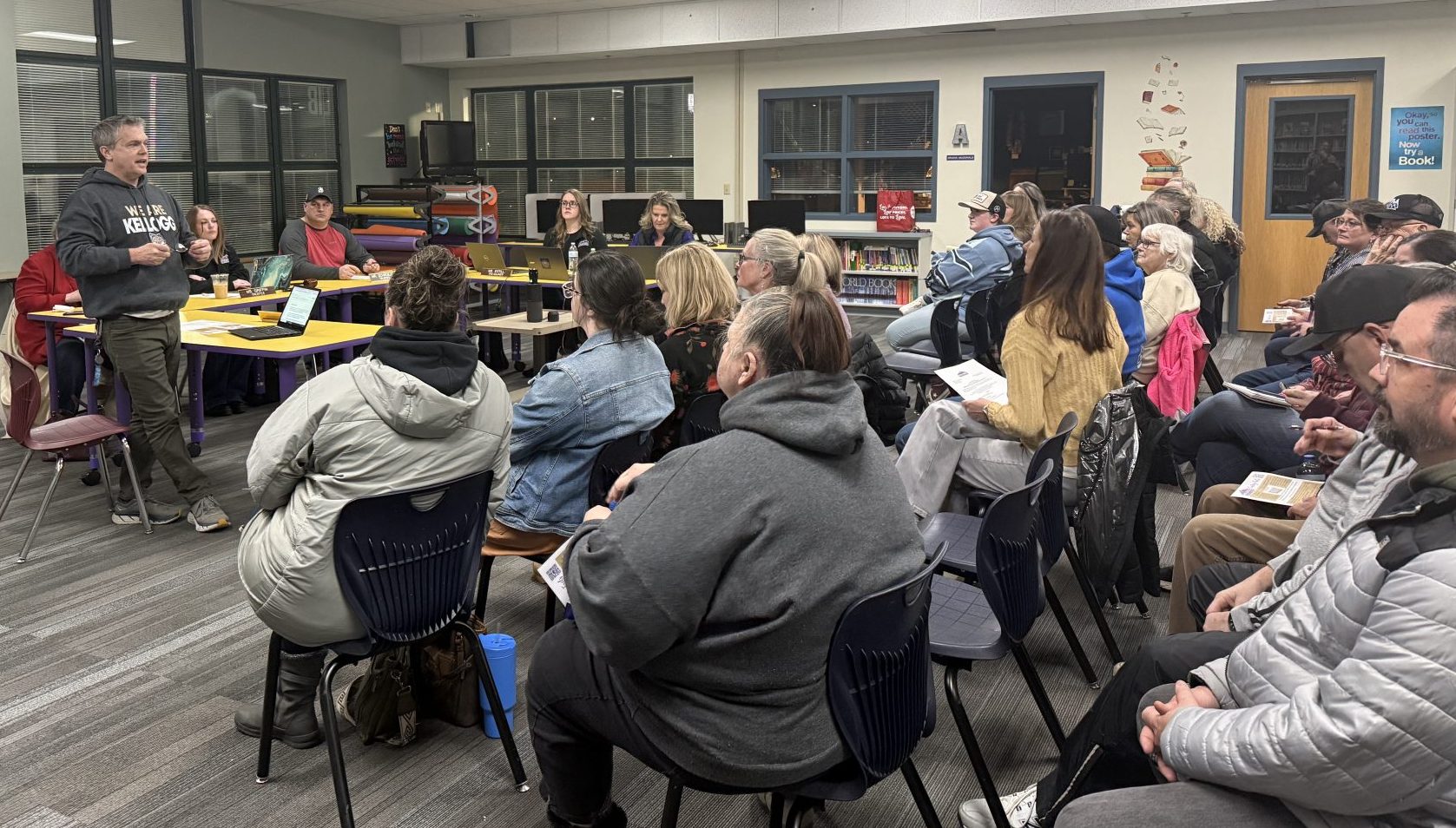
A few minutes in it was clear that attendees supported the tax. They asked questions about how to inform their neighbors and correct false information. They emphasized how program cuts could fuel increased drug use and crime in the community, where 78% of students are in poverty. They asked where they’d send their children when full-day kindergarten went away.
The perspective that wasn’t present was from whoever sponsored the “Vote No on All Levies” signs ahead of last November’s election. It’s unclear who paid for the signs because the legally required campaign disclosure statement wasn’t included.
Still, for Pearson, the signs spoke to an anti-tax mindset growing across Idaho as levies and bonds become more difficult for school districts to pass.
About the Kellogg district
Kellogg is the largest district in the Silver Valley, with nearly 1,060 students. The district has four schools.
- 78% of students are from low income families (compared to 44% statewide)
- 16% of students have a disability (compared to 13% statewide)
- 5% of students are homeless (compared to 2% statewide)
Griffin noticed politics creeping into local school board issues in recent years. The trend followed controversy surrounding a Kellogg student being barred from high school graduation. School levies failed in nearby Coeur d’Alene and Lakeland after opposition from the Kootenai County Republican Central Committee.
Yet Pearson thought last year’s supplemental levy, even with a $500,000 increase from the prior term to address inflation, would pass.
“We took that for granted,” he said.
Then the “Vote No on All Levies” signs popped up around the Silver Valley.
Griffin emailed the Secretary of State’s office to complain about the signs not revealing who paid for them. The office passed the complaint to Shoshone County, but the local prosecutor’s office didn’t respond to EdNews’ requests for comments about the complaint.
Related Reading: A Republican homeschooling mom came to love her public schools. Now she’s fighting other conservatives she thinks will destroy them.
Less than two weeks before the levy vote, the Shoshone County Sheriff’s Office was embroiled in controversy with Sheriff Holly Lindsey’s arrest for inattentive driving and subsequent resignation. The controversy and distaste for a $1 million sheriff’s office levy on the November ballot may have spilled over to Kellogg’s measure, Griffin said.
Still, a lack of conversation with the group responsible for the signs makes it hard to understand its concerns, other than disliking taxes.
A common complaint on local Facebook groups is that the Silver Valley’s school districts of Mullan, Wallace and Kellogg should consolidate to save money.
“I’m wondering if it’s necessary to have three high schools and three superintendents with six-figure salaries,” J. Riley Shockley wrote on the “Shoshone County Idaho Politics” Facebook page.
Shockley, one of the most vocal anti-levy posters online, said the district should listen to the community and make tough decisions instead of putting the levy on the ballot again in May.
“If you want something, figure it out, fundraise and pay for it,” Shockley wrote.
Kellogg relies heavily on local funds
Kellogg, like most school districts in North Idaho, has had a levy for decades. The levy historically has made up about 30% of the district’s budget.
Of that budget, approximately 83% is for staff salaries and benefits, meaning budget reductions are going to involve cutting jobs.
Lawmakers told the State Department of Education to prepare for budget cuts last month. While the budget is still being discussed, cuts feel inevitable and hard to absorb, Pearson and Griffin said.
There are also proposals that would cut Idaho Digital Learning Academy’s budget by 39%, a tool Kellogg uses to provide advanced coursework or credit recovery to students that the district doesn’t have staffing to offer.
Most of the levy, almost $1 million, would have paid for staff salaries and benefits. Half of the salary allotment, $512,713, was slated to cover special education staff.
“Our SPED costs, like everyone else in the state, are astronomical,” Pearson said.
The district has 18 students with a full-time aide. Kellogg isn’t alone in struggling to pay for special education. There is a $100 million gap between what Idaho districts pay for services and what the state and federal government reimburse.
And these services cannot be cut because they are legally protected, so often it’s other programs that suffer to cover rising costs.
The levy also paid for $510,000 in technology, $386,000 in utilities and $320,000 in extracurricular activities.
Those activities, Griffin said, are a huge part of keeping students off of drugs and out of trouble.
But activities are expensive with lots of long bus trips. Students routinely head to Grangeville for games, a trip that costs $1,000, Pearson said.
Often, patrons will ask why the district doesn’t do more fundraisers, but Pearson and Griffin are firm: You can’t fundraise $3.5 million annually when most families in the region live in poverty.
The other often-suggested solution is closing Canyon Magnet Elementary, but Pearson says, “It’s not on my table.”
Due to the state’s funding formula, the district gets more money per pupil for Canyon students than at the district’s other elementary school. Generally, schools with one class per grade level get more funds to meet minimum requirements than larger schools that operate at scale. Plus, the school is full with 141 students with nowhere else to go.
“If I put them in Pinehurst, I’d probably need bunk desks,” Pearson said.
With cuts to programs that keep kids in school, Griffin said leaders expect a decline in enrollment and attendance without a levy. That decline also means less money, so cuts will likely be deeper than they appear on paper.
“I think you have to look past the financial impact and look at the impact on the kids and the long-term effects,” Griffin said.

