
This story first appeared at The 74, a nonprofit news site covering education. Sign up for free newsletters from The 74 to get more like this in your inbox.
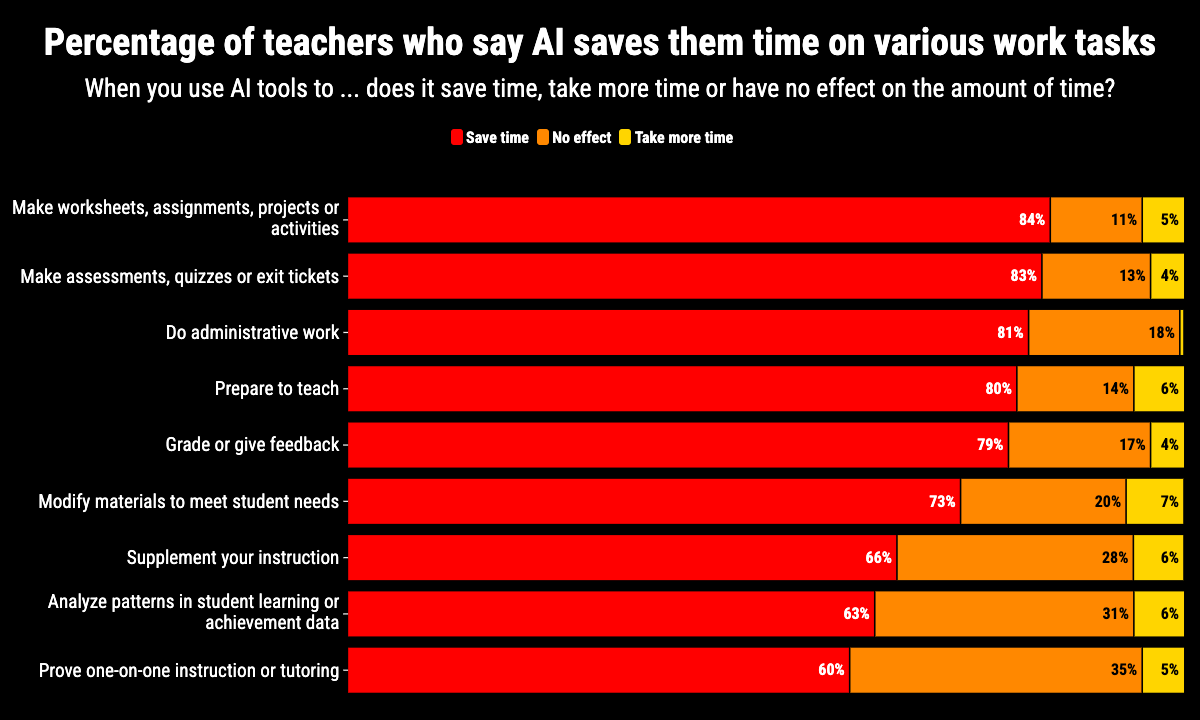
Nearly two-thirds of teachers utilized artificial intelligence this past school year, and weekly users saved almost six hours of work per week, according to a recently released Gallup survey. But 28% of teachers still oppose AI tools in the classroom.
The poll, published by the research firm and the Walton Family Foundation, includes perspectives from 2,232 U.S. public school teachers.
“[The results] reflect a keen understanding on the part of teachers that this is a technology that is here, and it’s here to stay,” said Zach Hrynowski, a Gallup research director. “It’s never going to mean that students are always going to be taught by artificial intelligence and teachers are going to take a backseat. But I do like that they’re testing the waters and seeing how they can start integrating it and augmenting their teaching activities rather than replacing them.”
At least once a month, 37% of educators take advantage of tools to prepare to teach, including creating worksheets, modifying materials to meet student needs, doing administrative work and making assessments, the survey found. Less common uses include grading, providing one-on-one instruction and analyzing student data.
A 2023 study from the RAND Corp. found the most common AI tools used by teachers include virtual learning platforms, like Google Classroom, and adaptive learning systems, like i-Ready or the Khan Academy. Educators also used chatbots, automated grading tools and lesson plan generators.
Nearly 60% of teachers agreed that AI improves the accessibility of learning materials for students with disabilities. For example, some kids use text-to-speech devices or translators.
More teachers in the Gallup survey agreed on AI’s risks for students versus its opportunities. Roughly a third said students using AI tools weekly would increase their grades, motivation, preparation for jobs in the future and engagement in class. But 57% said it would decrease students’ independent thinking, and 52% said it would decrease critical thinking. Nearly half said it would decrease student persistence in solving problems, ability to build meaningful relationships and resilience for overcoming challenges.
In 2023, the U.S. Department of Education published a report recommending the creation of standards to govern the use of AI.
Researchers have found that AI education tools can be incorrect and biased — even scoring academic assignments lower for Asian students than for classmates of any other race.
Hrynowski said teachers are seeking guidance from their schools about how they can use AI. While many are getting used to setting boundaries for their students, they don’t know in what capacity they can use AI tools to improve their jobs.
“There aren’t very many buildings or districts that are giving really clear instructions, and we kind of see that hindering the adoption and use among both students and teachers,” Hrynowski said. “We probably need to start looking at having a more systematic approach to laying down the ground rules and establishing where you can, can’t, should or should not, use AI In the classroom.”
Disclosure: Walton Family Foundation provides financial support to The 74.
