
The Idaho Digital Learning Alliance (IDLA) is one step closer to losing half its budget.
The House voted, 48-22, Wednesday to approve House Bill 940. The legislation makes several changes to IDLA’s state funding formula, including eliminating support for K-5 programs and Launchpad, an elementary literacy program. The changes would altogether cut $13.4 million from the online learning platform’s $26 million budget next fiscal year.
The vote followed months of discussion — largely behind closed doors — over reforms to IDLA that culminated in a heated House floor debate.
Created in 2002 to supplement public school curriculum with online courses, IDLA has grown beyond its “original scope,” said HB 940 sponsor Rep. Douglas Pickett. He pointed to instances where public school districts lean on IDLA for entire class sections.
“The primary purpose of the IDLA is to supplement, not to supplant, but to supplement local school curricula,” said Pickett, R-Oakley.

The bill would prohibit “custom sections” — when all enrollments in a course come from one district — unless there’s an “emergency,” such as a teacher’s unexpected departure. The bill would also eliminate state funding for driver’s education courses, but would preserve dual credit. A previous version of the bill cut funding for IDLA dual credit courses.
And the bill would require that private- and home-schoolers pay the full $445 fee for an IDLA course. However, a separate bill moving through the Statehouse would allow nonpublic school students to claim the Parental Choice Tax Credit to reimburse an IDLA course fee.
Fourteen Republicans and eight Democrats opposed HB 940 Wednesday. Rep. Monica Church, D-Boise, said she’s been an IDLA teacher for 15 years, and it’s an “essential service.” Church said she’s willing to have conversations about policy changes that would limit the scope of IDLA, but the cuts go too far.
“It’s going to impact your families, and you’re going to hear about it,” said Church, after giving each House member a handout that showed the potential impact of a 52% cut in their legislative districts.
Rep. Dan Garner, R-Clifton, said he was dumbfounded by cutting a program that “works so well” and is “successful” for rural school districts.
“If we have a problem with (students) being enrolled in a school district and then taking IDLA classes, then address that problem,” Garner said. “Don’t cut everything.”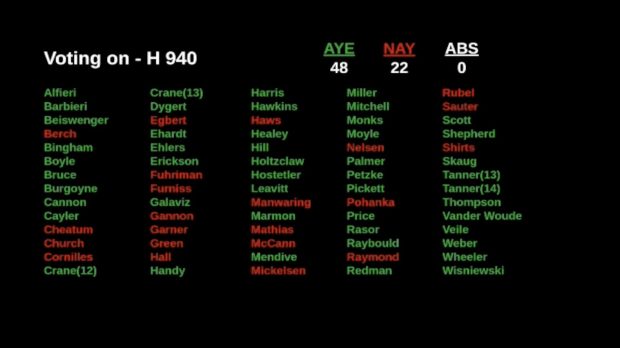
The House Ways and Means Committee — composed primarily of House majority and minority leadership — introduced HB 940 on a party-line vote Tuesday and sent it straight to the floor. This move bypassed the House Education Committee, which deadlocked on a handful of different proposals making cuts to IDLA’s budget. Ways and Means’ move also eluded the normal committee hearing process, which would require a public hearing.
Meanwhile, the budget-setting Joint Finance-Appropriations Committee already cut $13.5 million from IDLA’s budget for fiscal year 2027 — before Pickett’s policy bill had advanced to the House floor.
“The cut’s already been done,” said Rep. Dale Hawkins, R-Fernwood, who supported the bill. “This is just adding some policy to it.”
One Democrat voted in favor of the bill. Rep. Soñia Galaviz said the $13.4 million cut is “not great,” but the policy changes were “thoughtfully considered,” and the “best and most accessible” IDLA courses would be preserved.
“Folks will be able to access the vital courses, essential courses, courses that are required for graduation, the same as before,” said Galaviz, D-Boise, a public school teacher.
HB 940 now goes to the Senate. The Senate Education Committee could hold a hearing on it as soon as Thursday.
After an odd exchange, recess bill is on hiatus
A bill mandating elementary school recess is itself on at least a one-day recess.
The Senate Education Committee voted to hold House Bill 915, which requires a 20-minute daily recess in grade school and encourages “unstructured” daily breaks in middle school.
The hearing took a turn after a couple of committee questions. While presenting the bill, Sen. Ben Toews, R-Coeur d’Alene, glanced at his cellphone and said he needed to head to a second committee meeting.
Somewhat perturbed, committee Chairman Dave Lent, R-Idaho Falls, asked Toews if he was interested in the outcome of his bill. Toews said he was but said he needed to leave.
The committee then held the bill, which could come up at Senate Education’s next meeting, tentatively scheduled for Thursday.
HB 915 has already passed the House unanimously.
Senate Education gave two other proposals the green light.
Medical education. A late-session bill would carve out a new funding source to subsidize medical school tuition. Senate Bill 1420 would divert 1% of state health insurance taxes into a state medical education fund, beginning in 2028.
The state collects about $160 million in health insurance taxes per year, Lent said.
Idaho spends about $30 million per year on health education programs — including subsidies for out-of-state medical school seats.
The tax transfer would stabilize medical education funding, bill sponsors said. The medical education fund would provide a place for federal rural healthcare grants, a potential source of medical education funding, said Rep. Dustin Manwaring, R-Pocatello, a bill co-sponsor.
The bill now goes to the Senate floor.
Immigrant student costs. The committee passed a nonbinding resolution urging Congress to fully fund the cost of educating immigrant students.
Rep. Steve Tanner, R-Nampa, argued that this cost could range anywhere from $22 million to $82 million a year and is largely an unfunded mandate.
The memorial also goes to the Senate floor.
JFAC approves cash transfers to buoy next year’s budget
The Joint Finance-Appropriations Committee approved $227.3 million in cash transfers — a late-session push to buoy the state budget in case revenue doesn’t rebound in the coming months.
The state entered March with a $44.1 million deficit, after last month’s tax revenue missed projections. The shortfall looms despite budget cuts this legislative session affecting most state agencies. JFAC’s co-chairs said Wednesday that the transfers would allow the state to leave a more than $150 million cushion on the bottom line of the state budget.
The committee approved $131.9 million in transfers for fiscal year 2026 and $95.5 million for fiscal year 2027.
Gov. Brad Little recommended most of the transfers. JFAC’s House chairman, Rep. Josh Tanner had been critical of Little’s reliance on one-time transfers to balance the budget — calling them “one-time gimmicks” — but he changed his tune Wednesday.
“We’re trying to make sure we adjust some of these transfers to make sure that we have that room in case, for some reason, that revenue does not come in,” Tanner said.
The transfers include tapping interest earnings from several state funds and moving them to the general fund. This includes pulling $10.2 million from the Public Education Stabilization Fund. It also includes $65.8 million in interest earnings from American Rescue Plan Act (ARPA) funds, federal money that the state received during the COVID-19 pandemic.
JFAC also reverted pulled back operations funding for the House and Senate — 4% this fiscal year and 5% next fiscal year, aligning cuts to the legislative branch with other state agencies that took cuts this year. And the committee transferred to the general fund $5.8 million that had been earmarked for legislative office remodels.
JFAC members approved the transfers, but not without some skepticism.
Senate Minority Leader Melissa Wintrow suggested the state could instead use rainy-day funds — rather than a patchwork of cash transfers. Wintrow, D-Boise, said there’s going to be a new Legislature next year, and “it’s going to be hard to track all the Band-Aids we’ve put on the budget.”
House Bill 93 updates head to Senate floor
A House Bill 93 “cleanup” bill is heading to the full Senate after a swift committee hearing Wednesday.
House Bill 934 makes a handful of changes to the Parental Choice Tax Credit, aimed at clarifying the intent of last year’s HB 93.
But it also makes a more substantial change, which would allow students to participate in public school extracurriculars and remain eligible for the tax credit. The bill also would allow students who pay fees for Idaho Digital Learning Alliance courses to claim a state reimbursement.
The Senate Local Government and Taxation Committee unanimously voted to advance the bill Wednesday.
Sen. Ali Rabe supported advancing the bill but said she may oppose it on the floor. Rabe, D-Boise, said she’s heard concerns that public schools won’t be reimbursed for their costs when private- and home-schoolers participate in extracurriculars.
Senate urges Congress to disband U.S. Education Department
In a late-afternoon session, the Senate passed a pair of education-related resolutions.
U.S. Department of Education. The Senate passed a nonbinding memorial urging Congress to disband the U.S. Department of Education.
Essentially a letter to Uncle Sam, House Joint Memorial 19 calls the closure of the cabinet-level agency a “constitutional necessity.”
Debate was brief, and split on party lines. Senate Majority Leader Lori Den Hartog, R-Meridian, said the agency has failed to live up to its lofty goals. Sen. Janie Ward-Engelking, D-Boise, called the closure premature, and a possible threat to Idaho education funding.
The memorial passed on a 20-5, with 10 senators absent.
Community schools resolution. Also Wednesday, the Senate passed a resolution that would declare the Legislature’s support for community schools.
Senate Concurrent Resolution 126 says that the community model transforms schools into “neighborhood hubs.”
“Schools serve as trusted centers of community life and are uniquely positioned to partner with families, nonprofits, businesses, faith communities, and local organizations to help remove barriers to learning,” it says.
The resolution passed on a voice vote. It now goes to the House.

