
The House Education Committee introduced two new proposals Thursday — the 60th day of the legislative session.
School funding flexibility. A new bill would give public schools flexibility over state funding — if they meet academic and financial performance metrics.
Sponsored by Rep. Douglas Pickett, R-Oakley, and House Majority Leader Jason Monks, R-Meridian, the bill would set different benchmarks for school districts and charter schools to qualify for “earned autonomy.”
Districts could have flexibility to spend state discretionary and categorical funds along with salary apportionment if they meet the following benchmarks:
- A composite proficiency rate on the Idaho Standards Achievement Test (ISAT) in the top 20% of districts statewide or proficiency rates in math and English language arts 15 percentage points higher than the statewide average
- A proficiency rate of 75% or higher on the spring Idaho Reading Indicator (IRI) or a 15% reduction in students scoring below proficient on the IRI
- A graduation rate three percentage points higher than the statewide average or the percentage of graduates who achieve a postsecondary degree or certificate is five percentage points higher than the statewide average
It’s unclear how many districts would qualify under all three categories. But 35 districts met just one of the requirements — 75% or higher on spring IRI scores — during the 2024-25 school year, according to an EdNews analysis.
Charter schools would have to meet fewer benchmarks to qualify for earned autonomy. Charters would have to:
- Be in good academic, operational and financial standing, according to their authorizer.
- Post annual audits without “significant findings” or “going concern” disclosures.
- Demonstrate “evidence of strong academic results,” including “above-state average growth or proficiency” on the ISAT. This requirement would not apply to charters with 100% at-risk students.
The House Education Committee unanimously voted to introduce the bill. It comes after the committee introduced a similar bill that applied only to charters, and members debated whether it was fair to exclude school districts.
“We heard a lot of feedback about how we’re treating all schools,” Pickett said Thursday. “As a result of that, we collaborated, we got together, we worked and we came forward with this proposal.”

Memorial on undocumented students. Also Thursday, Rep. Steve Tanner proposed a joint memorial asking Congress to reimburse states for the cost of educating undocumented students.
Tanner, R-Nampa, said educating undocumented children is an “unfunded mandate.” The 1982 Supreme Court decision in Plyler v. Doe established that a state cannot prevent undocumented children from attending public schools without a substantial state interest.
“Principles of fiscal federalism support the proposition that when federal policy decisions generate substantial financial obligations for states, the federal government should provide commensurate funding support,” the memorial says.
It follows Tanner’s unsuccessful proposal this legislative session that would have required the Idaho Department of Education to collect data on the immigration status of students. The bill failed on a tie vote in the House Education Committee.
‘Harmful materials’ rewrite bills advance to full House
Two bills that would amend the state’s “harmful materials” library law are heading to the full House.
The House State Affairs Committee passed the bills Thursday.
Sponsored by Rep. Jaron Crane, R-Nampa, and backed by Attorney General Raúl Labrador’s office, the bills would align Idaho’s law with recent federal court rulings. The Children’s School and Library Protection Act, which Idaho lawmakers enacted in 2024, imposes penalties on libraries and schools that don’t restrict material deemed “harmful” to minors.
The recent court rulings include a Texas decision that found regulating library books is a form of government speech — not a regulation of private speech. The U.S. Supreme Court declined to hear the case, allowing the Fifth Circuit Court of Appeals’ decision to stand.
“In public schools and public libraries, the State of Idaho is exercising its own First Amendment rights through its selection of curriculum and library materials,” reads House Bill 819’s statement of purpose. “Those choices constitute ‘government speech.’”
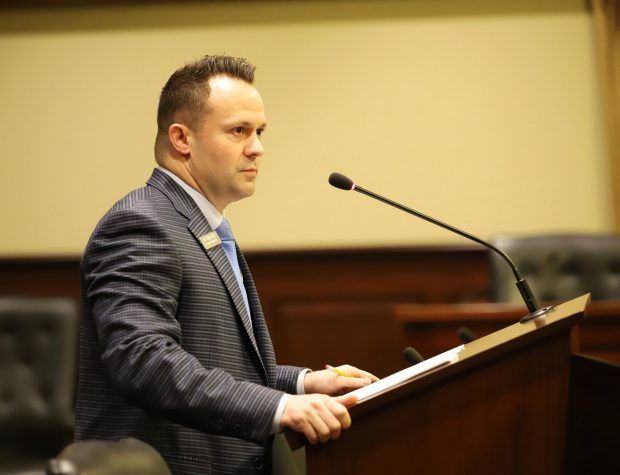
Most people who testified during a public hearing Thursday opposed HB 819. This included representatives from the city of Boise, Idaho Library Association, Community Library in Ketchum and Library Alliance of North Idaho.
Kathy Griesmyer, Boise’s director of policy and government affairs, said the bill “inappropriately” asserts that the “government speech doctrine” — a Supreme Court precedent that holds the government can express the views it favors — allows the state to “regulate private expression” by censoring library material.
“Applying the government speech doctrine to public libraries would fundamentally undermine the role of the public library and society, and instead allows a legislature to decide what is suitable reading material for all library users,” Griesmyer said.
Michelle Lippert of the Library Alliance of North Idaho argued that a proposed new definition of “sexually explicit” material is broad and will have a “chilling effect” on library collections. “People often avoid lawful speech or materials out of fear of punishment,” Lippert said. “Libraries may remove or avoid perfectly lawful books simply to avoid risk.”
The House State Affairs Committee voted 10-2 to advance HB 819. Reps. Stephanie Mickelsen, R-Idaho Falls, and Annie Henderson Haws, D-Boise, opposed it.

“I want our Idaho kids to have the ability, through the guidance of their parents, to explore ideas, to develop empathy for people that are different than themselves, that may have different experiences,” Haws said. “I see this as an additional step toward censoring particular ideas in our state.”
No committee members other than Crane, the sponsor, debated in favor of the bill.
Michael Hon, a Meridian resident and former city council candidate who led an unsuccessful effort to dissolve the Meridian Library District, supported the bill.
“What librarians seem to forget is that taxpayers are the ones that pay their salaries, keep their doors open, keep their lights on,” Hon said. “I would guarantee that a large percentage of taxpayers would not approve of this type of material in the libraries.”
State Affairs members also passed House Bill 795, a less controversial proposal that would remove a clause in the existing law that’s part of a provision shielding content with “serious literary, artistic, political or scientific value.”
Currently, the provision reads: “Nothing herein contained is intended to include or proscribe any matter which, when considered as a whole, and in the context in which it is used, possesses serious literary, artistic, political or scientific value.”
HB 795 would remove “in the context in which it is used.”
Michael Zarian, solicitor general for Labrador’s office, said removing this phrase responds to the Ninth Circuit Court of Appeal’s recent decision on Idaho’s library law. The federal court partially reversed a district court decision upholding the law.
In January, the Ninth Circuit ruled that a coalition of private schools and libraries and their patrons showed a “likelihood of success” because the bill’s context clause is “overbroad on its face” and threatens to regulate expressive activity, EdNews previously reported.
Lance McGrath, president of the Idaho Library Association, said the group was neutral on HB 795 while it opposed HB 819.
Both bills now head to the full House.
Sexual misconduct bills on hold, for a rewrite
A statewide disclosure bill for school applicants and a school employee whistleblower bill are on hold, for now.
The related bills address sexual abuse in schools — and spring from cases in several districts across Idaho. During a Senate Education Committee hearing Thursday, sponsoring Sen. Tammy Nichols alluded to the $7 million settlements the Boise School District offered in November. The settlements close a series of sexual abuse tort claims involving Gavin Snow, a former elementary school special education assistant.
“We have individuals that are being passed on into other districts and other schools,” said Nichols, R-Middleton. “The goal is to catch individuals before they can transfer into another school.”
Senate Bill 1371 would require schools to receive 10 years of disclosure statements on applicants. It also bans schools from conducting an internal review of abuse or neglect “in lieu of reporting to law enforcement,” as required by law. These requirements would apply to public and private schools alike.
Senate Bill 1372 forbids schools from retaliating against whistleblowers who report misconduct.
Nichols asked the committee to send both bills to the floor for amendment. After meeting Thursday with state superintendent Debbie Critchfield and Attorney General Raül Labrador’s office, Nichols said she had “scribbled notes” of possible amendments, with more formal fixes in the works. Nichols also said she wanted to combine the bills.
Committee members struggled to understand what the amendments would look like, and several seemed uneasy about opening up the bills to changes. They also asked why background checks are failing to flag problems.
Both Nichols and Critchfield said the background checks are inconsistent.
After lengthy discussion, Nichols agreed to start over and draft a new bill. Any new bill would need to be expedited, as the 2026 legislative session is heading into its waning weeks.
Senate Education Chairman Dave Lent promised to give a new bill a prompt airing.
“This is a this-year kind of thing,” said Lent, R-Idaho Falls.
Vaccine registry opt-in bill slated for Friday committee vote
A bill that would make Idaho’s vaccine registry into an opt-in program could get a committee vote Friday.
On Thursday morning, the House Health and Welfare Committee heard an hour’s worth of testimony on the bill — mostly in opposition. But with several more people signed up to speak, and the House floor session set to begin, the committee postponed its vote for a day.
House Bill 808 is a followup to a 2025 medical freedom law, which prohibits K-12 schools and colleges and universities — public and private — from requiring vaccines or other “medical interventions” for students, staff and visitors.
The bill asserts that all vaccinations are “voluntary” and may be “declined or refused on religious or other grounds.” This is consistent with existing law, which allows parents to opt their children out of vaccinations by turning in a note at school.
The bill also would require parents to opt in to the Immunization Reminder Information System, or IRIS, the state’s vaccination registry. Parents are now allowed to opt out of the program.
Several nurses testified in favor of IRIS, saying the system prevents double vaccinations and accurately tracks whether students are at risk during an outbreak. “I know who I’m going to contact if measles shows up in my school,” said Katie Rice, a Boise school nurse.
Doug Cameron of Hammett spoke in favor of the bill and reinforcing the existing medical freedom law. Cameron is confined to a wheelchair after suffering a severe blood clot, which he believes was caused by the COVID-19 vaccine.
“Coercion is what got me in this chair,” he told the committee.
Rep. Rob Beiswenger, R-Horseshoe Bend, is the bill’s sponsor.
Oversight plan for rural health grants heads to House floor
A House committee approved a proposal to oversee nearly $1 billion in federal healthcare grants — over concerns from hardliners who oppose taking the money.
House Bill 862 would create a Rural Health Transformation Committee, made up of eight legislators and a nonvoting gubernatorial appointee. The panel would monitor the $930 million in federal funds flowing into Idaho over the next five years.
“I believe it’s our legislative responsibility to oversee this,” said Rep. Jordan Redman, R-Coeur d’Alene, a co-sponsor of HB 862.
Some lawmakers have already suggested using some of the money to address Idaho’s physician shortage — by funding in-state residencies for medical school graduates or acquiring the Idaho College of Osteopathic Medicine, a for-profit medical school in Meridian.
But while some lawmakers view the federal money as an opportunity, critics view it as an albatross.
Rep. David Leavitt said the federal grants were just part of the dealmaking behind the federal One Big Beautiful Bill Act passed last summer. The grants will simply add to the federal deficit, he said.
“We keep on borrowing from our future,” said Leavitt, R-Twin Falls. “We are robbing the future of their posterity.”
The House Health and Welfare Committee approved HB 862, but Leavitt joined Republican Reps. Lucas Cayler of Caldwell and Faye Thompson of McCall in opposition. The bill heads to the House floor.
House, Senate cruise through education-related bills
The House sped through its reading calendar Thursday morning, passing a handful of education-related bills, including:
- House Bill 831, which would set new rules for schools that serve as polling places during elections. In-person instruction would not be allowed in buildings serving as a polling place, but districts could operate other schools on election day.
- Senate Bill 1227, which directs the Idaho Department of Education to develop a statewide framework for using artificial intelligence in K-12 schools.
- Senate Bill 1291, a DOGE Task Force proposal that eliminates sections of education law that were never implemented or funded.
In the afternoon, the Senate quickly passed these bills:
- House Bill 731, which codifies the state’s participation in a new federal tax credit reimbursing donations to organizations that fund scholarships to public and private school students. The Senate voted 30-5 to approve the bill, sending it to Gov. Brad Little.
- Senate Bill 1339, which replaces public schools’ current requirement to send the state Continuous Improvement Plans with a new multi-year plan. The new plans would have to set “measurable goals” for student proficiency, academic growth and graduation rates, among other things. The Senate unanimously approved the bill. It now goes to the House.
- House Bill 652, which designates hunting as the state’s official state sport. The bill was proposed by Betty Grandy, a fourth grader from Twin Falls. It now goes to the governor.

