Nearly ten years after the state started paying for high school students to take college-level courses, the dual credit program has grown in leaps and bounds — and with that growth has come a need to establish guardrails and support systems.
That’s according to the results of a comprehensive review of the state’s dual credit program, which were shared with the State Board of Education Thursday at its regular meeting.
The influx of Advanced Opportunities (AO) state funding — which began in 2016 and has now grown to $24.5 million annually — has fueled dual credit growth and led the State Board to start a review process in 2023. The review discovered inconsistencies in quality and rigor from class to class, a general lack of oversight, and uneven access to dual enrollment opportunities.
Now, the State Board is considering how to rein in and improve the statewide dual credit program.
The State Board also addressed how best to prepare teachers to use AI in the classroom (more on that below).
Dual enrollment by the numbers
- 27-48% of Idaho community college enrollment is from dual enrollment students.
- 10-16% of Idaho four-year institutional enrollment is from dual enrollment students.
- 45,091 secondary students participated in dual enrollment in the 2023-24 school year.
- 92% of those students were enrolled at one of Idaho’s eight public postsecondary institutions.
- $24.5 million state dollars invested into dual credit courses annually.
- $4,625: The amount of state money students in grades 7-12 can put toward dual credits, Advanced Placement exams, workforce training and more under the Advanced Opportunities (AO) program.
What went into the dual credit program review
The review combined findings from state and national reports, academic literature, and “extensive” stakeholder input gathered through 20 listening sessions. Those stakeholders included high school teachers, counselors, dual credit program leaders, postsecondary faculty, students and parents.
Plus, an independent internal auditor of dual credit programs at Idaho’s postsecondary institutions was conducted to assess the program’s fidelity to Board policy and sound financial practices.
You can read the review in full on page 107 of this document.
An influx of funding brought “pain points” as dual credit offerings grew
The review found that the state’s AO funding has been a double-edged sword: “Idaho’s student-first approach to funding via AO has provided many opportunities for students and has significantly eased financial concerns. At the same time, the increased pressure for more dual credit across the state has led to additional pain points.”
Those pain points include:
- Some private universities/colleges not accredited/following policy: Several private postsecondary institutions offering dual credit are not accredited, and are not required to follow Board policy or submit data to the state for oversight purposes.
- No staff member overseeing dual credit program: No State Board staff members are dedicated to overseeing the program, so “there is limited capacity to ensure institutions” meet requirements.
- Dual enrollment teachers have varying qualifications: This has led to concerns about quality and rigor of dual credit instruction.
- Students may accumulate credits that do not apply to their chosen field of study leading to elective credits that do not always contribute meaningfully to their education goals. Accumulating excess credit can, in turn, cause students’ financial aid to be jeopardized years later.
- Uneven access to dual credits: Students from underrepresented groups, including rural, first generation, and those from low-income backgrounds, may face barriers to participation, such as limited course availability and a lack of awareness or guidance. Additionally, rural teachers have less access to in-person graduate education programs, which they may need to become qualified to teach dual enrollment classes.
- Dual credit students may miss out on high school experience: The focus on dual credit coursework and familial pressure to maximize AO funding can lead to students missing out on extracurriculars, electives, or opportunities for broader personal and social development. This narrowing of the high school experience could potentially limit students’ overall educational growth and well-roundedness.
The reviewers’ recommendations include:
- Adopt a strategic vision: Proposed Strategic Vision: Idaho’s dual credit program enhances student self-advocacy, learning, and success by promoting purposeful, high-quality college courses and course sequences that provide students with a route into a broad array of postsecondary destinations in Idaho, whether academic or career-technical.
- Establish clear metrics for success: These metrics should go beyond simply measuring the quantity of dual credits earned. Instead, they should emphasize the quality, relevance, and accessibility of dual credit opportunities.
- Develop and implement a “credit with a purpose” framework: Staff should be directed to work with institutions, secondary partners, and stakeholders to develop a “Credit with a Purpose” framework that includes structured course sequences aligned with students’ educational and career goals.
- Advocate for organized systems: The Board should advocate for funding that promotes “systemness,” in particular: a statewide dual credit registration system and a statewide transcript platform.
- Establish regional partnerships: The Board should require institutions and high schools to form regional collaborative partnerships with clear roles, expectations, and opt-out provisions, ensuring equitable access to dual credit opportunities for all students across Idaho.
- Require NACEP accreditation: The Board should require all institutions offering dual credit in Idaho to receive accreditation through the National Alliance of Concurrent Enrollment Partnerships (NACEP). This accreditation will ensure that institutions meet high standards for quality, rigor, and consistency in dual credit offerings.
- Monitor and track: Board staff should develop systems for tracking dual credit offerings, teacher qualifications, and course availability statewide.
- Require financial transparency: The Board should require each institution to establish and maintain a sustainable, self-supporting financial model, if not already in place, where all dual credit funding is reinvested to support program needs, such as professional development and graduate education for high school teachers, provision of textbooks, and consistent compensation for faculty liaisons.
- Support the development of graduate certificates for dual credit teacher candidates: The Board should encourage postsecondary institutions to collaborate on creating accelerated online or high-flex graduate certificate programs in high-demand content areas for dual credit teachers, ensuring they are well-equipped to deliver high quality instruction that meets the needs of both high school students and postsecondary institutions.
In June, the State Board will vote on whether to adopt the recommendations.
Board addresses AI in the classroom: “This is transformational”
The State Board also discussed the need for more teacher training on artificial intelligence.
“For the 30,000 teachers that are already in our classrooms, they need (AI training) yesterday,” Superintendent of Public Instruction Debbie Critchfield said at the State Board’s regular meeting Thursday.
Leslie Younger, a content and curriculum coordinator for the Idaho Department of Education, said the department gets many questions and concerns about AI use across K-12, and that it is one of the most-requested teacher training topics.
“Teachers are actively asking what they can do to use it, how they can use it with their students, how they can use it to improve their own practices as educators,” Younger said.
Sabrina Gary, an instructional coach in the Boise School District, shared how she’s helping other teachers think about and use AI, and how she’s using it with students herself.
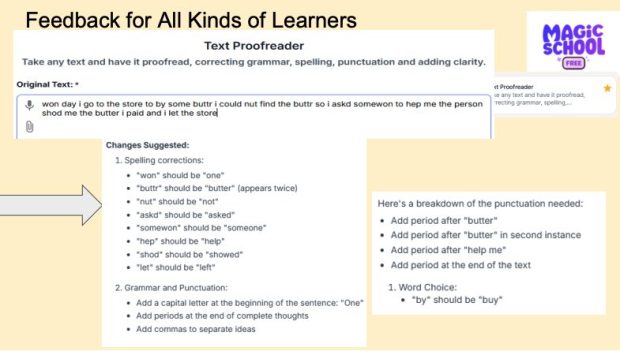
She showed trustees examples of how she uses an AI platform called MagicSchool in the classroom.
One tool, called character chat box, allows students to ask questions of historical figures like Meriwether Lewis, or characters in literature. Here’s an example:
Another tool takes a text and adjusts the reading level based on students’ needs, which Gary said can be helpful for special education students or English language learners. Here’s how AI modified a social studies text:
Or, students can paste in a chunk of their own writing and get feedback on grammatical, spelling and punctuation errors, like below:
“These are just a couple exciting opportunities of how AI is being used in the classroom, and there’s dozens of others,” Younger said.
Trustee Shawn Keough asked Younger how the AI content is validated and verified. “Who’s teaching the AI robot to talk about Meriwether Lewis?”
Younger said it would be up to teachers to preview the information beforehand and make sure it is historically correct. “That would be a responsibility of the teacher,” she said.
Critchfield said Keough’s question is “one of the most important ones in this whole conversation about AI — who’s generating it? … We must ask ‘Is that the right answer?’ because AI doesn’t know if it got it right.”
Critchfield said AI can be a great tool, but there are ethical questions to consider as well.
Trustee David Turnbull asked if someone at the State Board is the “point person” on AI.
Heidi Estrem, the associate academic officer for the State Board, said it’s been “kind of a shared responsibility right now. We don’t have one person. That’s something we’ve considered, but don’t yet have the capacity.”
“I think this is transformational,” Turnbull said of AI. “And anything that’s transformational can be transformational for the good and it can also be transformational for negative things. It’s come at us so fast that I just encourage the state to be really focused on how we’re using this in our school system.”