Part two of this article, covering the Legislature’s debate over using rainy-day funds, will be published later this week.
Some public school leaders are preparing to cut their budgets if lawmakers keep state funding flat next school year — even though K-12 is exempt from nearly all statewide cuts.
Budget-setting lawmakers this month advanced a $2.77 billion public school funding bill for 2026-27. It’s roughly the same amount the state appropriated this school year. And so far, brick-and-mortar public schools have been shielded from proposed spending cuts that apply to most state-funded agencies and institutions.
But stagnant funding is effectively a reduction amid increasing costs to operate public schools — costs for utilities, employee insurance, computer software, classroom supplies, fuel and other items affected by inflation.
“The cost of doing business has outpaced state funding,” said Republican state superintendent Debbie Critchfield. “Even a flat budget is a cut.”
Public school advocates have pointed to state savings accounts as an option that could spare K-12 from cuts. But Idaho’s $1.3 billion stockpile of reserve funds remains mostly untouched as Republican Gov. Brad Little and the GOP-dominated Legislature consider other ways to balance the budget amid a revenue shortfall. The governor and legislative leaders argue these savings should be used only in a recession.
This means school leaders will have to cover increasing costs by cutting their own budgets, leaning on local reserves or asking property taxpayers for higher supplemental levies.
School leaders hope to counter ‘held-harmless’ messaging from the Statehouse
The Bonneville School District is planning staff cuts to make up a projected shortfall estimated at $5 million to $6 million. The shortfall is tied to increasing costs for utilities, food and employee health insurance, according to Superintendent Scott Woolstenhulme.
“We are cutting our budget. I think that’s probably true of almost every district in the state,” Woolstenhulme told a group of public school trustees last week.

Woolstenhulme was a panelist for a workshop on “overseeing budget reductions” hosted by the Idaho School Boards Association. The advocacy group, composed of trustees from across the state, gathered in Boise for ISBA’s annual “Day on the Hill.”
Part of the workshop focused on how districts and charter schools could implement cuts in ways that minimize effects on students. The other part focused on how trustees will explain to patrons why cuts are necessary — particularly as state leaders paint a rosier picture of K-12 funding ahead of this year’s election.
Brick-and-mortar public schools are exempt next fiscal year from 5% budget reductions affecting most state agencies, including colleges and universities. The proposed cuts — including 3% from Little and an additional 2% from budget-setting lawmakers — come after state revenue underperformed over the last year, while $453 million in tax cuts and credits took effect. The Legislature passed the GOP-backed tax cuts, and the governor signed them into law.
During his State of the State address last month, Little touted a 70% increase in state support for public schools since he took office in 2019. And he promised to protect “classroom funding” from the budget cuts. Legislative leaders have also said they’re pushing to hold the K-12 budget harmless.
“My message to the Legislature has been very simple: Don’t you dare cut public education,” Sen. Kelly Anthon told ISBA members last week. The Rupert Republican is the Senate’s president pro tem.
Critchfield said she’s “thrilled” that state K-12 funding isn’t going backward. Her top priority this legislative session is keeping the public school budget flat, and she’s been successful for the most part.
Still, public schools won’t be immune from the impact of the state’s tightening budget:
- The $2.77 billion public schools bill, which the Joint Finance-Appropriations Committee (JFAC) approved on Feb. 13, represents an $18 million increase, or 0.7%. But it doesn’t account for cuts that could come later in the legislative session, including a $33 million reduction to virtual public schools and the state’s online learning platform.
- K-12 will get about $24 million less through the state’s attendance-based formula, which distributes funds based on “support units.” The metric essentially represents the cost to operate a classroom, and next year’s calculation assumes a small enrollment decline. Fall enrollment this school year was down 1%.
- Public schools that aren’t on the state’s employee insurance plan won’t be fully funded for benefit cost increases. While schools that participate in the state plan will get an additional 14.4%, those on a non-state plan will get 10.8%. The unfunded benefits total $9 million statewide, although the local effects will depend on how much each district’s insurance costs change. Some could be higher or lower than 10.8%.
- Budget cuts to other state agencies likely will trickle down to K-12. Taking 5% from the Division of Career Technical Education, for instance, could defund 164 CTE programs in public high schools, according to the governor’s office.
- And the K-12 budget doesn’t include an increase in discretionary funding, which public schools use for operating costs.
Anne Ritter, a trustee at Meridian Medical Arts Charter High School and former West Ada school board member, said during last week’s workshop that local leaders will have to explain these “whys” to their parents and staff.
“I don’t think a lot of people think that a ‘held-harmless’ budget is something that’s difficult for all of us to deal with,” she said.
School operations funding remains flat amid inflation
Along with Bonneville, administrators in the Coeur d’Alene, Nampa, Middleton, Kellogg and Grangeville school districts have said in recent weeks that they’re weighing budget cuts and/or increased supplemental levies.
Some administrators pointed to static state discretionary funding. Public schools won’t see an ongoing increase in discretionary funding for the second consecutive school year under JFAC’s proposed budget.
Schools typically use state discretionary dollars for operating costs like utilities, maintenance, supplies and other expenses affected by inflation. They also use it to supplement employee pay and benefits when state funding falls short of their staffing needs.
“Flat isn’t really flat,” Stephany Bales, executive director of community relations for the Coeur d’Alene School District, told EdNews by email. “We’d still be looking at budget reductions as inflation and operating costs (i.e., insurance) increase.”
The last time lawmakers made a permanent increase to discretionary funding was an additional $47 million ahead of the 2024-25 school year. Since then, inflation is about 3%, according to the U.S. Bureau of Labor Statistics’ Consumer Price Index.
The Nampa School District will have to make “significant cuts” if discretionary funding is flat again, said Matthew Sizemore, Nampa’s director of community and media relations. On top of increasing power and gas prices, software costs are up between 5% and 10%, he said by email.
“And none of the products we buy for supplies have gotten any cheaper,” he added.
But what about the 70% increase to public schools since 2019?
The 70% increase to public schools since 2019 was largely driven by targeted investments — facilities, teacher pay and literacy — and local leaders have limited flexibility to spend this money.
The $1 billion that districts got for facilities two years ago can be spent only on capital building projects, and $78 million in annual literacy money must support improving reading outcomes.
“They’re not fungible,” Critchfield said. “There’s no flexibility within the categories.”
A school district in the Treasure Valley, for instance, can’t use money earmarked for literacy to pay its bill from Idaho Power, which increased its rates 7.5% this year.
Previous state increases also fulfilled needs that local taxpayers had covered. Last year, districts requested $234 million in bonds and levies during the May and November elections. That was a 67% decrease since the record-setting March 2017 election when districts asked for $715 million.
And the state has yet to address a glaring hole in local budgets: an estimated $100 million gap between what districts spend on special education and what they get from state and federal governments. Grangeville’s interim superintendent, Amanda Bush, said last week that local funds cover 75% of the newly created district’s special education costs.
For Critchfield, this problem traces back to a familiar foe: the state’s antiquated school funding formula, which hasn’t had a major upgrade since 1994. “How we do the funding has not kept pace with what the actual day-to-day operations of a school look like,” she said.
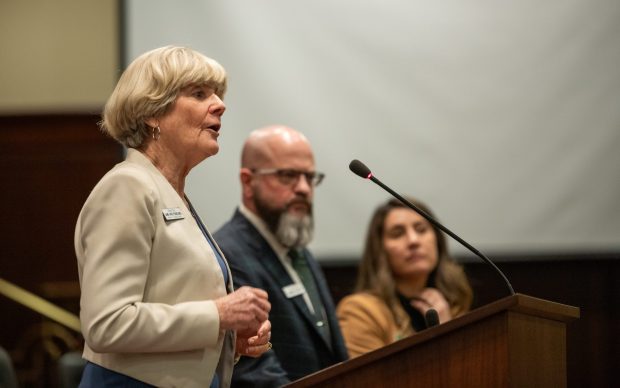
There won’t be any major formula changes this legislative session. But in the short-term, Sen. Janie Ward-Engelking worries that a flat K-12 budget will shift the burden to fund public schools back onto property taxes — the “most onerous tax of all,” she said. A Boise Democrat and longtime JFAC member, Ward-Engelking has pushed Republican leaders to cover schools’ increasing costs using state reserves.
“We’re not using this bucket of money, but districts are going to have to run more levies,” Ward-Engelking told EdNews. “It’s a cost shift.”