
(Updated, 9 p.m. Friday, to clarify that Rep. Wendy Horman drafted legislation to consolidate the STEM Action Center under the Workforce Development Council. Corrected, 9:23 p.m. Friday, to reflect that that the University of Utah’s medical education partnership is with Idaho State University, not the University of Idaho.)
Republican legislative leaders tried to tone down deficit concerns during a Legislative Council meeting Friday in Boise.
Bipartisan leaders from the House and Senate met at the Statehouse, where they announced key dates for next year’s session and heard reports from budget analysts and interim policy committees. The meeting also gave lawmakers a chance to weigh in on Idaho’s revenue dilemma — and this summer’s response, led largely by the governor’s office.
Last month, Gov. Brad Little issued an executive order directing agencies to make 3% holdbacks — midyear spending cuts — to avert a nearly $80 million year-end deficit. This month, the Republican governor’s office told agency directors that the cuts will be ongoing.
The directives come as sales tax revenue has missed targets in recent months, and after Statehouse Republicans this year passed $453 million in tax cuts and tax credits. Altogether, Idaho could collect $418 million less tax revenue than expected this fiscal year, which ends June 30, according to the latest forecast from state budget analysts.
Co-chairs of the Legislature’s Joint Finance-Appropriations Committee said Friday that they’re not worried. The gloomy forecasts are based on just two months of data, said Sen. C. Scott Grow, R-Eagle. “I’m still not crying wolf yet that everything is going to be terrible.”
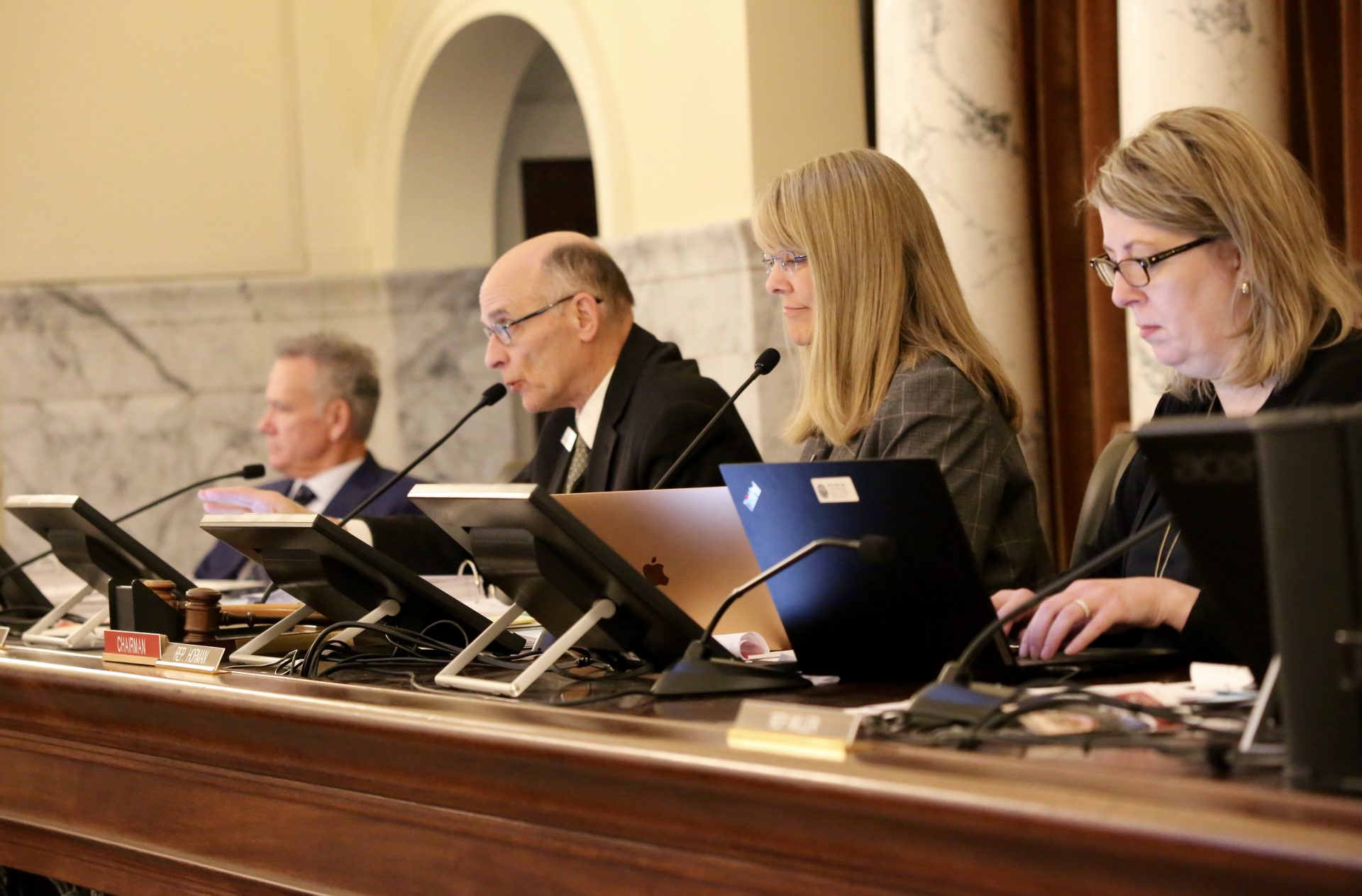
Rep. Wendy Horman, R-Idaho Falls, added, “We are not in a crisis here. These numbers at this stage are based on a hypothetical forecast. There’s one thing we know about that forecast: That it will be wrong. It will be higher or it will be lower, but it will not be exactly right.”
But the Legislature will ”have some work to do” to balance the budget, Keith Bybee, Budget and Policy Division manager for the Legislative Services Office, told the council Friday.
Little’s holdbacks should reduce general fund spending by about $80 million for the current fiscal year, Bybee said. But supplemental line items — midyear adjustments in expenses — will cost $109 million. Increased Medicaid and prisons costs are largely driving the costs, Bybee said.
Meanwhile, if lawmakers conform to federal tax changes in President Donald Trump’s “One Big Beautiful Bill,” that could cost the state another $167 million, according to an estimate from the Tax Foundation, a Washington, D.C.-based think tank.
Challenges loom over next year’s budget: Health insurance costs, for instance, are primed to spike by $3,600 per state employee, a 26% increase.
“That’s a problem,” said House Majority Leader Jason Monks, R-Meridian.
Still, Bybee lauded lawmakers for being “well-positioned” to handle shortfalls. The Legislature left $420 million on the bottom line at the end of this year’s session.
“I’m not ready to declare that there are stormy seas on the horizon,” Bybee said. “But the waters are a little bit choppy.”
Also on Friday, the Legislative Council discussed:
Medical education. House Speaker Mike Moyle threw a couple of barbs at the University of Idaho, which wants to grow its role in medical education.
Moyle’s remarks were an apparent reference to a U of I proposal, first reported by Idaho Education News earlier this month. The U of I wants to spend $8.5 million to convert 8,200 square feet at its Idaho Water Center in Boise, and partner with the University of Utah’s medical school.
Idaho State University already collaborates with the University of Utah, which reserves 10 Idaho-subsidized medical school seats for Idaho students.
Moyle, R-Star, said he was worried that the universities might be “trying to outcompete each other” on medical education, and he pointed out that Idaho State has long been the state’s lead institution in health care fields.

A working group is looking at Idaho’s doctor shortage — and ways to train more physicians. Its report is due in January.
Rep. Dustin Manwaring, R-Pocatello, the working group’s co-chair, said Idaho State and the U of I are both positioning for the long term. That means they are both exploring options, to see what might be viable. “And maybe they all will be,” he said.
The immediate question for the working group, and the 2026 Legislature, is whether to fund an additional 10 medical school seats. The Legislature passed a law this year calling for the additional seats — but not with WWAMI, a University of Washington-led partnership that takes 40 Idaho students per year. This year’s law says the state might, or might not, cut seats with the controversial WWAMI program, named for the member states of Washington, Wyoming, Alaska, Montana and Idaho.
Manwaring said he thinks the state needs to add medical school seats before cutting WWAMI. “We need to build capacity, period.”
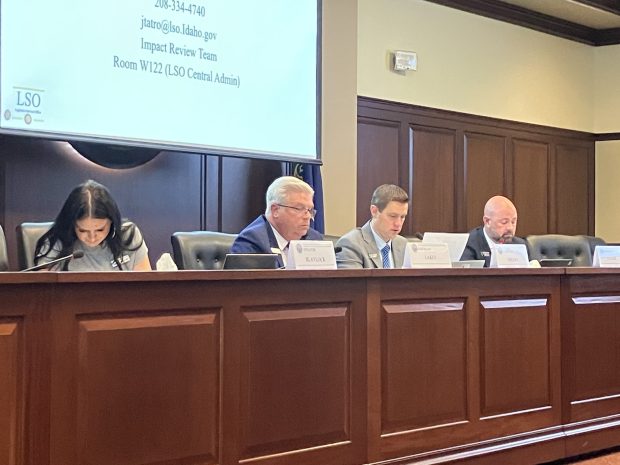
Agency consolidation. The Legislature’s DOGE Task Force next week will launch an agency consolidation effort, co-chairman Rep. Jeff Ehlers told the council.
The state has more than 220 agencies, divisions and commissions, Ehlers said, and the task force has identified 75 that will be reviewed for potential consolidation.
“Some of those may be scrutinized, and we may be OK with those,” said Ehlers, R-Meridian. “Some of those are low-hanging fruit.”
One example of the latter is the STEM Action Center, Ehlers said. Rep. Wendy Horman, R-Idaho Falls, has drafted legislation to roll the agency into the Workforce Development Council. Currently, the STEM Action center is a standalone agency under the governor’s office.
Senate Minority Leader Melissa Wintrow, D-Boise, asked Ehlers whether the task force is doing a “deeper analysis” about potential cuts, and considering what the impacts will be down the road.
Ehlers said task force members want to “engage stakeholders” such as agency leaders, and they will have a chance to weigh in on recommendations when they go before the full Legislature. And DOGE is focused on considering costs versus benefits, he said.
“We want true, significant savings, not necessarily just moving paper around.”
Legislative session schedule. House Speaker Mike Moyle is optimistic about how quickly the Legislature will complete its work next session.
Moyle and Senate President Pro Tem Kelly Anthon, R-Rupert, announced a target date to adjourn — March 27 — along with other key dates for the legislative session, which kicks off in mid-January.
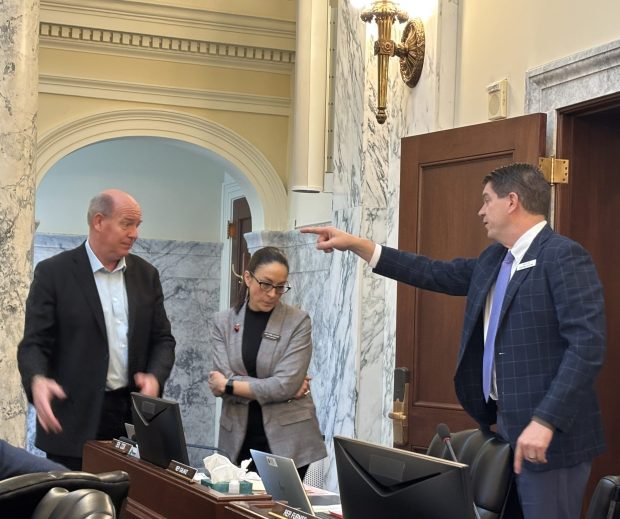
Moyle, R-Star, said lawmakers could adjourn even sooner than March 27. His reasoning: Budgets will be tight, and in an election year, legislators running for reelection will want to get home to campaign. He also said the Joint Finance-Appropriations Committee has settled conflicts that dragged out budget-setting last session.
“Generally, (when) the budgets are tight we’re able to get things done faster, because we don’t fight amongst ourselves as much,” he said. “There’s nothing to fight over.”
Here are the key dates for 2026:
- Jan. 12 – Legislative session convenes. Little delivers his State of the State address.
- Feb. 16 – Constitutional amendment deadline.
- Feb. 26 – Bill introduction deadline.
- March 6 – Transmittal deadline (the final date to move bills from the House to the Senate, and vice versa).
- March 12 – Target date to complete budget-setting.
- March 27 – Target date for adjournment, sine die.

