
Gov. Brad Little’s executive order for midyear spending cuts could avert a projected $79.9 million deficit caused by tax cuts and revenue shortfalls.
That’s according to a Tuesday revenue forecast from the Division of Financial Management (DFM). Little’s budget office said the state would collect $5.55 billion this fiscal year, $708 million less than DFM forecast in January and $854 million below the initial revenue target that the Legislature used to set the budget for this fiscal year, which began July 1 and ends June 30.
Little’s executive order attempts to ward off the deficit, DFM administrator Lori Wolff said Thursday. The Republican governor on Friday called for 3% holdbacks — midyear spending cuts — for all state agencies, except public schools, which should generate about $86 million in savings.
Much of the revenue dip isn’t surprising. Earlier this year, Little signed into law sweeping tax cuts, which will reduce state revenue by $470 million, according to DFM’s latest calculations.
But the state is also collecting less sales tax revenue than expected. July’s collections were 9.9% below projections, and 8.8% less than last fiscal year.
Wolff attributed the sales tax shortfall to more cautious consumer spending. Overall, the state’s economy is still strong, she said. The unemployment rate was 3.7% in July, below the 4.2% national average, while job growth, personal income and construction data remains positive.
“We don’t have an economy problem,” Wolff said.
The Legislature set the state’s budget using a $6.4 billion revenue target, adjusted to $5.93 billion when accounting for the planned tax cuts. DFM’s forecast suggests actual revenue will be $854 million below the original target and $375.5 million below the adjusted target, eating up carryover funds from last fiscal year and leaving a $79.9 million deficit on the bottom line.
Rep. Wendy Horman, co-chair of the Legislature’s budget-setting Joint Finance-Appropriations Committee (JFAC), noted Thursday that the DFM forecast was based on just one month of tax collections. But she applauded Little’s “smart, preemptive budget move” to order holdbacks.
“One month does not make a trend,” said Horman, R-Idaho Falls. “We’ll assess where we are again in January and see what needs to be sustained, what we need to adjust, what actual revenues are.”
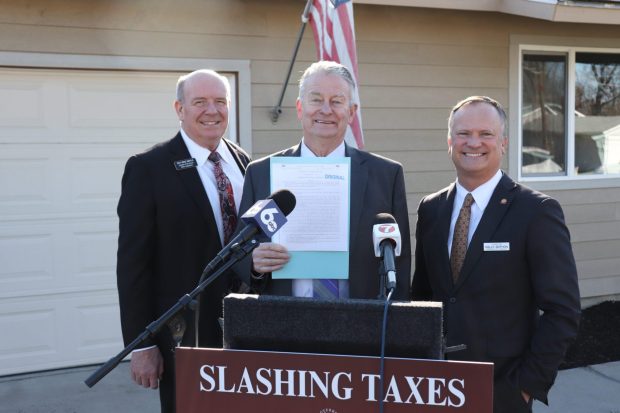
GOP lawmakers set high revenue target to make tax cuts
Aside from revenue shortfalls, DFM’s deficit prediction pointed to a suite of GOP-backed tax cuts enacted earlier this year.
The biggest reduced the individual and corporate income tax rate from 5.695% to 5.3%, sending an estimated $240 million back to taxpayers. Three other bills increased a credit for taxes on food, bolstered a property tax relief fund and created a new tax credit for private schoolers and home-schoolers.
These cuts were supported by the Legislature’s over-projection of revenue, said Boise Sen. Janie Ward-Engelking, one of three Democrats on the Legislature’s budget-setting committee. Every year, JFAC sets a revenue target for the upcoming fiscal year, which typically guides how much money will be spent throughout the session.


This year’s target — $6.4 billion — came late in the session, after much of the state’s budget had already been set and the income tax cut bill had already cleared the House and Senate. The target also surpassed a $6.23 billion revenue forecast from the governor’s office.
Projection decisions were “politically motivated,” Ward-Engelking said, and gave House Republicans a cushion to fund their priorities.
“This is a perfect storm of what shouldn’t have happened,” she said Thursday. “We over-projected our revenue and then did tax cuts way beyond what we knew was fiscally responsible.”
Republicans didn’t hide that their tax-cut goals influenced the revenue target. During a January meeting of the Economic Outlook and Revenue Assessment Committee — which recommends a revenue target to JFAC — House Majority Leader Jason Monks, R-Meridian, said the revenue number needed to be high enough to justify tax relief.
JFAC ultimately adopted the advisory committee’s $6.4 billion suggestion in March, after two stalemate votes in January.
Horman said the delay in setting a revenue target was a simple “political reality.” While the House was united behind $6.4 billion, some Senate Republicans pushed for a smaller number. Without referring to them by name, Horman said the Senate holdouts wanted to “forestall a school choice bill,” referring to House Bill 93, the private education tax credit that she sponsored and ultimately succeeded in passing.
In defense of the tax cuts, Horman manifested the Republican Party’s platform. It’s a GOP principle to “return as much of the people’s money to them as we can afford,” she said, “and only pay for the size of government that’s necessary to serve the people.”