Something didn’t add up for State Superintendent Debbie Critchfield when she heard the U.S. Department of Education on Monday denied an appeal to continue Idaho’s $45.9 million community schools grant.
“I was puzzled a little bit,” Critchfield told EdNews on Friday. “It was kind of one of those head-scratching moments.”
She worked the phone for hours to learn how the feds made the decision. In speaking with U.S. Department of Education staff, she learned that the department during the government shutdown lost an amendment removing DEI language from the original grant application, jeopardizing millions of dollars for Idaho schools.

“That’s how it was communicated to me,” Critchfield said. “During that shutdown, things had not migrated and had not made their way where they needed to be. And it appears that our amendment was one of those things.”
In a quick turn of events this week, the feds reinstated the grant to support community school coordinators at 47 rural schools in 22 school districts that connect families to local resources like food pantries and healthcare.
On Dec. 12, the federal government notified grant recipient United Way of Treasure Valley that it was canceling the Idaho Rural Scaling Full-Service Community Schools Project on Dec. 31, three years ahead of schedule. The grant has about $30 million left.
The nonprofit on Dec. 17 appealed the cancellation with letters of support from the Idaho Department of Education, U.S. Sens. Jim Risch and Mike Crapo, both Republicans, and nearly 2,000 signatures from community members in Idaho. The U.S. Department of Education denied the appeal on Dec. 29.
That’s when a puzzled Critchfield said she got to work reviewing emails and documents. She called staffers for both senators, Gov. Brad Little’s office and Kirsten Baesler, assistant secretary for the U.S. Department of Education. She pieced together that the feds didn’t have an amendment that the United Way submitted in September.
With the amendment and appeal in front of U.S. Department of Education staff, officials reversed their decision on Dec. 31 and continued the grant on the same day it was scheduled to end.
“That has been the roller coaster that we’ve been navigating,” Megan Remaley, president and CEO of the United Way of Treasure Valley, told EdNews on Friday.
The federal government awarded Idaho’s community schools grant in 2023 during the Biden administration, which required grant writers to include elements of diversity, equity and inclusion (DEI) training.
Remaley said the nonprofit in September amended the grant to remove that DEI language to comply with new federal directives under President Donald Trump. They submitted the amendment directly to their program officer at the U.S. Department of Education and received receipt confirmation but no formal followup after that.
Remaley said the nonprofit has not done “any of the work that was of concern” regarding DEI training.
“We had submitted an amendment in September articulating that, and so we were able to revisit that promise and assurance in our appeal,” said Remaley.
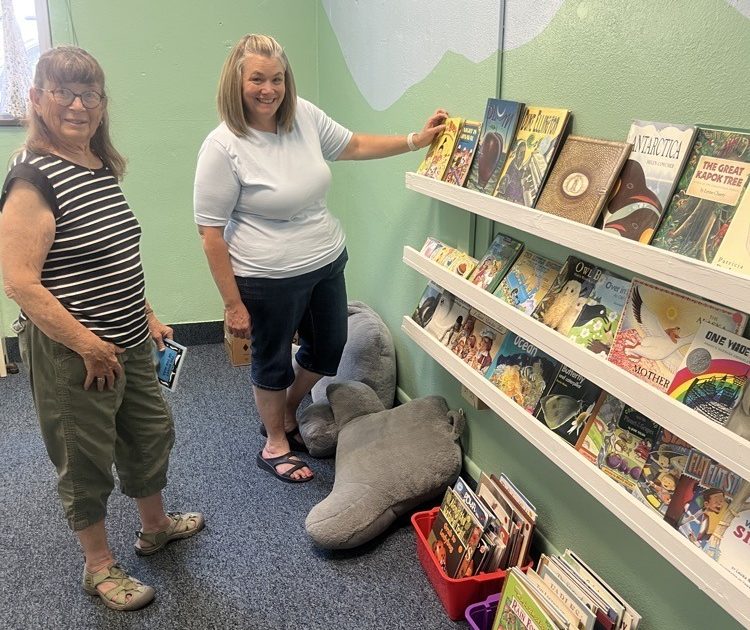
(Photo courtesy of Moscow School District)
While the continuance is good news for the families and staff members the grant supports, Remaley said the past few weeks have been disruptive and stressful as kids left for holiday break. The work, she said, is critical to the care of kids and families.
“We are disappointed that we had to navigate such disruption in a really untimely, unnecessary way,” Remaley said.
The grant supports community school coordinators and programming in rural schools across the state. The staff members help organize resources that already exist in the community.
In American Falls, the grant helps support a food bank, a free clinic and an income tax assistance program. In Moscow, it supports a community hub that provides free books, haircuts and hygiene supplies, among other programs.
“We’re not having doctors come into the classroom by any means, but the grant helps make the connections to services and other things that help support families and kids,” Critchfield said.
Basketball coaches, neighbors, grandparents, teachers and superintendents rallied together over the past three weeks to show support for the program, Remaley said, along with the “advocacy and persistence” of Critchfield.
“It seems like that persistence and really making sure that it was fully reviewed is what changed the tide for us,” Remaley said.