
Canyon County residents will have a new agriculture-focused technical high school option in the fall of 2027.
The Idaho Public Charter School Commission approved the Idaho AgriTech Academy on Thursday, unanimously and with glowing praise.
“I have been on the commission for a little over 10 years and I think this is the most impressive introduction to a charter school I’ve seen,” said Commissioner Wanda Quinn.
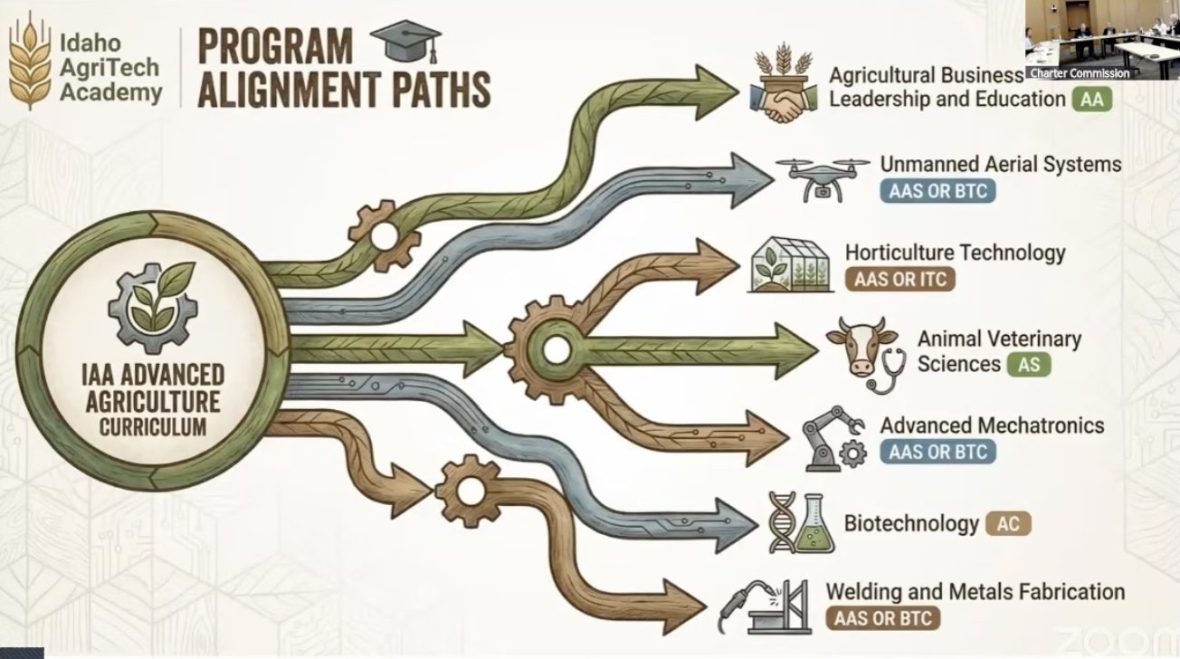
The school will be the first agricultural-focused charter in the state. Students will learn technical skills needed in the agricultural industry along with business and technology-driven courses.
“The next generation of agriculture leaders will need a very different skill set than those in the past,” said Sue Lux, the school’s founder and administrator.
The school plans to start with 300 students in grades 9-11 and then grow by 100 students and and add grade 12 in its second year.
“We envision our students as globally minded, locally rooted leaders, closing the generational gap in agriculture through curiosity, innovation, and commitment to sustainability and community,” the founding board’s vision statement reads.
AgriTech already has an agreement with the College of Western Idaho to offer dual enrollment and other early college opportunities.
The board is looking at two facilities, one in Nampa, just three miles from the College of Western Idaho. The second is the former library building at the College of Idaho.
The founding board chair is Nanette Lehman-Merrill, executive director of the Idaho Charter School Association.
The school received a letter of support from MOSAICS Public School, a nearby K-8 STEM-focused charter school, saying AgriTech would be a good option for MOSAICS students. The Idaho Future Farmers of America (FFA) Foundation also submitted a letter of support.
The commission unanimously approved the school.
Chairman Alan Reed said the school exemplifies the goal of charters: innovation.
“You are to be commended, the topic is most unique,” Quinn said. “I don’t think we’ve had one focused on an industry like this.”
She suggested the school expand to North Idaho as soon as possible.
Hayden Canyon Charter hybrid proposal denied
Hayden Canyon Charter School leaders proposed a hybrid home partnership model to commissioners Thursday, who unanimously denied the expanded partnership and said current financial and academic problems need to be solved.
Students in the program would attend in-person schooling two to three days per week, then complete the rest of their learning at home with parent supervision.
School administrator, Sam Abrams argued there’s a huge market in North Idaho for hybrid programs where parents can maintain control over their students’ learning.
“We want to build a community of learners even if they’re doing some of the work at home,” Abrams said.
The proposal comes after enrollment at the K-8 school dropped from a peak of 577 in the Fall of 2024 to 413 in the fall of 2025. The school has also cycled through four administrators in the five years since it opened.
Despite the challenges, the school’s academic performance improved in 2025.

Abrams told the commission he expects significant improvements to both test scores and the school’s finances in next year’s report. The school laid off teachers and restructured its mortgage in recent months.
Despite promised improvements, commissioners were against approving new programs when the school’s current students were not meeting standards. The school also struggled financially last year.
“That’s a red flag,” Commissioner Wally Hedrick said. “In my mind, those two things are a challenge that you need to address.”
Quinn agreed.
“I think we need to see that you’re meeting the conditions to either meet or exceed for us to be talking about any other changes to your program,” she said.
Other Commission News:
- Liberty Charter and Victory Charter schools were authorized to expand their primary attendance area by two miles due to an increase in growth on the west boundary of both schools’ primary attendance zones. The schools share similar educational philosophies and busing.
- Commissioners approved the Charter Commission’s fiscal year 2027 budget with a less than 2% increase, largely due to an increase in employee benefit costs. The budget totals nearly $745,000. The commission is funded by a mix of state dollars and authorizer fees.
The commission meets every other month. Their next meeting is set for June 11 in Boise.

