
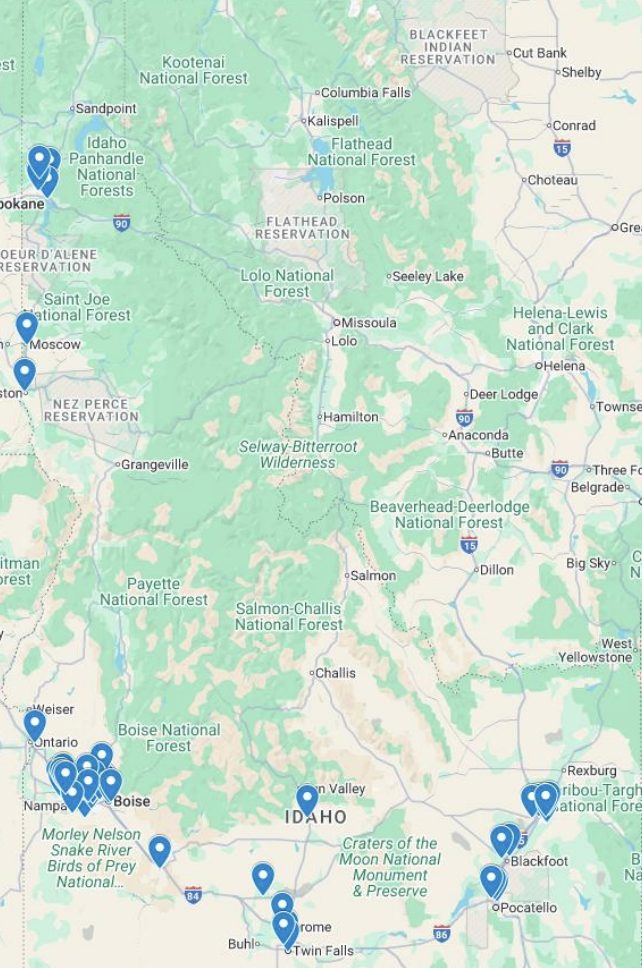
The Idaho Public Charter School Commission posted its first annual report since 2022, detailing the academic and financial health of the 59 schools it oversees.
Those schools serve about 29,500 students across Idaho.
Commissioners also renewed three charter schools’ certificates — and revisited prior confusion over their approach to renewals — during a meeting in Boise Thursday.
Annual report looks at charter schools statewide
The commission’s annual report and individual school reviews were posted late last month.
The report comes as executive director Rachel Burk enters her sixth month with the commission. Burk’s hiring followed years of instability as the commission went through half a dozen directors and lost program staff. The commission is now fully staffed.
Since its last report in 2022:
- 8 charters opened.
- 3 charters closed.
- 1 school merger occurred.
The report includes proficiency ratings for a variety of criteria, including academic performance, governance and financial health.
Here are the 2025 academic standard results for proficiency among schools the commission oversees:
- Math standards: 23.3% exceed, 38.3% meet, 31.7% approach, 6.7% do not meet
- English language arts: 25.4% exceed, 39.7% meet, 25.4% approach, 9.5% do not meet
- Literacy: 34% exceed, 40.4% meet, 17% approach, 8.5% do not meet
Read the full 2025 report here.
Charter certificates renewed
Commissioners approved renewals for three charter schools, including improvement conditions for one.
Commissioners renewed Cardinal Academy, which serves pregnant and parenting students in the Treasure Valley, with four conditions.
The Boise school has served 210 students and 101 babies since it opened in 2021. The school serves moms and dads, ages 14 to 21, by providing services like full-time child care, rides to and from school, and parenting classes.
“Parenting is hard but finishing high school doesn’t have to be,” Cardinal Academy Executive Director Jaime Garn told commissioners.
Garn shared the school’s impacts, including how one student arrived after living in a tent while pregnant. The student’s mother was incarcerated, and she had no support.
Cardinal students befriended her and some were there for her delivery.
Community is essential for Cardinal students, Carn said.
Still, Cardinal has struggled with attendance and graduating students, largely because of the population it serves.
Most students have few family members or partner support, Garn pointed out. Students often arrive behind in school and credits. Pregnant students miss weeks of school for delivery and doctor appointments.
Cardinal’s average daily attendance is at about 73%. Garn and her team are considering new curriculum, self-paced work, hybrid opportunities, and increased math and reading interventions as part of a three-year plan to address issues. The goal is to increase attendance to close to 80%.
The commission’s renewal conditions include:
- A minimum 5% increase in college and career readiness
- A 10% increase in math achievement and growth
- A 10% increase in English language arts achievement and growth
- A 4% increase in progress toward graduation for the next two straight years
Commissioners renewed certificates for Alturas Preparatory Academy in Idaho Falls and Gem Prep Meridian North without conditions.
Commission revisits approach to conditions
In December, legal counsel for the commission raised concerns about commissioners asking schools that failed to meet conditions to return to the commission in one year to report on their progress. If the condition is not met at that after a year, commissioners could start the process of revoking a charter certificate.
In doing so, commissioners took no formal action on the outstanding conditions. The commission’s attorney was unsure if the lack of action was allowable.
Burk said that after additional review, the commissioners can continue to ask schools to come back annually under the old condition language. However, new conditions will include specific annual goals to avoid the issue in the future.

