Amid a statewide budget crunch heading into the legislative session, Republican leaders Thursday signaled that K-12 won’t be targeted for cuts.
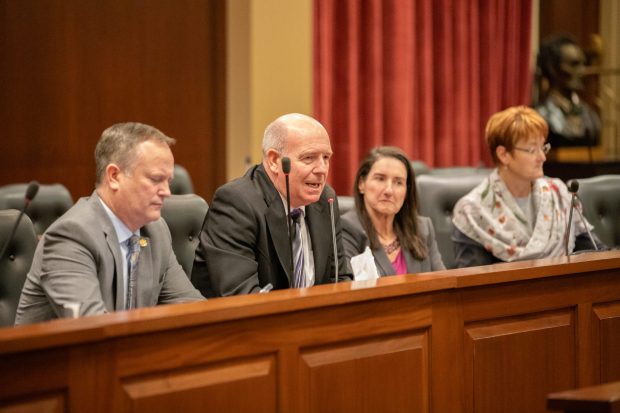
Gov. Brad Little and legislative leaders from both major parties spoke with reporters during a session preview hosted by the Idaho Press Club and the Capitol Correspondents Association. The session kicks off Monday with Little’s State of the State address, when the Republican will announce his 2026-27 budget priorities.
“We’re going to continue to balance the budget,” Little said. “We’re going to plan forward. I’m optimistic but cautiously optimistic.”
Little offered few details about how his spending plan will address the state government’s recent revenue shortfalls. But he signaled that K-12 will be safe. “You know what I did when I passed the Idaho Act,” Little said, referring to his executive order in August, which imposed 3% cuts across state-funded agencies but exempted public schools.
The budget crunch comes after sales tax collections slowed last year, at the same time that $453 million in GOP tax cuts and credits took effect. As a result, the governor and Legislature will have to resolve a $40 million deficit this fiscal year. Then they’ll have to balance next fiscal year’s budget, which currently has a $555 million gap between agency spending requests and projected revenue, roughly 10% of this year’s $5.5 billion general fund spending.
This doesn’t include the cost of conforming to federal tax changes in President Donald Trump’s “One Big Beautiful Bill Act,” which could cost the state up to $284 million, or more, depending on who you ask.
Altogether, state leaders may have to find $1 billion in savings to balance the books and leave a cushion on the bottom line next fiscal year, which starts July 1.
The $2.8 billion the state sent to public schools this year represented about half of the overall budget. But GOP legislative leaders also offered assurances that K-12 funding isn’t under threat.
“The Idaho Legislature supports public schools and will continue to support public schools, and I have not heard any chatter of trying to back off of that position,” said Senate President Pro Tem Kelly Anthon, R-Rupert. “We’re trying to keep things whole and move forward and protect our public schools.”
House Speaker Mike Moyle agreed, although he noted that there will likely be a decrease in state support tied to declining enrollment. Idaho’s school funding formula is based on student attendance, and enrollment is down 1.2% this school year.
“But education is No. 1, and we’ll do our best to take care of K-12,” said Moyle, R-Star. “We always do.”
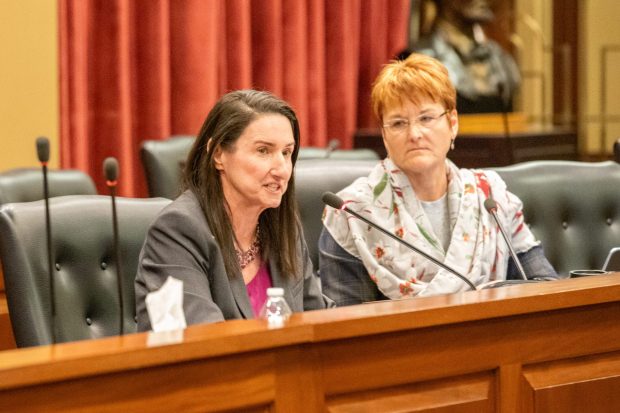
Democratic leaders were skeptical. House Minority Leader Ilana Rubel said she doesn’t “ see any way” that K-12 could be held harmless if the state conforms to the federal tax changes.
“I would love to jump on the optimism train that my good colleagues here have started,” Rubel said. “I guess I’m feeling a little bit more concerned about what’s facing us right now. We are in a hole.”
The Boise Democrat reminded her Republican colleagues of their promise that House Bill 93, the state’s new tax credit for private education, wouldn’t affect the public schools budget. “We better not see any more cuts to K-12 as long as we’re sending out voucher checks for private school tuition,” Rubel said.
Special education a ‘critical issue’ — for the future
Rubel also argued that public schools have already suffered from the budget “hole,” pointing to state superintendent Debbie Critchfield’s decision to table her $50 million special education block grant proposal.
“She cares very passionately about this,” said Rubel. “I doubt very much she would have dropped that $50 million if we were not in the budget hole that we’re in.”
The grants would have chipped away at the $100 million gap between state and federal funding and what school districts spend on special education. Critchfield, a Republican, revealed last month that she was hitting pause on the proposal, and her priority this session will be maintaining K-12 funding levels.
Little said Thursday that special education funding is a “critical issue.” He noted that state dollars could have a greater impact if not for costly rules attached to federal money that Idaho receives. The governor said he’s spoken to Critchfield and U.S. Secretary of Education Linda McMahon about dialing back the strings attached to the funding.
Asked whether he regrets not addressing the special education funding gap during recent years of budget surpluses, Little pointed to investments in teacher pay and literacy that took priority.
“There’s only so many things you could do,” he said. “As we normalize things, I think special education, behavioral health investments are two investments that we need to look at.”

Little: Measles prevention should focus on parent education
Also Thursday, Little was asked whether a new law that prohibits schools and daycare centers from quarantining unvaccinated students during a measles outbreak protects children. Little said he’s “concerned” about low vaccination rates, but measles prevention should focus on educating parents.
In 2025, the Legislature passed and Little signed into law the “Idaho Medical Freedom Act.” The law prohibits most government agencies and businesses from requiring vaccines or any other “medical intervention.”
This includes requiring unvaccinated children to stay home from school or daycare during a measles outbreak, unless they show symptoms. It can take up to four days for someone infected with measles to show symptoms, noted Audrey Dutton, an Idaho-based reporter for ProPublica.
Little responded that measles — a potentially fatal disease that has cropped up in Idaho several times over the last six months — is “terrible” and “very highly infectious,” and parents should talk to their doctor about it. But he stopped short of addressing any changes to the law.
“I’m concerned about it,” he said. “Our vaccination rate, particularly in certain parts of the state, is starting to get down to a number where we’re going to be susceptible. I think we need to continue to educate parents.”