
A last-minute bill restricting teachers’ unions passed the House Thursday afternoon, after surviving two procedural challenges Thursday morning.
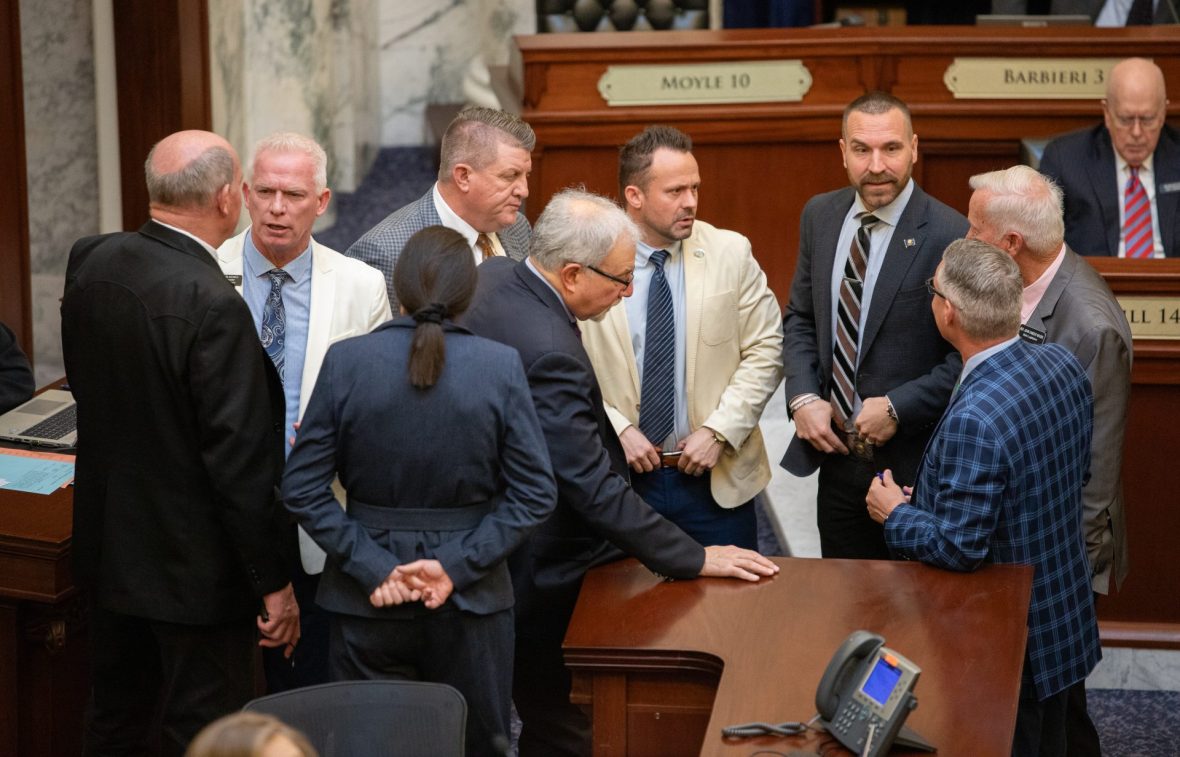
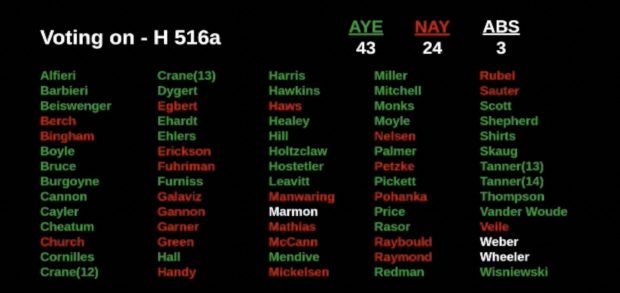
The 43-24 House vote sends the heavily amended House Bill 516 to Gov. Brad Little’s desk, as lawmakers look to adjourn for the year. Thursday is the 81st day of the 2026 session — and the final day of the session. The Senate formally adjourned for the year at 6:19 p.m.; the House followed suit at 6:29 p.m..
At issue is a controversial proposal that would make it illegal for schools to “use or authorize the use of taxpayer funds to support teachers unions.” Among other things, schools could no longer use their payroll systems to collect union dues, increase teacher pay to cover the cost of union activities, or provide a teacher paid time off for union activities.
These proposals aren’t new — lawmakers have debated them in past sessions, and earlier this session — but the issue came back to life in the waning days of the 2026 session.
On Monday, the Senate transformed a three-page bill on LGBTQ+ instruction into a 10-page union bill. The total rewrite is known in Statehouse parlance as “radiator capping” — taking one part from a car, and building a new vehicle around it. The Senate passed the overhauled bill Wednesday.
During debate over the bill, Rep. Judy Boyle, R-Midvale, downplayed the impact on teachers’ unions, which represent educators in 83 Idaho school districts. The bill would simply prevent taxpayer support of teachers union.
Rep. Soñia Galaviz, an elementary school teacher, took a much more dim view of the situation. She cited language that broadly defines “teachers union activities,” a definition that includes promoting the union or soliciting membership.
“This will kill the teachers’ association,” said Galaviz, D-Boise. “It will not let us utter a word about it.”
Galaviz attempted to move the bill to the House’s amending order — saying it should be extended to cover law enforcement and fire department unions that actively lobby the Legislature. She withdrew her motion after Republicans objected.
Earlier in the day, the eleventh-hour amendment process came under scrutiny in a pair of procedural votes.
First, the House had to vote to accept the Senate’s amendments to HB 516.
House Education Committee Chairman Dale Hawkins, the author of the original LGBTQ+ instruction bill, defended the overhaul.
“Nothing was done sneakily,” said Hawkins, R-Fernwood. “This is a good measure. It does not stop one educator from being involved in unions.”
Boyle also debated in favor of the rewrite. Earlier this year, Boyle sponsored a similar union bill, House Bill 745, which passed the House last month. Sen. Dan Foreman, R-Moscow, refused to bring the bill before the Senate Commerce and Human Resources Committee, prompting the HB 516 makeover.
“The Senate doesn’t do that very often,” she said. “That tells you how upset they were.”
House Minority Leader Ilana Rubel said the entire process has “smacked of shenanigans,” cutting the public out of the process.
“At no point has the substance of this bill … been heard by an education committee,” said Rubel, D-Boise.
Galaviz said the union bill reflects a “continual and steady erosion of trust, of respect,” for what educators do. Every legislative session, she said, “public school teachers hold their breath across the entire state.”
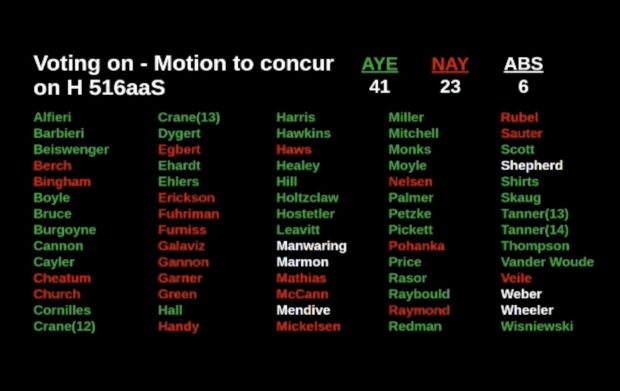
The House voted to accept the amendments on a 41-23 vote, over bipartisan opposition.
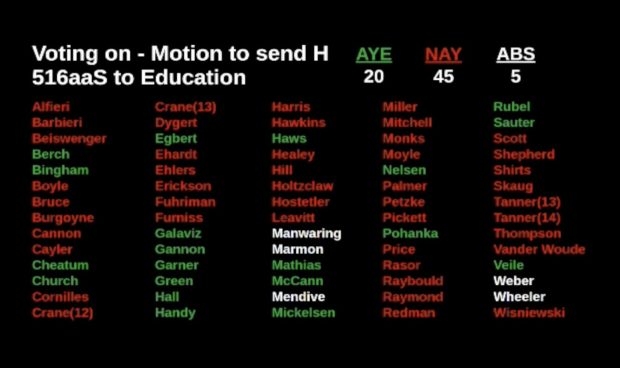
Minutes later, the House rejected an attempt to ship the bill back to House Education for a hearing.
Rep. Lori McCann, R-Lewiston, pushed for the move, noting that House Education has “never had the opportunity” to hear the issue.
House Majority Leader Jason Monks said the issue received a full public hearing, when the House Commerce and Human Resources Committee considered Boyle’s HB 745. “Let’s just move along with the process,” said Monks, R-Meridian.
McCann’s motion failed on a 20-45 vote.
Thursday afternoon’s vote turns the focus to Little.
The amended HB 516 fell short of two-thirds support in both the House and the Senate — meaning Little would have the support to sustain a veto. However, Little has not vetoed a single bill so far this session.
Virtual education cuts head to governor
Several budget bills cutting state funds for virtual education are heading to Gov. Brad Little’s desk — and they’ll look different than the proposals he brought to the Legislature in January.
The House passed three bills affecting virtual schools and the Idaho Digital Learning Alliance (IDLA):
- Senate Bill 1438, which cuts IDLA’s budget by $13.5 million and caps its enrollment next fiscal year.
- Senate Bill 1452, which sets IDLA reimbursements at $40 for courses that fulfill graduation requirements and at least $100 for courses that don’t fulfill graduation requirements. House Bill 940, which already passed both the House and Senate, changed the course fees in state code.
- Senate Bill 1444, which takes $3 million in discretionary funding from virtual schools.
Little, who has yet to veto a bill this session, will have some options when the bills reach his desk. In January, the Republican second-term governor recommended $10 million in cuts to IDLA and $23 million to virtual schools.
The Senate passed the virtual education budget bills Wednesday. The House’s Thursday debate focused on SB 1438 — the $13.5 million IDLA cut.
“I am standing on behalf of the thousands and thousands of kids, in particular (in) rural Idaho, who rely on IDLA to graduate, to get classes that they cannot normally get because they are from a very small rural district,” said Rep. Lori McCann, R-Lewiston, one of 28 House members who opposed the bill.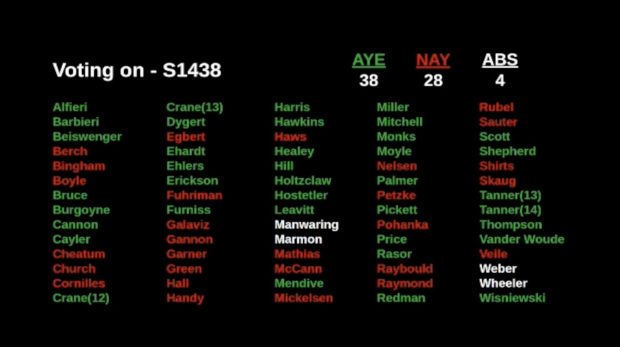
Sponsoring Rep. Elaine Price, R-Coeur d’Alene, called SB 1438 a “trailer” to House Bill 940, the policy bill that made sweeping changes to IDLA’s state funding formula. If Little signs the policy bill, IDLA will have to shutter its elementary courses and limit public school districts from using the platform to “supplant” their own courses, among other new restrictions.
But Rep. James Petzke said the budget bill isn’t a “trailer.” It was introduced before the policy bill. And HB 940’s policy changes take only about $10 million from IDLA, while the bill’s fiscal note assumes an additional cut through SB 1438, the budget bill.
“What we’re doing here with this appropriation bill is going way beyond that and taking an additional cut to a program that I think does a fantastic job, and nobody has argued that they don’t,” said Petzke, R-Meridian, who argued that the House doesn’t need to pass the “enhancement” budget.
The House passed it on a 38-28 vote, short of a veto-proof majority.
Little could sign both HB 940 and SB 1438 and cut IDLA by $13.5 million. Or he could veto the budget bill, which would cut IDLA by about $10 million — the amount he recommended.
Civics bill goes to governor
After debating for nearly an hour, the House overwhelmingly approved a bill codifying sweeping new requirements for civics instruction in public schools.
Supporters of Senate Bill 1336 argued that public schools are failing to adequately teach children about civics — leading today’s youth to have anti-American views.
“We need to do something to help get our young people back (to) loving our country,” said sponsoring Rep. Barbara Ehardt, R-Idaho Falls. “It is impossible to teach somebody to love our country by teaching them propaganda that is antithetical to how this country came about.”
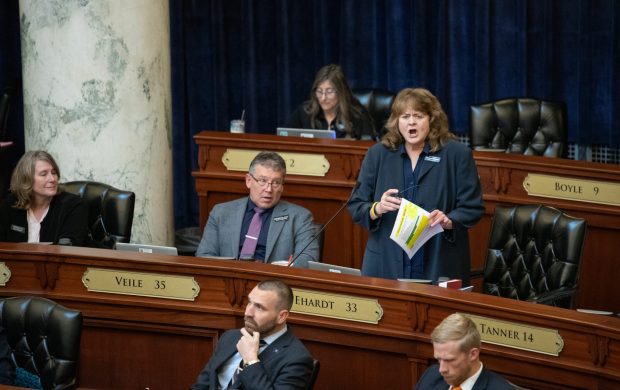
Rep. Clint Hostetler, R-Twin Falls, said that there’s an “anti-American sentiment” among the “vast majority of kids these days.” Fifth and sixth graders a century ago would “make us embarrassed at their knowledge and the history that they embraced and enveloped in academia,” he said.
SB 1336 would add far-reaching new civics requirements to state law. Students would be required to exemplify “cardinal virtues” and understand the significance of a list of “key historical documents.” The bill also includes a list of content requirements for coursework in American history.
Charter schools could ask the State Board of Education for permission to opt out of the requirements.
The bill was co-authored by Greg Wilson, state superintendent Debbie Critchfield’s chief of staff, and Samuel Lair of the Idaho Freedom Foundation, with input from others.
Rep. Monica Church, a social studies teacher, debated against the bill for about 15 minutes Thursday, pointing to the ways it would be burdensome for schools to implement. For instance, schools already teach the Idaho Constitution — a requirement in the bill — but it’s part of a general education government class. A more advanced AP course doesn’t include an Idaho section.
“Now, we are requiring those students to either take a separate course or learn it on their own, because they will be tested on it,” she said.
Church, a Democrat from Boise, said that she was previously involved in the drafting of the bill — until Wilson and Lair decided that she was “no longer needed.”
“These are the things I would have said, had I been able to be in the room when these decisions were made,” she said.
Meanwhile, Rep. Heather Scott, R-Blanchard, said teachers would have more time to implement the requirements if students could opt out of instruction on “activism, socialism, DEI training, gender confusion … how to be a victim, indoctrination, how to participate in a protest and how to undermine their parents, or systematic racism.”
This prompted an objection from Rep. Chris Mathias. “If school districts are doing these things, then we need some sort of evidence,” said Mathias, D-Boise. “But if they’re not, I’d rather us just stick to the bill, please.” 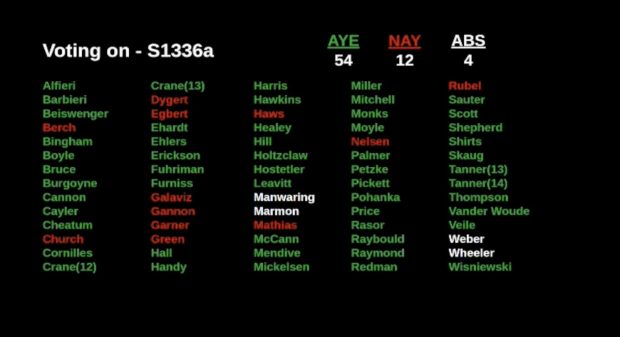
The House passed it on a 54-12 vote.
Democrats and three Republicans were opposed: Reps. Jack Nelsen, R-Jerome; Dan Garner, R-Clifton; and Shawn Dygert, R-Melba. Garner is a former school board trustee and Dygert is a former teacher.
Rep. Lori McCann, R-Lewiston, debated against the bill but voted in favor of it.
SB 1336 now goes to the governor’s desk.
House passes plan for rural healthcare grants
The Legislature’s plan for overseeing $930 million in federal healthcare grants is on its way to Gov. Brad Little’s desk.
Senate Bill 1453 would establish a nine-member committee to oversee the grants — which could be used to address medical education in Idaho, and the state’s overriding physicians’ shortage.
Four House members and four senators would sit on the committee — and at the House’s insistence, leadership is not required to put rural representatives on the panel. Little would be able to appoint a ninth, nonvoting member.
House debate was brief, with only Rep. David Leavitt speaking on the bill. Leavitt, R-Twin Falls, criticized state officials for accepting federal funds that will only add to the national debt. “It is leveraged against our posterity.”
The bill passed the House, 46-20. The Senate passed it Wednesday evening.
Updates to ‘harmful’ library materials law clears Legislature
Lawmakers Thursday gave their final approval to a bill updating the state’s law restricting “harmful” library materials after recent court decisions.
Senate Bill 1448 updates the “Children’s School and Library Protection Act,” enacted through House Bill 710 in 2024. Sponsoring Rep. Bruce Skaug, R-Nampa, said the bill fixes definitions in the existing law based on recent decisions from the Ninth and Fifth Circuit courts of appeals.
“This will keep our bill in place and enforceable,” he said.
Skaug said it could also spare Attorney General Raúl Labrador’s office from paying attorney fees in a lawsuit challenging HB 710.
The House passed the bill on a nearly party-line vote. GOP Reps. Jack Nelsen, R-Jerome, and Lori McCann, R-Lewiston, voted against it.
House Minority Leader Ilana Rubel said she opposed the changes because they didn’t include removing “homosexuality” from the existing law’s definition of “sexual conduct.”
“This captures the most innocuous references in children’s books where Heather loves her two mommies, with no nudity, no problems whatsoever,” said Rubel, D-Boise.
The bill restricts material that includes depictions of sexual conduct and “taken as a whole, appeals to the prurient interest of adolescent minors” between 13 and 17 years old.
Skaug said that the bill doesn’t restrict depictions of homosexuality alone. “It would have to be obscene actions that are taking place.”
SB 1448 now goes to the governor’s desk.

