
For the second straight year, the House has voted to create a high-needs special education program.
But this time, the vote was decisive — and probably final.
By a 49-21 margin, the House endorsed state superintendent Debbie Critchfield’s $5 million proposal — aimed at helping districts and charters pay for full-time aides or specialized care for high-needs students. The bill already passed the Senate, which means it goes to Gov. Brad Little, who publicly endorsed the proposal during his Jan. 12 State of the State address.
Tuesday’s vote culminates a significant turnaround in the Statehouse. Last year’s $3 million high-needs bill squeaked through the House by a single vote, only to die in the Senate by another one-vote margin.
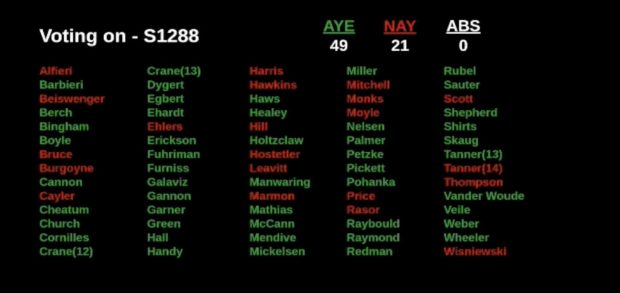
Tuesday morning’s debate, while brief, foreshadowed the one-sided vote.
Republican Reps. Barbara Ehardt of Idaho Falls and Judy Boyle of Midvale — conservatives who opposed the 2025 bill — debated in favor of the new version.
Ehardt praised Critchfield for finding a funding shift for the high-needs program — shifting money for a driver’s education account and interest from career-readiness student fund.
Boyle, a co-sponsor of the high-needs bill, says the state funding will cover costs that are now a burden for local districts and their patrons. “This is actually a property tax relief bill.”
Senate Bill 1288 would still require districts and charters to cover the first $30,000 of a student’s special education costs. A local school could qualify for up to $100,000 in state reimbursements.
Some supporters noted that the high-needs program would help address Idaho’s $100 million special education shortfall — the gap between state and federal funding and local costs.
“It’s not a leap, but it is a step,” said Rep. Lori McCann, R-Lewiston. “We need to get this going.”
Opponents said they were fearful about starting a program that will add pressure on the state budget, next year and beyond.
“I think this will be a continuous appropriation,” said Rep. David Leavitt, R-Twin Falls.
“There’s nothing more permanent than a temporary government program,” said Rep. Heather Scott, R-Blanchard.
In the end, SB 1288 passed with strong bipartisan support. Forty of the House’s 61 Republicans voted for the bill, joining the House’s nine Democrats in support.
GOP leadership bypasses committee, sends new IDLA bill straight to floor
GOP leadership Tuesday introduced a new policy bill making long-term cuts to the Idaho Digital Learning Alliance (IDLA) — and bypassing the deadlocked House Education Committee, which rejected a nearly identical version of the bill Monday.
The new version, introduced by the House Ways and Means Committee on Tuesday, might be slightly easier to swallow for IDLA and its supporters. For instance, it restores state funding for dual credit courses, and it leaves alone the online learning platform’s board of directors. The earlier version, House Bill 918, overhauled the board and added representatives from the Legislature.
The new bill also reduces IDLA’s budget by $13.4 million, instead of $13.5 million, and it strikes a requirement that the platform produce an audit for the Legislature every three years.
But these two points could be moot in the short term. The budget-setting Joint Finance-Appropriations Committee last week advanced a funding bill that takes $13.5 million from IDLA’s state appropriation next fiscal year, and it requires a “detailed report” with expenditure data to the Legislature by August.


The Ways and Means Committee voted along party lines to introduce the bill and send it straight to the House floor — skipping a public hearing. The committee is composed mostly of majority and minority leadership, with four Republicans and three Democrats.
Only Rep. Monica Church, D-Boise, debated the bill Tuesday.
“It’s a terrible idea to take any money from IDLA as it has become such a lifeblood for schools, for our rural districts, for our families,” she said.
The House Education Committee considered a few bills this session that would have slashed IDLA’s budget, ranging from a little over $9 million in cuts to completely defunding the platform. IDLA receives $26 million from the state each year.
Introducing the new bill in Ways and Means effectively bypasses House Education, which deadlocked on proposed reforms. HB 918 failed on a tie vote Monday.
Sponsoring Rep. Douglas Pickett, R-Oakley, noted Tuesday that the new bill also restricts state funding for private entities that use IDLA. It says that “private entities shall not receive any state reimbursement and shall be subject to the full course fee.” IDLA charges $445 per course enrollment.
Church asked whether recipients of the Parental Choice Tax Credit — a refundable tax credit covering nonpublic school expenses — would be able to claim the credit for an IDLA course fee.
“This doesn’t address that,” Pickett responded.
Church is the House’s minority caucus chair and Pickett is the assistant majority leader.
A separate bill that’s moving through the Statehouse, House Bill 934, would update the tax credit rules to say that paying a fee to take an IDLA course doesn’t count as being enrolled in a public school. In other words, home schoolers potentially could claim the credit to reimburse IDLA course fees.
Competing rural healthcare bills land in limbo
A House-Senate stalemate over Idaho’s $930 million in rural healthcare grants took two unexpected turns Tuesday afternoon.
First, the Senate Health and Welfare Committee abruptly rejected the House’s version of a bill to create a legislative panel to oversee the federal grants. Idaho could use some of this money to address its medical education needs.
House Bill 916 would create a nine-member panel to oversee the rural health grants — made up of four House members, four Senate members and nonvoting gubernatorial appointee.
The panel is designed to give legislators “better stewardship” over the five-year grant program, said Rep. Jordan Redman, R-Coeur d’Alene, a co-sponsor of HB 915. And he said the open-ended language is designed to allow legislative leaders to pick their most qualified members.
But Senate committee members lamented that the House bill sets aside no seats for rural lawmakers. Expertise is a factor in filling a committee, said Sen. Brandon Shippy, R-New Plymouth, but “it also has to do with advocacy.”
The committee voted to hold HB 916 — a move that left Redman and bill co-sponsor John Vander Woude, R-Nampa, visibly startled.
Minutes after the committee vote, the Senate sent its version of a committee bill to its amending order. As now written, Senate Bill 1264 would create a seven-member panel, with at least three of the six legislators coming from rural Idaho.
SB 1264 has been parked on the Senate floor since mid-February, without a vote. It’s unclear how the bill might be amended — or what might happen to it if it goes to the House.
Rewrite of parental rights law heads back to the House
The Senate quickly passed a rewrite of a 2024 parental rights law, governing medical care.
House Bill 860 is a far-reaching rewrite of the Idaho Parental Rights Act, and the bill’s Senate sponsor described the changes as a common-sense makeover.
“The state only steps in where we must,” said Senate President Pro Tem Kelly Anthon, R-Rupert. “Parents lead where they should.”
The bill makes several substantive changes:
- One change — known as a Band-Aid provision — makes clear that schools and other entities can provide a child with nonemergency medical care, from bandages to health checks. “Apparently we need to adjust the law to make sure people understand that,” Anthon said.
- Health care providers would be allowed to provide treatment to “address a serious bodily harm.”
- Staff at the state’s 988 suicide hotline can make a followup call to a child “experiencing suicidal ideation.” During committee hearings, teenagers said the hotline has cut short calls from minors who did not have parental consent for a call.
The Senate passed HB 860 on a 34-0 vote. It now heads back to the House, which needs to agree to Senate amendments to the bill.
Senate unanimously passes school sexual abuse bill
A late-session bill to address school sexual abuse investigations sailed through the Senate.
Without debate, the Senate unanimously passed Senate Bill 1412 — a response to the spate of tort claims filed against the Boise School District, involving former special education assistant Gavin Snow.
SB 1412 would add whistleblower protections for school employees who report sexual abuse. The bill also would prohibit schools from conducting “an internal review or investigation of alleged abuse, abandonment, or neglect of a child in lieu of reporting to law enforcement.”
During opening remarks, the bill’s Senate sponsor said SB 1412 is designed to bring consistency to the process of vetting applicants and hiring staffers.
“Student safety should never depend on whether the right steps are followed,” said Sen. Tammy Nichols, R-Middleton.
Introduced in Senate committee last week, the bill heads to the House.
The Senate passed a handful of other bills Tuesday:
School enrollment counts. The Senate also unanimously approved a bill that bars public schools from counting a student as enrolled if they miss the first 10 days of school.
House Bill 846 now goes to Gov. Brad Little’s desk. It cleared the House on a unanimous vote.
Sponsoring Sen. Tammy Nichols said that under current law students can be counted toward a public school’s enrollment even when a student “never actually attended school at the start of the year.”
“This can create inaccuracies in student counts,” said Nichols, R-Middleton.
CTE career-ladder funding. The Senate narrowly approved a bill allowing career technical educators and pupil service staff to count professional experience toward the career ladder, the state’s salary funding mechanism.
House Bill 849 now heads to the governor’s desk. The Senate approved it on an 18-14 vote after no debate against the bill.
Online behavior. House Bill 785 creates a definition for “inappropriate online behavior” by students, along with measures for schools to discipline the behavior. The Senate approved the bill, 32-1, and it now goes to the governor’s desk.
Anser bus funding. The Senate unanimously passed House Bill 815, which fills a $40,000 funding loophole affecting only Anser Charter School.
The Garden City school has received a 50% funding match for busing — based on a small, pilot physical education program. Other districts and charters receive a 70% to 90% match. HB 815 goes to Gov. Brad Little.
Senate moves through budget bills
The Senate also passed a few education budget bills Tuesday, sending them to the governor’s desk.
Medical education. The Senate approved a rare growth area in the state budget — 15 residencies for medical school graduates.
The $900,000 line item is part of the state’s 10-year strategic plan to address its doctors’ shortage, said the bill’s floor sponsor, Sen. Jim Woodward, R-Sagle. Idaho ranks last in the nation in physicians per capita.
Opponents questioned whether the state has the money.
“I’m concerned that we’re adding employees in a deficit year,” said Sen. Joshua Kohl, R-Twin Falls. “What we need to be doing is making structural changes.”
House Bill 920 passed, 22-11.
Federal education programs. House Bill 921 is a $517,800 “enhancement” budget, mostly from federal funds, for the Idaho Department of Education.
The money would go to school bus equipment along with the farm-to-school grant program and the Child Nutrition Program.
The Senate passed the budget bill on a 23-11 vote.
One opponent said that the Child Nutrition Program “has a lot of DEI in it.” Sen. Glenneda Zuiderveld, R-Twin Falls, said that accepting the federal funds forced a school district in her area “to make a bathroom” before trailing off and saying with a laugh that she didn’t want to say what kind of bathroom it was.
State Board endowment funds. The Senate also approved a budget bill giving universities $1.9 million in state land endowment funds.
House Bill 922 also cuts $752,900 for the Canvas Learning Management System, and it transfers four full-time risk managers from universities to the State Board of Education.
It passed on a 30-4 vote.
Bill to streamline school building permits advances
A bill that would reduce red tape for public school building projects is heading to the Senate floor.
The Senate Commerce and Human Resources Committee on Tuesday unanimously approved House Bill 721. It would eliminate the requirement that school districts obtain permits before advertising building project bids.
“We’re not sure why this was put in place in the first place,” said Sean Schupack, a lobbyist for the Idaho Association of General Contractors. “It doesn’t really make any sense.”
The House unanimously approved the bill.

