
Senators passed 5% budget cuts to colleges and universities for the next fiscal year, after a Thursday debate that revolved around whether the state should fund higher education at all.
House Bill 876 is the fiscal year 2027 “maintenance” budget for the Idaho State Board of Education and includes funding for two- and four-year colleges and universities. The budget rolls over base spending from the current fiscal year.
It also takes out 3% — Gov. Brad Little’s proposal — along with an additional 2% cut proposed by legislators. Higher education stands to take a disproportionate hit from budget cuts affecting most state agencies this year.
Sen. Janie Ward-Engelking, D-Boise, said the “maintenance” budget doesn’t keep the lights on for higher education institutions. She detailed cuts and restructuring already underway on campuses across the state.
Idaho State University is laying off dozens of employees and merging colleges. Boise State University will combine two schools and close a college. The University of Idaho is pausing its engineering program buildout, said Ward-Engelking, the longest-serving member of the Legislature’s budget-writing committee.
“It’s going to impact our children and grandchildren for years to come,” she said. “This ship will not be turned around easily and will have long term economic consequences.”

But hardline conservatives say funding higher education isn’t the state’s responsibility.
Sen. Glenneda Zuiderveld, who supported the higher education cuts, argued that colleges and universities should be funded by tuition and donations — except for U of I, the only higher education institution called out in the Idaho Constitution, she said.
“For decades now, we actually have been going against our oath of office, according to our Idaho state constitution,” said Zuiderveld, R-Twin Falls.
Sen. Dave Lent, chairman of the Senate Education Committee, countered that the Idaho Constitution was written when “higher education was not even close to what it is today.” In 1889, most people didn’t travel more than 50 miles from home, he said, and electricity was scarce.
“If you want to be successful in today’s world, you have to have an education, and I think that’s our responsibility,” said Lent, R-Idaho Falls.
The Senate voted 23-12 to approve the cuts, with half a dozen Republicans joining the Senate’s six Democrats in opposition.
HB 876 now goes to the governor’s desk.
Also Thursday, the Senate passed:
- House Bill 871, an “enhancement” for the Idaho State Tax Commission. It would give the commission an additional $903,000 in state general funds, covering increased administrative costs to implement tax cuts from the One Big Beautiful Bill and House Bill 93, the private education tax credit.
- Senate Bill 1335, which requires graduates from Idaho’s veterinary program to stay in the state after graduation. Graduates would have a four-year work requirement and would have to spend at least 600 hours a year working on agricultural animals.
House committee pushes debate on IDLA cuts to Monday
The House Education Committee punted a decision on budget cuts for the Idaho Digital Learning Alliance (IDLA), potentially opening the door for the budget-setting committee to implement the cuts itself on Friday.
After hearing public testimony and facing a time crunch to convene on the House floor, House Education members voted to hold House Bill 918 until Monday. Rep. Douglas Pickett’s bill would cut $13.5 million from IDLA’s budget.
This cut would lead to fewer opportunities for rural students, according to nine school administrators, superintendents and trustees around Idaho who testified against the bill Thursday.
Rep. Soñia Galaviz, D-Boise, said sitting through the testimony was rough, and she finds herself torn. Gov. Brad Little called for $10 million in cuts to IDLA’s $26 million budget. HB 918 would cut that funding nearly in half, with $3.5 million more than what Little proposed.
But if the committee does not adopt these cuts, Galaviz said she expects more cuts from the Joint Finance-Appropriations Committee (JFAC). Rep. Josh Tanner, the House chairman of the budget-setting committee, said JFAC plans to consider IDLA’s annual budget Friday.
“If we don’t do this, myself and others in this committee have been assured there will be a deeper cut produced by JFAC,” Galaviz said.
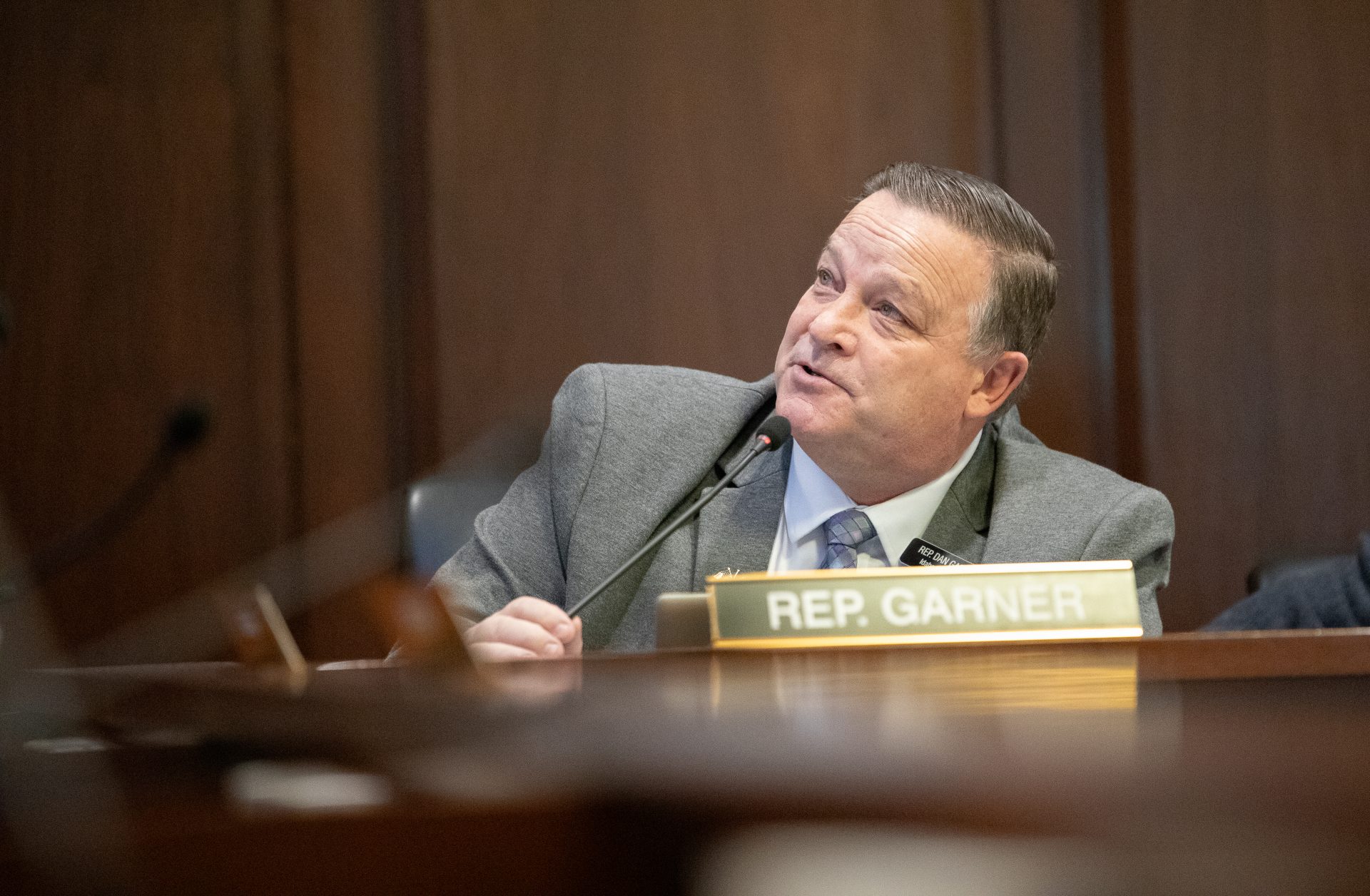
IDLA provides the “biggest bang for the buck” in Idaho’s education system, said Rep. Dan Garner, R-Clifton. He has concerns about cuts to dual credit programs and said the bill would have a detrimental impact on his district.
“I fully support IDLA and what it does for our rural communities,” Garner said.
The virtual education program provides online classes that are often used in rural school districts that can’t afford to hire teachers for some courses.
Matt Valadao, superintendent of Bliss School District, said HB 918 would cut off a lifeline for his 110 students. The bill would cut some state funding for dual enrollment courses, driver’s education and electives that expose students to college and career pathways.
“Don’t take the axe to the very bridge that helps roll students into their futures,” Valadao said.
Karen Pyron, trustee for Butte County School District, said 206 students in her district use IDLA this year, which is about 55% of their enrollment. She said HB 918 would pass the financial burden from the state onto the district.
“We will absorb them, and that’s going to be critical budget decisions for us,” Pyron said.
Luke Schroeder, superintendent for Kimberly School District, said Idaho has a long history of innovation and fiscal responsibility, and he believes IDLA reflects it.
“IDLA is a force multiplier for districts like mine,” Schroeder said. “It allows small and rural schools to offer courses and opportunities that would otherwise be impossible to provide locally.”
IDLA Superintendent Jeff Simmons told EdNews after the hearing that he was asked to make a proposal on how to meet Little’s recommendation for $10 million in cuts. Those recommendations were included in a previous bill on IDLA cuts, House Bill 622, which did not make it out of committee. But Simmons said he wasn’t consulted this time.
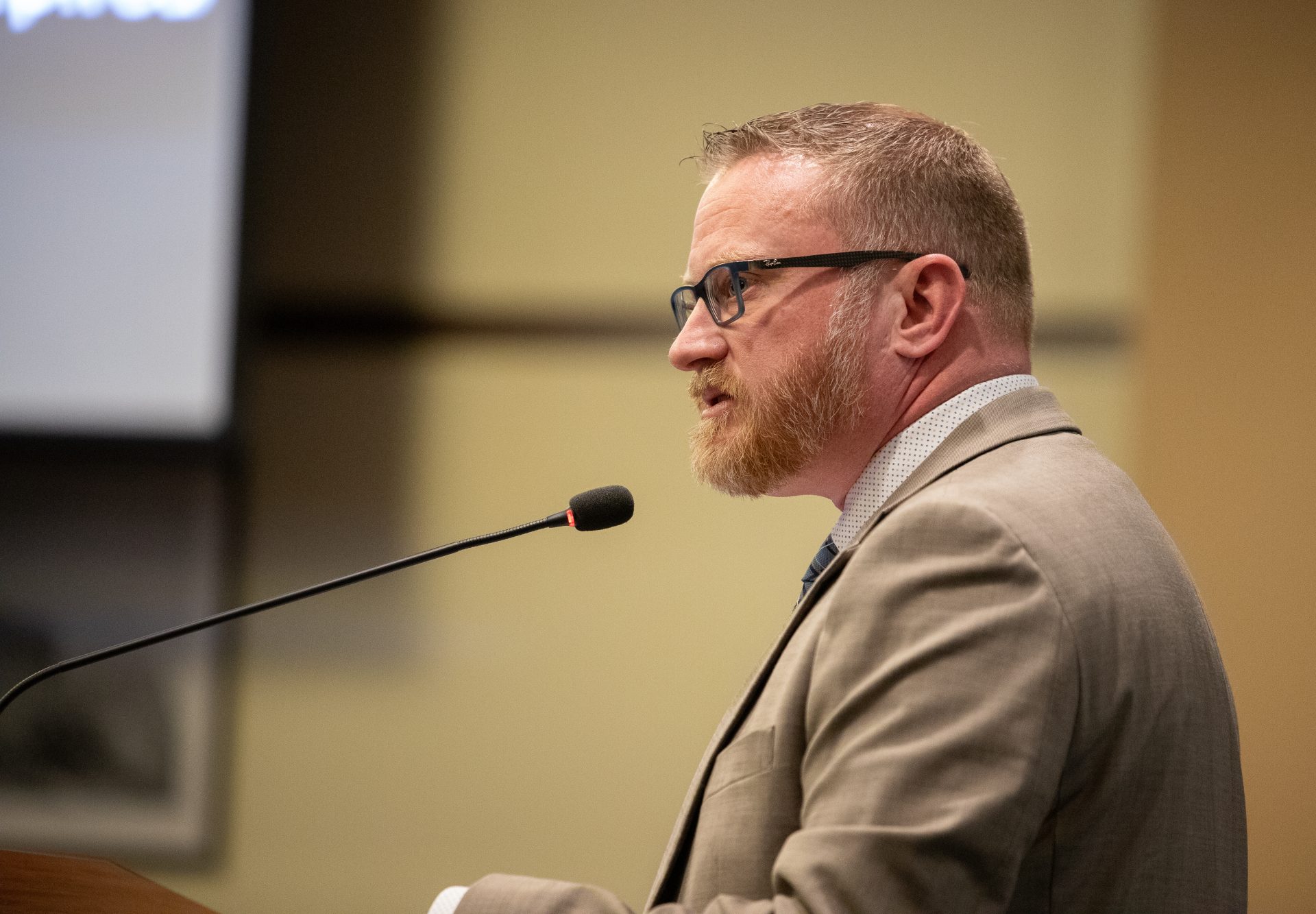
“We were not included in the conversation for this bill,” he said.
In rural communities, IDLA is not just a choice, Simmons said. It is critical for rural schools to meet graduation requirements, and HB 918 would reduce districts’ abilities to do that.
“So then you leave the districts with needs that are unmet — that’s my biggest concern,” Simmons said in an interview.
The debate on HB 918 will continue in the House Education Committee on Monday.
Far-reaching civics bill advances with promise of amendments
The Senate Education Committee advanced a far-reaching civics bill to the Senate floor, where it may be rewritten, after the sponsor said it’s “not ready.”
Senate Bill 1336 would codify requirements for how schools teach civics and government, from ideologies and historical documents to the principles that schools should reinforce — such as tenet that “the preservation of the republic depends, above all else, on the vigilant and manly spirit of the American people.”
The bill was co-authored by state superintendent Debbie Critchfield’s staff, Samuel Lair of the Idaho Freedom Foundation and others. Sponsoring Sen. Kelly Anthon, president pro tem of the Senate, said Thursday that the bill is “a worthy work in progress,” but “it’s not ready.”
Anthon, R-Rupert, asked the committee to send the bill to the Senate’s amending order. This move advances the legislation to the Senate floor, where it can be rewritten and voted on without another public hearing.
Senate Education members unanimously voted to advance SB 1336.
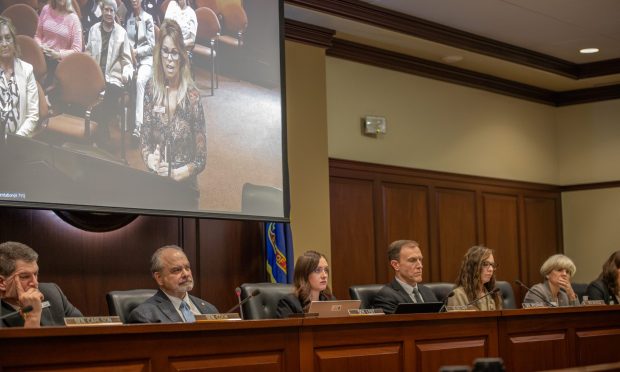
Anthon welcomed people with concerns about the bill to contact him. “I want you to be assured that you can come visit with me about the bill, and we’ll see what we can do to fix your concerns,” he said.
Public school lobbyists and administrators shared a few of their concerns Thursday.
“We really felt like some of the language was wading into areas that the Legislature has typically reserved to local school boards working with their educators and their parents on curriculum adoption,” said Quinn Perry, deputy director of the Idaho School Boards Association.
Lori Gash, social studies coordinator for the West Ada School District, said the bill’s requirement that 8th graders take a full year of western civilization would interrupt the district’s current sequencing. West Ada already teaches what’s required by the bill, but not in the order that it calls for, Gash said.
“Placing this content in 8th grade does not make sense from a scope and sequence perspective,” she said. “We teach prior and we teach post. This would be the middle, taught at the end.”
Bill barring LGBTQ+ instruction resurfaces, advances — with an amendment
A bill barring K-12 instruction on sexual orientation and gender identity resurfaced and advanced Thursday — with an amendment aimed at allowing “incidental reference” to the topics.
The Senate Education Committee last week voted to hold House Bill 516. But co-sponsoring Sen. Cindy Carlson, R-Riggins, brought the bill back with a proposed amendment. It would still ban instruction on sexual orientation and gender identity, but it wouldn’t prohibit:
“Incidental reference to such topics within the context of teaching literature, history, biology, health sciences, career technical education or other academic subjects aligned to state content standards or otherwise permitted by statute.”
The committee voted to send the bill to the full Senate floor, after some back and forth over what constitutes an “incidental reference.”
Sen. Jim Woodward asked the bill’s authors for examples of what would be allowed and what wouldn’t. “Are teachers going to know what incidental is, and are lawyers going to interpret it the same?” asked Woodward, R-Sagle.
Doug Taylor, a lobbyist who co-authored the bill with Rep. Dale Hawkins, R-Fernwood, struggled to come up with examples. Then Carlson stepped in and offered a hypothetical that conflated gender identity and sexual orientation.
“I believe that you could talk about Pete Buttigieg and the position he was in our government and what gender he has, or how he prefers his gender to be, whatever, or the fact that he’s homosexual,” Carlson said. “That’s part of history. I don’t believe that’s what we’re asking them not to teach.”
Buttigieg, previous secretary of transportation in the Biden administration and former candidate for president, is a gay man. But he doesn’t identify as a different gender.
Sen. Tammy Nichols said she understood “incidental” to mean instances where instruction just “touches on” sexual orientation and gender identity, rather than these topics being “the main focus.” The Middleton Republican pointed to “The Bluest Eye” by Toni Morrison as an example of the latter. The book “references a lot of sexual-type stuff in nature,” she said.
The committee unanimously supported advancing the bill.
Sen. Carrie Semmelroth said she supported the amended bill with reservations. The bill proposes codifying content standards written by a lobbyist and a business owner, she said, referring to Taylor and Carlson.
“I’m sure (they) are very successful in their own right, but they’re not educators,” said Semmelroth, D-Boise. “They are writing curriculum standards for schools and then putting that into code when we have processes in place that involve content experts and public input.”
New bill would clarify eligibility for private education tax credit
Lawmakers Thursday introduced a new bill that would ensure private and homeschoolers who compete on public school sports teams can claim the Parental Choice Tax Credit.
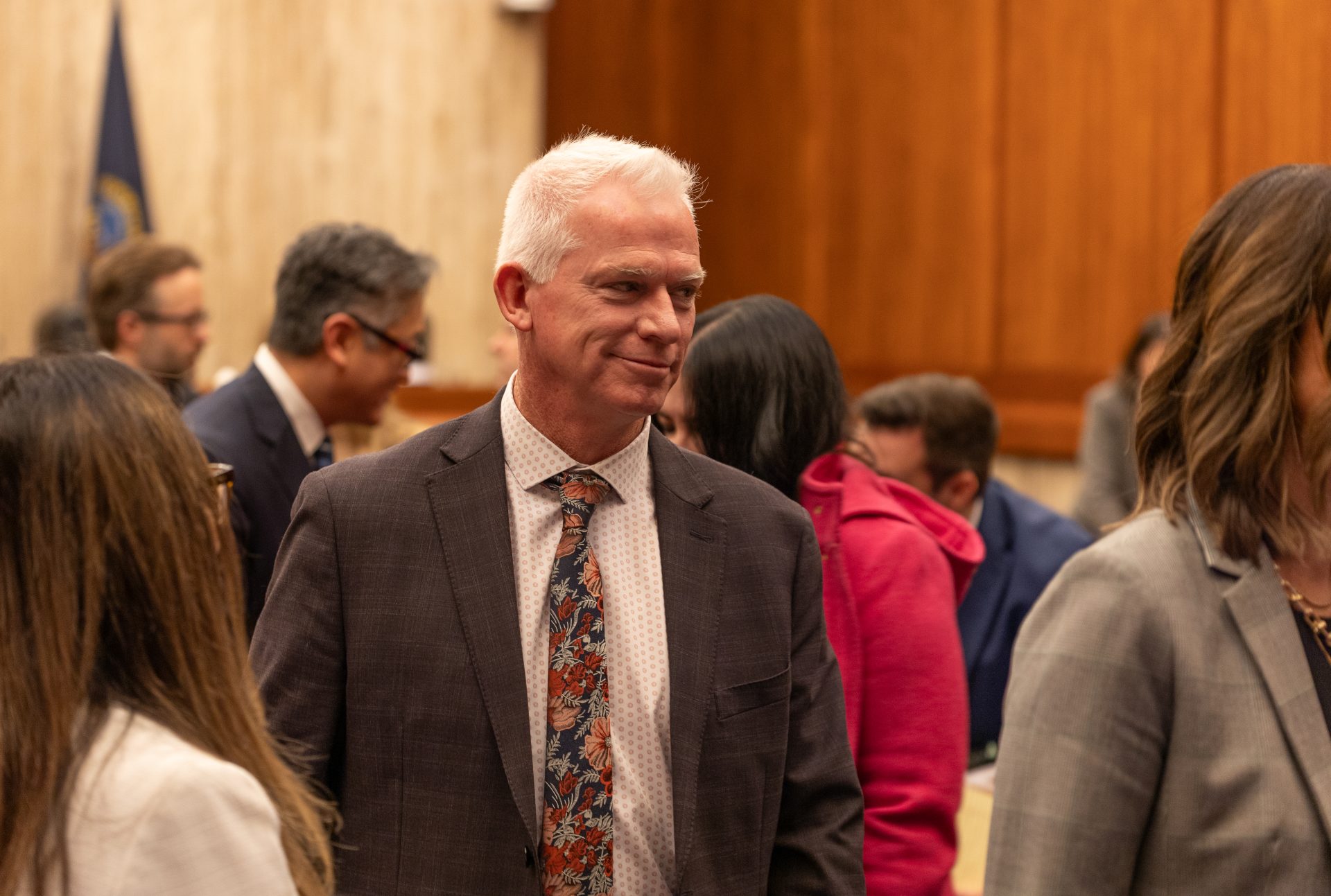
House Majority Leader Jason Monks described the proposal — introduced on the 67th legislative day of the session — as a “clean-up” of last year’s House Bill 93. Legislative sponsors and the Idaho State Tax Commission had “difference of opinion” when it came to interpreting language in the bill creating the $50 million refundable tax credit program, he said.
“This has some clarifications there to make sure that the intent of the Legislature is being followed,” said Monks, R-Meridian.
The bill would codify that participating in public school athletics and other nonacademic activities does not count as enrollment for the purposes of the tax credit. In addition, a private or homeschooler who paid a fee for an Idaho Digital Learning Alliance course wouldn’t count as being enrolled in a public school.
The changes would have a retroactive effective date of Jan. 1, 2026, meaning they would affect students who already applied for the tax credit this year.
Applications for the first round of tax credits closed March 15. The Tax Commission received 6,069 applications covering 13,568 students.
The bill would also clarify that students qualify for the credits when they’re between 5 and 18 years old — at any time during the tax year in which they apply. And it clarifies that tutoring must be for academic instruction and that curriculum can be purchased from more than one vendor.
The House Ways and Means Committee voted to introduce the bill, setting the stage for a public hearing in the coming days.
Reps. Steve Berch and Monica Church, both D-Boise, opposed a motion to introduce the bill. Berch said it should have included cuts “proportional” to budget cuts that have applied to most state agencies this legislative session.
Senate Education Committee approves three more bills
The Senate Education Committee sent three other bills to the full Senate with recommendations that they pass.
These included:
Idaho Student Safety and Educator Disclosure Act. Senate Bill 1412 targets gaps and inconsistencies in how schools share information when hiring educators, ensuring that misconduct cannot be hidden.
Under the bill, schools could not conduct internal investigations in lieu of reporting abuse to law enforcement. The bill also includes whistleblower protections.
Sen. Tammy Nichols, R-Middleton, is the sponsor.
“We don’t want our kids to slip through the cracks, and we don’t want retaliation when people are doing the right thing,” Nichols said.
Several educators told the committee that they have been retaliated against for reporting their coworkers.
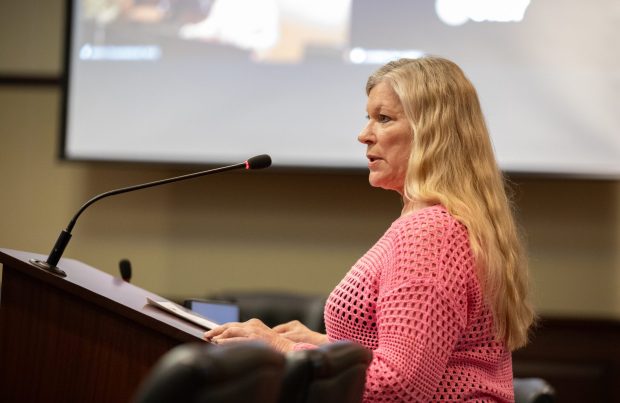
Marianne Baker, a former special education teacher in Boise School District, told the committee that in January 2025 she reported paraprofessional Gavin Snow, who died by suicide when police attempted to arrest him on sexual abuse charges. She said the district retaliated against her.
“I beg of you to recognize this bill for us as whistleblowers, for us as mandatory reporters,” Baker said. “I have been retaliated against. I lost my entire 30 year career.”
Requirements for career technical educators. House Bill 832 would replace the minimum 6,000 hours of industry experience for CTE educators with “adequate professional experience” as determined by the Idaho Division of Career Technical Education.
Sen. Cindy Carlson, R-Riggins, presented the bill. “It gives a little bit of leeway instead of specific hours,” Carlson said.
Alternative authorizations for administrators. HB 711 would create two alternative pathways for school principals and superintendents: A “grow your own” pathway and an “executive leadership pathway.”
Carlson also presented this bill.
“This bill is being introduced to help Idaho school districts that are struggling to find qualified administrators, particularly in rural areas,” Carlson said.
Several superintendents who testified said they have not experienced a lack of qualified applicants and oppose watering down requirements for administrators.
“This is not a pipeline, this is a shortcut,” Craig Wood, superintendent of the Emmett School District, said.
Scott Muir, superintendent of Soda Springs School District, said district leaders in rural areas have to understand federal programs, transportation, facilities, special education law, finance and a full range of other complex, high-stakes regulations.
“Lowering the bar does not solve our recruitment challenges,” Muir said.
State superintendent Debbie Critchfield supports the bill. She said some parts of the state have a plentiful supply of administrators, but other areas do not.
“I don’t see this at all as a diminishment of the profession or an acknowledgement that we don’t care about standards,” Critchfield said.
House passes memorials on undocumented students, federal education department
The House on Thursday passed two nonbinding joint memorials, including:
House Joint Memorial 20. Without debate, the House passed a memorial calling on Congress to pay Idaho’s costs to educate undocumented students.
Rep. Steve Tanner’s proposal argues that the federal government, through the U.S. Supreme Court’s 1982 decision in Plyler v. Doe, required that public schools educate all students regardless of their immigration status.
“What the court did not address is the fiscal impact on the states, and that’s the role of the Congress, but Congress hasn’t addressed it either,” said Tanner, R-Nampa.
The House approved the memorial on a voice vote amid some audible opposition.
House Joint Memorial 19. The House also passed a memorial declaring Idaho’s support for the Trump administration’s effort to eliminate the U.S. Department of Education.
It passed on a nearly party-line vote. One Democrat, Rep. Monica Church of Boise, supported it. Church, a teacher, said she didn’t oppose the memorial, but she warned that eliminating the federal education department would come at a cost to the state.
“The department was created as an enforcement mechanism,” she said. “Getting rid of that doesn’t get rid of the federal laws. The state would then be required to enforce those federal laws, which would be expensive.”