
The House Education Committee Thursday advanced a nonbinding memorial urging the federal government to fulfill its special education funding promise.
With the passage of the 1975 Individuals with Disabilities Education Act (IDEA) — which required that public schools educate students with special needs — the feds promised to cover 40% of states’ special education costs. Today, Idaho receives a 12% match.
The continued shortfall undermines IDEA’s promise and strains resources at the state and local levels, the memorial says. The House Education Committee unanimously voted to advance it to the full House.
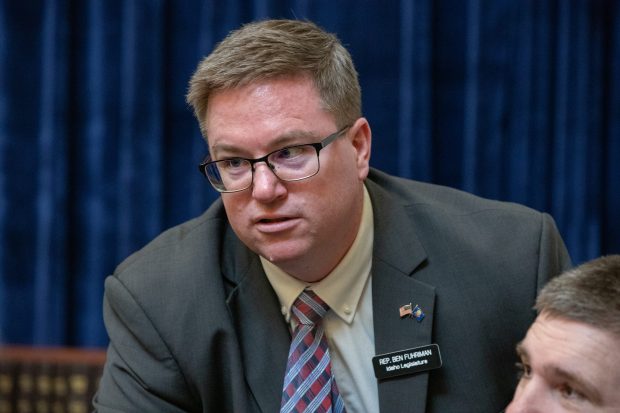
“It’s a long-overdue collection notice,” said sponsoring Rep. Ben Fuhriman.
A special education teacher and a handful of administrators spoke in favor of the proposal.
Chynna Hirasaki, the Boise School District’s special education director, said her district spends more than $35 million on federally mandated special education services. But it only gets $5 million from the U.S. Department of Education.
Rep. Barbara Ehardt suggested that many students may be miscategorized in special education, leading to higher numbers. “How are we going to separate the actual special ed kids and those who probably shouldn’t be in special ed?” asked Ehardt, R-Idaho Falls.
Hirasaki responded that the state’s Special Education Manual has “very clear criteria” on what makes a student eligible for special education services. Hirasaki also said that schools are getting better at identifying disabilities earlier.
Idaho Falls special education teacher Kevin Field agreed.
“What we’re seeing is an increased need driven by population growth, increased awareness, more complex student profiles,” Field said. “As the needs grow, our resources must grow alongside them.”
An Idaho Department of Education estimate pegs the state’s special education funding gap at $100 million.
Report highlights state shortfall for high-needs students
Before voting on the special education memorial, House Education heard about a report that highlighted where state funding is also falling short for high-needs students.
The Office of Performance Evaluations (OPE), a nonpartisan research group directed by legislative leaders, released the report last year. It showed that the biggest driver of K-12 funding is district size, not student characteristics or needs — and Idaho’s funding formula doesn’t adequately support special education students.
The formula, for instance, assumes that about 6% of public school students have special needs, Casey Petti, OPE’s principal evaluator, told House Education. In reality, it’s closer to 12%. And districts with a high proportion of special education students — say, 22% — can receive the same level of state funds as a district with low proportion, like 3%.

Rep. Clint Hostetler, R-Twin Falls, asked Petti why Idaho’s formula is based on support units — essentially the cost to operate a classroom — rather than a per-student model like most other states. “Have you done the research on … if we switch to that model, how that would affect our spending here?”
OPE hasn’t been asked to research that question, Petti said. But neighboring states like Oregon and Utah use per-student models that allow school funding to apply weights that account for student needs like special education, English-language learners and household income.
“It allows (the formula) to get very specific,” Petti said.
State superintendent Debbie Critchfield in recent years has proposed moving Idaho’s formula toward a per-student model with weights based on student characteristics. Last year, her bill narrowly cleared the Senate. But House Speaker Mike Moyle, R-Star, held the bill, effectively killing it for the legislative session.
Idaho’s One Big Beautiful Bill heads to Senate floor
The fast-moving Idaho version of the One Big Beautiful Bill cleared another hurdle Thursday.
The Senate Local Government and Taxation Committee approved a far-reaching bill to adopt most tax cuts in President Donald Trump’s 2025 policy bill.
The vote wasn’t a surprise. The bill passed along party lines — as it did earlier this week in House committee and on the House floor.
The debate also wasn’t particularly new, with Republican proponents saying the tax breaks on tips, overtime and car loan interest will help working Idahoans. “I do think this is a win for individuals,” said committee Chairman Doug Ricks, R-Rexburg, one of the co-sponsors of House Bill 559.
Opponents, including the committee’s two Democrats, questioned the bottom-line cost — and the fallout for education and other programs. Sen. Ron Taylor, D-Hailey, noted that the state already cut 3% from most budgets this year, with additional 1% to 2% cuts now on the table.
For the budget year ending June 30, the tax bill would reduce state revenues by an estimated $155 million, with the projected impact increasing to $175 million next year. Even bill supporters have said the cost could be higher.
With Thursday afternoon’s vote, HB 559 heads to the Senate floor for a vote. That could come in the next few days — but the Senate could expedite the bill. The House put the bill on the fast track this week, approving it just one day after the committee hearing.
Supporters Thursday pushed for quick action, so families and businesses can finish their 2025 tax returns and capitalize on the tax cuts. “There is an urgency to get started filing,” said Rep. Jeff Ehlers, R-Meridian, a co-sponsor of the bill.
If and when HB 559 passes the Senate, it would go to Gov. Brad Little. Little did not recommend adopting the new tax changes until July 1, avoiding a hit on this year’s razor-thin budget. However, legislative votes so far indicate that lawmakers would have the votes needed to override a veto from Little.
Divided committee approves Blaine Amendment repeal
The Blaine Amendment debate is headed to the House floor, after a close committee vote.
A proposed constitutional amendment would repeal Idaho’s Blaine Amendment, which forbids the use of public dollars to support religious enterprises. Blaine Amendments — which are in place in more than three dozen states — have become a centerpiece in the national debate over private school choice.
The repeal’s sponsor, Rep. Elaine Price, R-Coeur d’Alene, has argued that the Blaine Amendment is discriminatory.
“I don’t see this as a mandate to equally fund all private schools,” Price told the House State Affairs Committee Thursday.
The debate also touched on the Blaine Amendment’s origins.
Rep. Anne Henderson Haws, D-Boise, argued that the amendment was designed to protect public school funding.
Rep. Brent Crane, R-Nampa, said the amendment was a product of a time when discrimination was folded into the Constitution. He cited language which banned members of The Church of Jesus Christ Of Latter-Day Saints from voting. “I think it’s long overdue for us to remove the Blaine Amendment.”
The committee passed the amendment on an 8-6 vote, over bipartisan opposition. But Thursday’s narrow vote does not bode well for the repeal’s prospects on the floor. Constitutional amendments require two-thirds majorities in the House and the Senate.
JFAC co-chair doubles down on request for K-12 budget cut plan
Rep. Josh Tanner doubled down this week on his request to see a budget cut plan for public schools — although K-12 was exempt in a forthcoming bill that would make up to 2% cuts to many state agencies.
On Tuesday, the budget-setting committee’s Republican co-chair sent a letter to state superintendent Debbie Critchfield after she refused to make recommendations for cuts to the $2.7 billion public school support budget.
“Other agencies are living within tighter revenues by providing prioritized operating plans: what is essential, what can be delayed, redesigned, or eliminated,” Tanner wrote to the Republican superintendent. “That is what Idaho households and businesses do when revenues tighten.”

The letter responded to Critchfield’s message last week that she had “already fulfilled the assignment” by reducing her budget request ahead of the legislative session.
Ultimately, K-12 was exempt from the omnibus budget-cut legislation that the Joint Finance-Appropriations Committee’s co-chairs’ teased Tuesday morning. The budget-setting committee plans to vote Friday on Tanner and co-chair Sen. C. Scott Grow’s “Idaho Budget Rescission Act.”
But Tanner told Critchfield Tuesday afternoon that she must still provide a “clear, accountable roadmap” with spending priorities, ideas to improve efficiency and accountability metrics “if outcomes do not improve.”
“Please provide these items in writing prior to your next budget setting hearing and be prepared to walk through priorities and tradeoffs line-by-line,” Tanner wrote.

Grow did not co-sign the Tuesday letter. Click here to read it.
Tanner’s requests appeared to conflate the public school support budget with the Idaho Department of Education’s. The former would direct $2.7 billion to public schools while the latter would give $12.1 million to IDE, which oversees K-12 education.
While she declined to recommend cuts to public schools, Critchfield gave JFAC a plan to cut up to $241,000, or 2%, from the department’s budget.
“As you know, the Department submitted the final K-12 budget request in December,” Critchfield said through a spokesperson Thursday. “We support the Governor’s recommendation for a balanced budget where no additional cuts are made to public schools funding.”
New bill would distribute digital curriculum funding by need
Idaho public schools currently collect limited state digital curriculum funds through a first-come-first-served process reminiscent of “The Hunger Games,” said Rep. Jerald Raymond.
A new bill from the Menan Republican would instead dish out the money based on need. The legislation directs the Idaho Department of Education to establish “competitive, needs-based criteria” that governs which districts are prioritized when state funding for digital curriculum is limited.
“It seems like a common sense thing to me,” Raymond said.
The House Education Committee unanimously voted to introduce the bill Thursday, setting the stage for a future public hearing.

