
The House Education Committee unanimously voted Monday to advance two bills to update parameters for school districts’ state facilities funding.
House Bill 608 would eliminate a provision in the Public School Facilities Cooperative Fund, which requires districts to try unsuccessfully to pass a bond measure before qualifying for the revolving loan program.
House Bill 636 would make lease-purchase agreements an eligible expense for the School District Facilities Fund, a property tax relief account enacted in 2023.
Both bills now head to the full House.
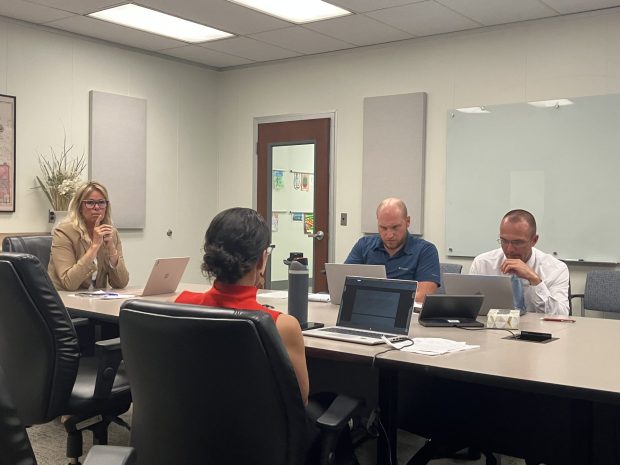
Cooperative fund. The Camas County School District successfully applied last year for a $1.75 million Public School Facilities Cooperative Fund loan.
But first, the district had to ask voters for a bond for the same amount. Only if the bond failed — which it did in November, with 85% opposition — would the district qualify for the revolving loan fund.
“This caused an unbelievable amount of confusion,” Kevin Lancaster, Camas County’s superintendent, told House Education. “We believe that continually placing these bonds on the ballot to meet the needs of the grant will diminish the trust the community has in us to run the district.”
HB 608 would eliminate the requirement that districts, which previously failed to pass a bond, ask for another bond.
Reps. Douglas Pickett, R-Oakley, and Rod Furniss, R-Rigby, are sponsoring the bill.
It would also make a few other updates to the $50.5 million fund, including requiring districts to repay the fund any cost savings from an approved project.
Facilities fund. Currently, school districts must use their share of $141 million in state property tax relief funds to pay down existing bonds or levies.
HB 636 would add lease-purchase agreements — loans that don’t require taxpayer-funded bonds — to the bottom of the list of eligible expenses.
“School districts that have sufficient money after they’ve paid off their debt will be able to potentially leverage money that allows them to do big construction needs, rebuilds, deferred maintenance, without going to the taxpayers,” said sponsoring Rep. Soñia Galaviz, D-Boise.
West Ada School District Superintendent Derek Bub spoke in support of the bill Monday. The state’s largest district, with nearly 40,000 students, will be debt-free in about six years, Bub said.
“HB 636 allows a district to have the option of securing a lease-purchase agreement without burdening taxpayers,” he told House Education. “This clarification matters. By explicitly allowing additional payments on lease-purchase agreements, the bill incentivizes districts to pay down debt more aggressively.”
New bill would mandate start date for academic year
Rep. John Vander Woude wants to decide when Idaho’s 192 public school districts and charter schools start the academic year.
Vander Woude, R-Nampa, proposed a bill mandating that the school year statewide starts the Tuesday after Labor Day. The House Education Committee voted to introduce the bill Monday.
“We seem to be creeping up more and more into August, and the tourist industry would like to keep their employees through Labor Day,” Vander Woude said.

The bill could face pushback if it returns to House Education for a public hearing. A couple Republicans wondered how the mandatory start date would affect harvest breaks in rural districts, and whether it would delay Christmas break or the end of academic years.
“The later we start, the longer we go in the spring,” said Rep. Jack Nelsen, R-Jerome.
Also Monday, the committee introduced bills related to:
Administrator certification. Rep. Dale Hawkins resurrected a proposal from last legislative session that would allow school districts to hire uncertified administrators through an apprenticeship program.
The bills would allow districts to hire superintendents and principals who don’t have a state certification but have experience in other fields. It would create “pathways” for teachers along with military leaders, private sector executives, nonprofit leaders and government officials.
“It’s an apprenticeship program so that small, rural areas through their boards … can seek and get these positions filled where it seems to be very hard,” said Hawkins, R-Fernwood.
Hawkins proposed a similar bill last year. It cleared the House but stalled in the Senate Education Committee.
Civics diploma endorsement. Rep. Michael Veile, R-Soda Springs, introduced a bill to create a civics endorsement for high school diplomas.
The “State Seal of Excellence in Civics” would recognize a “high level of civics proficiency and civics engagement.”
Students would qualify by obtaining a 3.25 grade point average or higher in social studies courses and by scoring 90% or higher on the state’s civics assessment. Students would also have to complete a civics research project and participate in volunteering.
Senate committee OKs a pair of special education measures
The Senate Education Committee endorsed two related special education proposals — a rural pooling program and a nonbinding plea to the feds.
The committee printed a bill to create “regional service centers,” which would allow rural schools to share hard-to-hire staff.
“Districts and charters often compete for a limited pool of qualified special education professionals at a high cost, and many do not require full-time staff to meet their students’ needs,” the bill’s statement of purpose reads, in part.
The regional service centers bill is one of state superintendent Debbie Critchfield’s two proposals to address Idaho’s $100 million special education funding shortfall. She is also proposing a $5 million high-needs fund, which would help districts and charters cover the cost of full-time special education aides, such as American Sign Language interpreters. Senate Education printed the high-needs bill Thursday.
Critchfield hopes to bankroll both programs through fund shifts. She would siphon $1 million in startup money for the regional centers from a state driver training account.
Future funding would come from districts and charters that use the regional services.
Senate Education also approved a memorial urging the federal government to make good on a 50-year-old special education funding commitment.
When Congress passed the Individuals with Disabilities Education Act in 1975, it promised to cover 40% of states’ special education costs. Idaho receives a 12% federal share.
Fruitland superintendent Stoney Winston urged the committee to pass the memorial.
Winston’s district spends $1.8 million a year on special education, and has to come up with $790,000 locally. A 40% federal match would reduce local costs by more than half.
“Idaho public schools have been doing the job,” Winston said. “It’s time for (the feds) to pony up.”
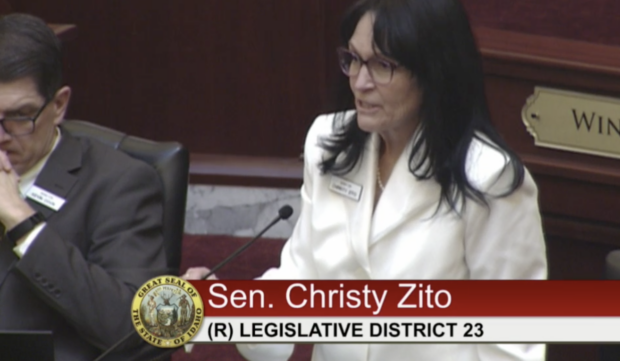
Sen. Christy Zito voted against the nonbinding resolution. Zito, R-Hammett, said she is the grandmother of two special-needs students, and is aware of the challenges facing local schools. But she said the state needs to push back against unfunded federal mandates. “It’s time to just say no.”
Senate Education voted to send House Joint Memorial 11 to the Senate floor for a final vote.
House passes public buildings bathroom bill
After lengthy debate, the House overwhelmingly passed a bill that would extend transgender bathroom bans to libraries and other public facilities.
House Bill 607 would require public agencies to provide separate restrooms and changing facilities on “the basis of biological sex.” Existing laws already apply to public schools and college and university campuses, and this bill would extend those requirements to other public entities.
Opponents focused largely on bill language pertaining to “places of public accommodation” — requiring business owners to take “reasonable steps” to protect the safety and privacy of restroom users.
The bill passed on a 56-13 vote and now goes to the Senate.
Library directors’ bill introduced
A bill to give city officials a say in hiring or firing library directors made its debut Monday.
Sponsored by Rep. Jeff Cornilles, R-Nampa, the bill would give city councils hiring and firing authority — which now sits exclusively with library trustees.
If cities opted into this language, personnel decisions would need to get majority support from the city council. During a brief hearing, Cornilles said he envisions councils working in tandem with library boards, not superseding them.
Rep. Steve Berch, D-Boise, questioned the need for the bill, noting that city leaders already have the authority to appoint trustees. “I’m not sure why there’s a problem.”
The House Local Government Committee voted to introduce the bill, which could lead to full public hearing at a later date.

