
(UPDATED, 5:10 p.m., with comment from Gov. Brad Little’s office on tax conformity bill.)
With brief discussion — and some foreshadowing of the debate to come — a bill to adopt federal tax cuts cleared its first hurdle Friday.
The Legislature passes a tax “conformity” bill every year, and often this is a routine and minor change.
“This is a much bigger deal this year,” said the bill’s sponsor, Rep. Jeff Ehlers, R-Meridian, noting that the state must decide whether to adopt 39 tax changes folded into President Donald Trump’s One Big Beautiful Bill law.
This bigger deal carries a sticker price to match.
The conformity bill projects a $155 million annual cost — money that would be shaved out of tight state budgets for the current spending year and every year thereafter.
The immediate rollout of the tax cuts could make Idaho’s current budget crunch even more challenging.
Gov. Brad Little’s budget recommends conformity with the Trump tax cuts — on July 1, the beginning of the 2026-27 spending year. Little does not recommend putting the tax cuts into effect immediately. His budget for this year, which leaves K-12 exempt from spending cuts, also balances on a razor-thin margin. He proposes leaving an end-of-year balance of $32.1 million, not nearly enough to cover the immediate cost of tax cuts.
Earlier this week, however, legislative budget-writers approved a revenue projection for the current year, exceeding the governor’s forecast by more than $130 million. The Legislature’s rosier prediction — if it comes to pass — would allow a cushion to make the changes in tax code this year.
“Gov. Little strongly supports the Trump tax cuts enacted through the One Big Beautiful Bill and remains committed to policies that keep taxes low for Idahoans,” Joan Vargas, the governor’s press secretary, said in a statement to Idaho EdNews late Friday afternoon. “Gov. Little will continue to work closely with the Legislature to ensure Idaho’s budget remains balanced and Idahoans receive this crucial tax relief.”
While lawmakers and Little seem to be at odds about the rollout date, they are in agreement on the math.
Little has also pegged the cost of tax conformity at $155 million per year.
Cost estimates were the focal point of Friday’s first hearing on the tax conformity bill.
Ehlers defended the price tag, which represents a midpoint of State Tax Commission estimates running from $111 million to $192 million. Echoing earlier comments from Lori Wolff, Little’s budget chief, Ehlers says the state’s math tracks with costs in Utah, where conformity came with a $200 million price tag.
Rep. John Gannon was skeptical.
Gannon, D-Boise, pointed to estimates from the Tax Foundation, a Washington, D.C., think tank, which has estimated Idaho’s conformity costs at $284 million. And based on numbers from Indiana — a state with a lower income tax rate than Idaho – Gannon said Idaho’s bill could spiral to $800 million.
If tax conformity costs more than expected, this could break the 2026-27 budget. “The bank is going to be empty,” Gannon said.
Little’s budget blueprint — which assumes the cost of tax conformity at $155 million a year — generally protects K-12 spending, except for some online school spending. He has proposed a hold-the-line budget for higher education, but wants to cut a line item designed to help colleges and universities absorb enrollment growth.
But like this year’s budget, Little’s $5.6 billion plan for next year sits on a knife’s edge. A projected $25.5 million end-of-year budget cushion leaves Little and the Legislature limited margin for error.
The House Revenue and Taxation Committee voted on party lines to introduce the bill Friday, with only Gannon in opposition. It will likely come back to the committee for a full public hearing — with costs and budget impacts likely to be a focal point of the debate.
Survey reveals support for private school choice — but a split on next steps
Idahoans generally support the state’s controversial new private school choice law — but they’re undecided about where to go from here.
That’s one takeaway from Boise State University’s annual statewide Public Policy Survey, released Friday.
Most survey respondents said they support the $50 million private education tax credits, passed in 2025.
Not surprisingly, support for tax credits varies based on political affliliation. More than two-thirds of Republican respondents support the program; fewer than 45% of Democrats support it. Independents are more or less evenly divided.
When asked what the 2026 Legislature should do on private school choice, Idahoans are deeply split.
In all, 36% of Idahoans say the Legislature should leave the new law as is, and see how it works, while 35% say the Legislature should repeal the law and 21% say the state should put more money into the program.
These responses also broke along party lines. Republicans said they preferred to keep the program in place. Independents and Democrats said they preferred repeal.
The survey revealed one wrinkle that left Boise State researchers baffled.
About half of the survey’s respondents were asked for their opinion about the Idaho Parental Choice Tax Credit — the law’s title, as written by its supporters. About 56% of these respondents voiced support.
The other half of survey respondents were asked for their views about House Bill 93 — the bill number assigned to the 2025 law. In this case, 61% of respondents voiced support.
This gap falls outside the survey’s 3.1% margin for error.
There “may just be more familiarity” with the law’s bill number, which was widely used in media coverage of the 2025 legislative debate, said Matthew May, survey research director for Boise State’s School of Public Service.
As in past years, Boise State asked Idahoans to rate the state’s K-12 system — and their local schools. Respondents again gave their local schools a higher grade.
Here’s the breakdown:
| Idaho’s K-12 system | Local schools | |
| Excellent | 7.4 | 9.8 |
| Good | 27.2 | 32.7 |
| Fair | 35.9 | 30.0 |
| Poor | 21.6 | 17.4 |
| Not sure | 7.9 | 10.0 |
Both sets of grades showed improvement.
Close to 35% of respondents rated Idaho’s schools as good or excellent, up from 31% a year ago. Meanwhile, 42.5% of respondents rated their local schools as good or excellent, up from 39.5%.
Boise State surveyed 1,000 adults from Nov. 8-17.
Former legislator Linden Bateman, a champion of cursive, dies at 85
Linden Bateman — a school teacher who served more than 15 years in the Idaho House of Representatives — died Thursday.
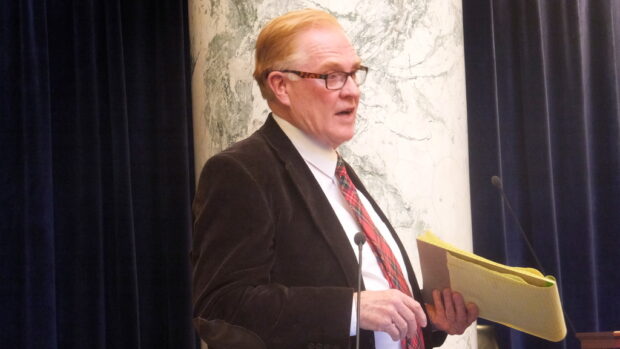
Bateman was 85.
The Idaho Falls Republican served two stints in the Legislature, from 1977 to 1986 and then from 2010 to 2016.
In 2013, Bateman led a push to protect cursive handwriting in the classrooms. The Legislature passed a resolution directing the State Board of Education to establish a rule requiring the instruction of cursive handwriting.
The 2025 Legislature followed up with a law requiring students to demonstrate proficiency in cursive by fifth grade, starting this school year.
“Linden understood the value of passing knowledge from one generation to the next,” state superintendent Debbie Critchfield said in a statement Friday. “His advocacy for the teaching of cursive writing reflected his belief that students benefit from understanding where we have been as they prepare for where they are going.”