
Bruneau Elementary School is staying open — for now — but last month’s election likely won’t be the last word.
On Nov. 4, the majority of voters in Owyhee and Elmore counties rejected the Bruneau-Grand View School District’s request for permission to shutter Bruneau Elementary. The school’s enrollment has dropped to 24 students, and Bruneau-Grand View leaders weighed consolidation across the large but sparsely populated district.

The election result — confirmed by a recount in Elmore County last week — was a victory for Bruneau residents, who battled the closure plan and even threatened a lawsuit, prompting the unusual ballot question. Sherry Colyer, a leading advocate for preserving Bruneau Elementary, said she’s “ecstatic.”
“We were very excited that the voters throughout the district felt that it was important for Bruneau to stay open,” Colyer, a Bruneau rancher and former school board trustee, said by phone.
But the election wasn’t decisive — 307 voters opposed the closure while 248 voters supported it. And the result confirmed that Bruneau-Grand View patrons are divided about the future of the district, largely along geographic lines. Bruneau residents overwhelmingly voted to keep their elementary school open while most Grand View and Oreana residents supported closing it.
In other words, the debate probably isn’t over.
Voters this month were “shortsighted,” said Mandi Boren, an Oreana mother whose children attend Grand View Elementary. Bruneau Elementary will have to close eventually, she said by phone, and “this just kicks the can further down the road.”
Boren’s husband, Steven Boren, serves on the Bruneau-Grand View school board. But Mandi Boren said her opinions on consolidation are independent from her husband’s.
Bruneau-Grand View covers two towns — Bruneau and Grand View — along with the unincorporated community of Oreana and a wide stretch of rural land across two counties, from the Snake River to the Nevada border. The district has three schools: Bruneau Elementary, Grand View Elementary and Rimrock Junior/Senior High School, located about halfway between Bruneau and Grand View.
District leaders for more than a decade have considered consolidating the schools amid a steady enrollment decline since the early 2000s. While enrollment increased to 297 students this school year — with gains at Grand View Elementary and Rimrock — the district serves fewer than half the students it did during the mid-1990s. Qualified teachers are also difficult to come by, making it hard to justify staffing a small school.
Bruneau Elementary is much smaller than the district’s other schools, and it’s shrinking. Between 2021 and 2025, Bruneau’s enrollment went from 37 students to 24 students. Grand View Elementary — which serves Grand View and Oreana students — went from 70 students to 92 students during the same period.
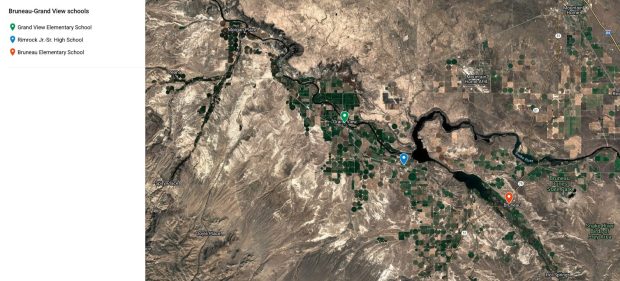
This summer, trustees considered closing Bruneau Elementary ahead of the 2025-26 school year and moving its two dozen students to Grand View Elementary, 19 miles west of Bruneau. Eventually, the district would transition Rimrock into a K-12 campus serving all grades, according to a plan presented in July by former Superintendent Jeff Blaser.
But Bruneau residents protested and threatened a lawsuit challenging the closure. After a tense school board meeting this summer, trustees unanimously decided to keep Bruneau Elementary open for 2025-26 and ask voters what to do in 2026-27.
During last month’s election, 55% percent of voters opposed closing Bruneau Elementary next school year. Colyer said she wasn’t surprised by the result, after talking to voters from all three communities.
“They have strong feelings about keeping the two grade schools open and operational as long as they’re in good repair — and they are,” she said. “I was fairly confident that that’s the way people would see it, and the votes showed that.”
Precinct-level election data suggests Colyer could be right about some residents of Grand View and Oreana: 31% of voters from these communities opposed closing Bruneau Elementary, 87 votes that likely made the difference in the final result.
| Close Bruneau Elementary? | Yes | No | Result % |
| Bruneau | 21 | 166 | 89% |
| Grand View | 148 | 71 | 68% |
| Oreana | 48 | 16 | 75% |
| Riddle | 1 | 20 | 95% |
| Chattin Flats | 17 | 12 | 55% |
| Murphy | * | * | * |
| Absentee | 13 | 20 | 61% |
| All precincts | 248 | 307 | 55% |
* = data shielded for privacy
Still, the precinct-level data shows a stark geographic divide: 68% of Grand View voters and 75% of Oreana voters supported the closure while 88% of Bruneau residents opposed it.
This type of conflict could become more common in rural Idaho school districts if enrollment continues to decline. Statewide, enrollment is down for the second consecutive school year, just the fourth dip since the late 1990s. And budgets are tightening. The state could face a revenue shortfall up to $1 billion next fiscal year, which could affect K-12 spending, the Idaho Capital Sun reported Tuesday.

Both sides of the Bruneau debate have argued that their position is fiscally responsible. Bruneau supporters questioned closing a school building that while old — it opened in the 1950s — still works. And they pointed to a recent survey showing very little support for a bond to finance renovations at Rimrock and turn it into a K-12 campus.
“I think they need to focus on education instead of consolidation,” Colyer said.
But keeping Bruneau Elementary open doesn’t make financial sense, either, Boren said. It costs twice as much to educate students at Bruneau compared to Grand View, she said, and the lack of support for bonding to finance a consolidated campus in between the two towns means the district should be extra careful with its spending.
Asked how she would feel if roles were reversed, Boren said she wouldn’t oppose a consolidated campus at Rimrock, if Grand View Elementary’s enrollment were declining. But it’s not. And Grand View is the “halfway point” between the west and east sides of the district, making it the “logical” place to educate elementary students under one roof, she said.
“We need to unite these communities,” Boren said. “What you’ve got to base everything on is what is best for our students and what is best for the long-term stability, financially, of the district.”