
In a flashback to last year’s private school choice debate, the Senate approved a series of fixes to the state’s new tax credit law.
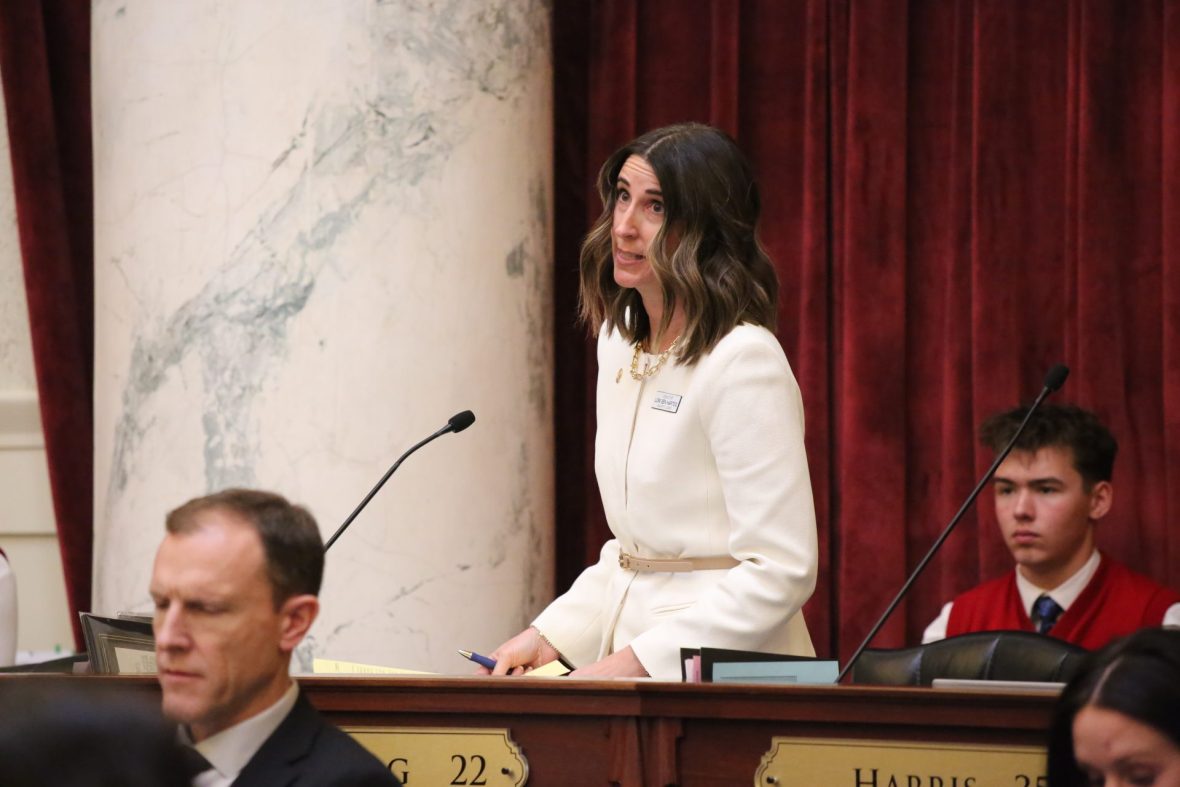
On Tuesday, senators focused on one section of the cleanup bill, House Bill 934: language that says that students who qualify for the private school tax credits can participate in non-credit sports programs and extracurricular activities at public schools.
HB 934 supporters say this is nothing new — and say this was their intention a year ago, when they pushed House Bill 93, the $50 million tax credit law. And during Tuesday’s floor debate, Senate Majority Leader Lori Den Hartog pointed out that parents cannot use tax credit dollars to cover pay-to-play sports or extracurricular fees.
“That was intentional,” said Den Hartog, R-Meridian, a sponsor of HB 934 and HB 93. “All of this was related to academics.”
Roll call
Tuesday’s 23-12 Senate vote on the private school tax credit followup bill:
Yes: Adams, Anthon, Bernt, Bjerke, Blaylock, Carlson, Den Hartog, Foreman, Galloway, Grow, Hart, Kohl, Keyser, Lakey, Lenney, Nichols, Okuniewicz, Ricks, Toews, VanOrden, Woodward, Zito, Zuiderveld.
No: Burtenshaw, Cook, Guthrie, Harris, Lent, Rabe, Ruchti, Semmelroth, Shippy, Taylor, Ward-Engelking, Wintrow.
Opponents said HB 934 would let families benefit from the publicly supported tax credits, while cherry-picking from public school offerings.
“To me, you don’t get to do both,” said Sen. Janie Ward-Engelking, D-Boise. “I think this is a double dip.”
Saying that sports and extracurriculars are part of the fabric of a community, Sen. Ben Adams discussed his own experience. Adams, R-Nampa, said he played on public school sports teams while he was a homeschool student.
“This is not dipping into anybody’s pocket,” he said. “I didn’t take anybody’s spot. I competed. Homeschoolers are still a part of a community.”
Sen. Ben Toews, R-Coeur d’Alene, said it would be unfair to punish parents who take a tax credit that comes out to less money than the state spends per public school student. (The tax credit maxes out at $5,000 per student, or $7,500 for a special-needs student.)
HB 934 passed on a 23-12 vote. The House has already passed it, so it now goes to Gov. Brad Little’s desk.
Senate rejects motion to send ‘radiator-capped’ union bill back to committee
Opponents of a bill that would restrict teachers’ union activities threw a counterpunch Tuesday, after supporters on Monday snuck the proposal into a separate bill already on the Senate floor.
The counter didn’t land.
Sen. Dave Lent, chairman of the Senate Education Committee, made an unsuccessful motion to send House Bill 516 to his committee, where it could have a public hearing along with a vote on whether it should go to the full Senate.
“If this is the people’s work, why in the world would we think that they should not have every opportunity to provide input on the legislation that goes through this building?” said Lent, R-Idaho Falls.
Lent’s motion failed on a 16-19 vote. But it may have succeeded in one respect: It forced an on-the-record vote on Monday’s “radiator cap” scheme.
Radiator capping is a controversial method for rewriting a bill on the House or Senate floor while maintaining its number — effectively replacing one bill that reached the floor with another that hasn’t. On Monday, the Senate voted to replace HB 516 — an LGBTQ+ instruction bill that had passed the Senate Education Committee — with House Bill 745, the teachers’ union bill, which had stalled in the Senate Commerce and Human Resources Committee.
But floor votes on amendments aren’t officially recorded, so it wasn’t clear which senators supported or opposed the radiator cap. That changed Tuesday after a heated debate on Lent’s motion and a roll-call vote.
Roll call
Tuesday’s 16-19 vote on the motion to send the “radiator-capped” version of House Bill 516 to the Senate Education Committee:
Yes: Anthon, Bernt, Burtenshaw, Cook, Foreman, Guthrie, Harris, Lent, Rabe, Ruchti, Semmelroth, Taylor, VanOrden, Ward-Engelking, Wintrow, Woodward.
No: Adams, Bjerke, Blaylock, Carlson, Den Hartog, Galloway, Grow, Hart, Keyser, Kohl, Lakey, Lenney, Nichols, Okuniewicz, Ricks, Shippy, Toews, Zito, Zuiderveld.
Like HB 745, the amended HB 516 would prohibit public schools from deducting teachers’ union dues from paychecks, offering paid-time off for union activities (without reimbursement from the Idaho Education Association) and from communicating on behalf of the union, among other restrictions.
Sen. Dan Foreman, chairman of the Senate Commerce and Human Resources Committee, declined to give HB 745 a hearing. And he opposed Monday’s radiator cap proposal.
“This is a new bill,” Foreman, R-Moscow, said during Tuesday’s debate. “The public has not had a chance to hear it. We have not had it in committee, and I think, in keeping with our process, it should go to the Education committee.”
Opponents of Lent’s motion argued that the radiator cap followed the Senate’s rules. Senate Rule 28(D) says that amendments to a bill must have the same subject, and must not incorporate “any other bill or resolution introduced and pending before the Senate or any committee.”
The amended version of HB 516 is slightly different from HB 745. For instance, the new version would amend a section of code that applies only to teachers’ unions, while HB 745 amended a section of code that applied to all public-sector unions and exempted police and fire unions.
“Although it did not have a full hearing in the Education committee, everybody in that committee knows exactly what this legislation is,” said Sen. Ben Adams, R-Nampa, who opposed Lent’s motion. “This body followed the process that is available to the Senate.”
Sen. Van Burtenshaw, R-Terreton, responded that he’s a member of the Education committee, and he hasn’t seen the new version of HB 516. “I’m not aware of what’s in it, and we are following the process by taking it back to the committee for discussion,” Burtenshaw said, before voting in favor of Lent’s motion.
But if the bill went to Senate Education, the radiator-capped bill would have the same fate as HB 745 had in Foreman’s committee, said Sen. Joshua Kohl, R-Twin Falls. “It goes back to the committee to die, to be shoved in a drawer,” he said.
This prompted a warning from Lt. Gov. Scott Bedke, a Republican who presides over the Senate but only votes to break ties. “You don’t know that,” Bedke told Kohl. “You’re out of order if you keep on that line.”
After Tuesday’s vote, the teachers’ union bill will remain on the Senate’s calendar. Senators could vote on it in the coming days. If it passes, it would go back to the House floor, which would have to concur with the amendments.
Senate committee advances library law rewrite
A library director turned to literature Tuesday to illustrate her scruples with the latest legislation updating Idaho’s “harmful” materials law.
Like the tragic monster in Mary Shelley’s “Frankenstein,” which was composed of “pieces of the dead,” Senate Bill 1448 “has been put together from the pieces of other dead and damaged bills,” said Jenny Emery Davidson, director of the Community Library in Ketchum.
“This past legislation has cost Idaho taxpayers money and unnecessary lawsuits,” Davidson said. And the bills “have diminished Idahoans’ ability to access information and lifelong learning freely.”
The Ketchum library director was among five people who spoke against SB 1448 on Tuesday before the Senate Judiciary and Rules Committee voted to advance it.
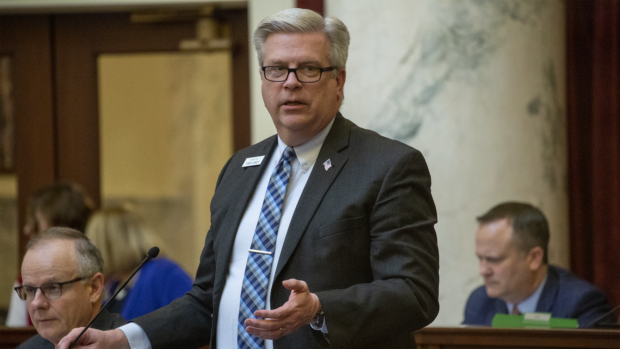
Sen. Todd Lakey’s bill would update language in the “Children’s School and Library Protection Act” — enacted in 2024 through House Bill 710 — to align it with recent court rulings on laws restricting library material. Attorney General Raúl Labrador’s office proposed the changes, said Lakey, R-Nampa.
“This is about technical changes to the bill,” he said, referring to HB 710. “It’s not about the concept of the bill, the requirements of the bill that we passed two years ago.”
SB 1448 would:
- Add a definition of “adolescent minors,” or children between 13 and 17 years old. According to the updated language, library material would be “harmful to minors” if it: “Taken as a whole, appeals to the prurient interest of adolescent minors as judged by the average person, applying contemporary community standards.”
- Add a definition of “sexually explicit.” This is material that contains “erotic depictions” of “nudity, sexual conduct or sadomasochistic abuse” or “any explicit and detailed description or narrative account of sexual excitement, sexual conduct, or sado-masochistic abuse.” Sexually explicit material would not include “diagrams about anatomy for scientific education, religious books such as the Bible and the Torah, or content relating to classical works of art.”
Libraries would be prohibited from giving minors material that is “sexually explicit and, taken as a whole, is harmful to minors.”
The Senate Judiciary and Rules Committee voted to advance the bill after little debate. Only Sen. James Ruchti opposed it. The Pocatello Democrat said that SB 1448 could “improve the language” of the existing law, but he has negative “holdover” feelings from previous library bills.
Lakey, meanwhile, said members of the public who opposed the bill misunderstood it. “I think some people that testified, perhaps, don’t understand how to read the legislation and look at what’s new compared to what’s existing,” he said.
But opponents noted that they only had a day to read it. The bill was introduced Monday and scheduled for a hearing Tuesday. This “gives the appearance of an end-run around public scrutiny,” said Michelle Lippert from the Library Alliance of North Idaho.
Boise resident Bonnie Shuster suggested the best way to handle the “harmful” material law is to repeal it. “It’s OK to change your minds,” she said. “It would be a breath of fresh air to the people of Idaho if you did that.”
SB 1448 now heads to the full Senate.
Little signs high-needs special education bill
A $5 million special education program is now law.
Gov. Brad Little on Tuesday signed a bill creating a state fund addressing high-needs students — special education students who might need full-time aides or specialized equipment or support.
Under Senate Bill 1288, districts and charters could receive up to $100,000 in state assistance for high-needs students. They would still be responsible for covering the first $30,000 of costs.
The high-needs program was state superintendent Debbie Critchfield’s top priority for the 2026 legislative session. She is using one-time money to start the program., diverting funds and interest from two Idaho Department of Education accounts.
JFAC gives go-ahead for federal health care grants
Legislative budget-writers gave the initial green light for spending $930 million in federal health care grants, money that could help the state address its chronic physicians’ shortage.
And a House-Senate tussle over governing the grants also came to an end Tuesday.
The federal health care money — an offshoot of the feds’ 2025 One Big Beautiful Bill — is already on the way to Idaho. The feds awarded the five-year grant program late last year.
However, the Legislature must give the Department of Health and Welfare the authorization to spend the money, and the Joint Finance-Appropriations Committee voted Tuesday to provide that go-ahead.
But legislators want a direct say in how the money is spent. Both houses have agreed on the need for a legislative committee to oversee the grants. They also agreed on the numbers: four House members, four senators and a nonvoting gubernatorial appointee.
But they didn’t agree on one point. The Senate wanted language that would guarantee six lawmakers come from rural communities; the House wanted no such restriction.
JFAC approved the House’s language. And that drew fire from a senator who has been pushing for rural membership.
“We can have all kinds of legislators positioned around Saint Alphonsus and St. Luke’s,” said Sen. Kevin Cook, R-Idaho Falls, referring to Boise’s two hospitals. “Why would you want city people representing rural?”
The committee also talked about the need for legislative oversight over the funds.
The Department of Health and Welfare has already turned in a budget for the grant program, said Rep. Dustin Manwaring, R-Pocatello. If the House-Senate committee doesn’t get the process done right on the front end, he said, “I believe the Legislature will have some issues (in 2027).”
But legislators sometimes get in agencies’ way, said Sen. Melissa Wintrow, D-Boise.
“We are not project managers,” she said. “We are policymakers.”
House approves cash transfers to buoy budgets
The House approved about $229 million in cash transfers, designed to buoy the state’s budget in case revenue doesn’t rebound in the coming months.
Gov. Brad Little recommended most of the transfers. But the Joint Finance-Appropriations Committee proposed a couple others, including tapping $65.8 million in interest earnings from American Rescue Plan Act (ARPA) funds, federal money that the state received during the COVID-19 pandemic.
Rep. Josh Tanner, JFAC’s co-chair, said Tuesday that House Bill 968 “helps from our bottom-line aspect.” Tanner and Sen. C. Scott Grow, both R-Eagle, said last week that they hoped to leave at least $150 million on the bottom line this fiscal year and next fiscal year.
The House voted 53-13 to pass the cash transfer bill. Eight Democrats and five Republicans opposed it.
“I just can’t wait to tell my constituents that this Legislature left money on the bottom line, along with $1.6 billion in a rainy-day fund, while the Legislature is cutting vital services they count on and depend on,” said Rep. Steve Berch, D-Boise.
The bill now goes to the Senate.

