Every legislative session produces the unexpected.
Here’s one upset: Boise State University football coach Spencer Danielson found himself testifying before Senate committees twice in the span of four days. The money line on that action would have paid off handsomely.
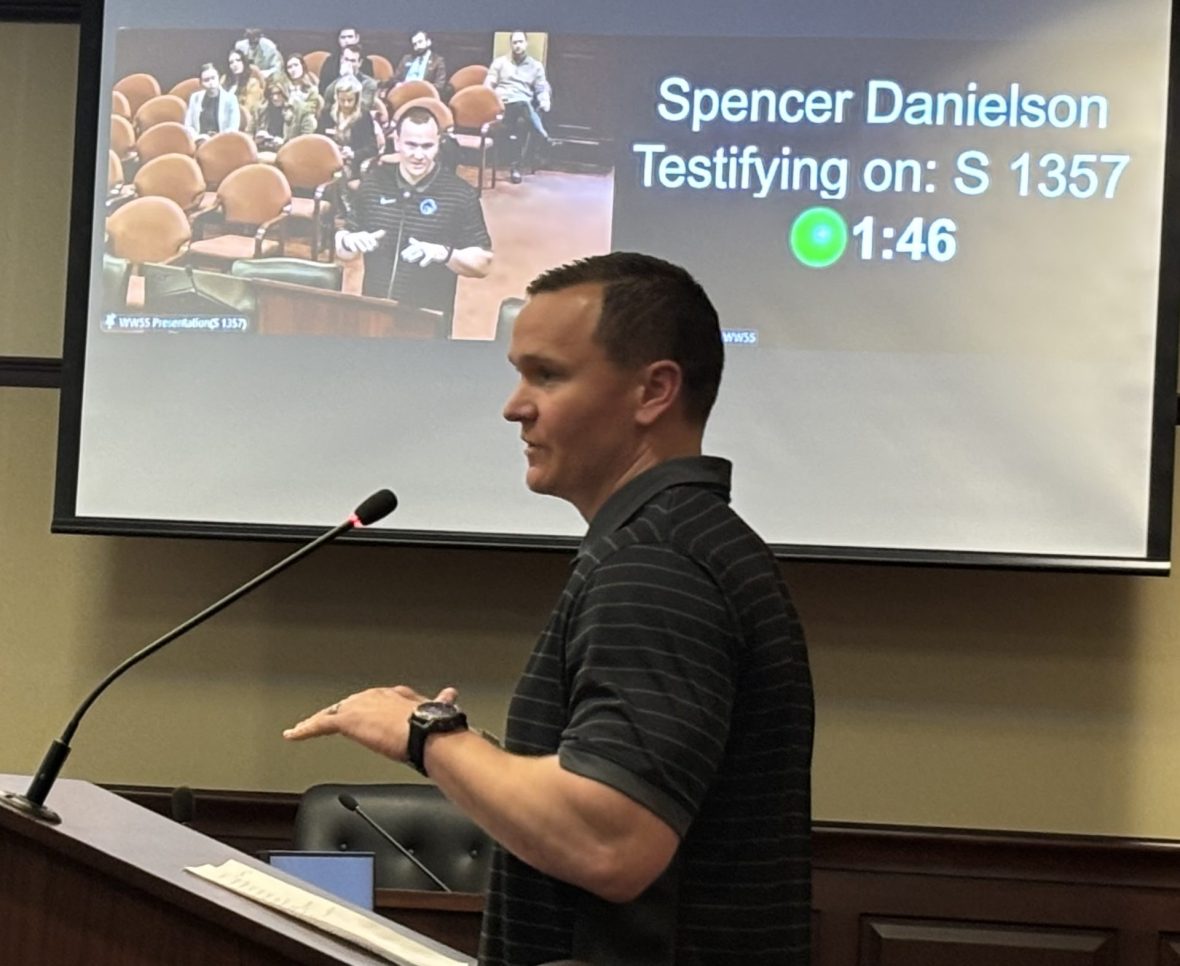
Yet there he was. And there he was again. Going unbeaten for the week.
The hearings say something about the external and internal pressures facing Idaho college athletics — and, by extension, Idaho higher education.
While it was a big week on the basketball court, with the University of Idaho men’s and women’s basketball teams both earning Big Sky Conference titles and NCAA Tournament berths, it was also a busy week for Statehouse political football.
The Idaho Legislature vs. the Power Two
Joining athletic directors and other coaches, Danielson faced a friendly crowd at the Senate State Affairs Committee Friday.
On the docket was a cupcake: a nonbinding joint memorial asking Congress to take on the big money and the big conferences that are reshaping college sports. And, the memorial argues, leaving Boise State and other athletic programs in the dust.
“In the evolving collegiate athletics landscape shaped by name, image, and likeness (NIL), revenue sharing, and shifting conference dynamics, there is a compelling need for federal policy and funding frameworks to ensure fair competition, sustainable athletic programs, and continued economic and community benefits for states like Idaho,” the memorial reads, in part.
Or, as Danielson put it, “We need the help from the state, really the federal level, to create really good rules, guidelines that are upheld so that we can continue to transform players’ lives and not live in insanity, which is where college athletics is, and especially college football is now.”
The memorial pins much of this “insanity” on college sports’ Power Four conferences: the Big Ten, the Southeastern Conference, the Big XII and the Atlantic Coast Conference. Or the Power Two — the Big Ten and the SEC. (I note, by way of disclosure, that I hold a degree from a Power Two university, but, I hasten to add, not one of those damned SEC schools.)
Talking smack at the big boys and playing the underdog card is easy politics, which is why this memorial is an easy yes vote. Not that it actually makes much difference.
Remember, memorials to the feds have absolutely no weight of law. They are simply letters from the Statehouse. It’s hard to envision members of Congress from Michigan or Alabama or Oklahoma heeding the better angels of their nature, at the mere nudging of the Idaho Legislature.
But these weightless memorials do reflect the pulse of the Legislature. Lurking amid all of this rah-rah is, at least, an acknowledgement that the fate of Idaho college sports will be determined by outside forces. (Factors that drew the attention of President Donald Trump during a summit last week.) And big money hangs in the balance.
“For every $1.00 invested in Boise State University athletics, the State of Idaho receives an estimated $2.00 in return through added economic activity, tax revenues, and public sector savings, underscoring the department’s high return on public and private investment,” the memorial reads.
Of course, one can ask if the Legislature is equally concerned with higher education in general — and a system facing two years’ worth of disinvestment. But that’s another topic.
Athletic programs 9, Okuniewicz 0
Hayden GOP Sen. Doug Okuniewicz did a difficult thing Tuesday: He got Broncos, Vandals and Bengals to rally together.
They united against Senate Bill 1357, Okuniewicz’s bill to limit the number of athletic scholarships the state could award to foreign athletes.
A proposed 10% limit — across a college or university’s entire athletic program — wouldn’t appear to have much to do with football. By Okuniewicz’s count, Idaho’s three football teams are under the limit.
That didn’t stop Idaho State University football coach Cody Hawkins and Danielson from testifying against the bill. Foreign athletes are playing an increased role in college football, Hawkins said. And Danielson said SB 1357 would provide an edge to the competition. “I would recruit against Boise State, and use this bill against us, if this bill passes.”
Based on Okuniewicz’s data, every athletic program in Idaho exceeds the 10% scholarship cap. With 71 foreign athletes on its rosters, the University of Idaho is more than 42 scholarships over the limit. Idaho State is closest to compliance, but not quite there — with 32 foreign scholarship athletes, more than six over the cap.
Okuniewicz pointed out that SB 1357 left existing scholarships intact, creating a “runway” for colleges and universities to comply. But in time, the 10% cap would require some maneuvering.
A second cap — a 50% limit on foreign scholarships for individual teams — posed other challenges. Every men’s and women’s tennis program in Idaho exceeds this limit. The same goes for men’s and women’s golf at U of I.
That’s important — even if you only follow football, the tyrannosaurus tail that wags the rest of intercollegiate sports. Tennis, golf and the other so-called Olympic sports don’t generate revenue on the scale of football and basketball, but are part of a full athletic portfolio. They’re also crucial for compliance with Title IX, the federal education law that outlaws discrimination based on sex.
In perhaps Tuesday’s most significant testimony, U of I athletic director Terry Gawlik said SB 1357 would force her to seriously consider disbanding both tennis programs — which would, if nothing else, keep the U of I on the right side of Title IX.
After hearing from three athletic directors, four coaches and the commissioner of the Big Sky Conference, all in opposition, the Senate Education Committee voted to hold the bill for the session. The vote was unanimous: 9-0.
The vote didn’t seem to catch Okuniewicz completely off guard; after the vote, he said he never expected SB 1357 to pass. But he said he wanted to start a conversation — and about making sure more subsidized student-athletes work in Idaho after graduation — and he said he was surprised the debate centered on athletics.
And he said he might bring his bill back next year, depending on the makeup of Senate Education, after the election.
Translation: This issue isn’t necessarily going away.
A more complicated game
For years, Boise State football has provided a bright light and a feel-good talking point for university presidents. When things got tough around the Statehouse for former Presidents Bob Kustra and Marlene Tromp — and for Tromp, the atmosphere was often downright hostile — there was always the blue turf to break the fall.
And it’ll probably be the same for the next president, whenever the State Board of Education hires one.
But college sports are bigger business and more complicated business than ever, as evidenced by the past week in the Statehouse.
So don’t bet that the Legislature has seen the last of Spencer Danielson and his colleagues.
Kevin Richert writes a weekly analysis on education policy and education politics. Look for his stories each Thursday.