
State budget-writers Monday refused to fund staff for a new Idaho School for the Deaf and the Blind dormitory.
The $6 million dorm should be ready by early next year, but it might remain shuttered after a divided Joint Finance-Appropriations Committee vote.

The $108,000 funding request would have funded five dorm staffers for the final four months of the 2026-27 budget year. The 18-bed dorm, approved by the Legislature in 2024, would accommodate high school students at the Gooding campus. And the new dorm, in turn, will free up bed space elsewhere on the campus.
While relatively modest — in the context of a $5.6 billion state budget — the school’s request highlighted deeper tensions over the budget, as the 2026 legislative session enters its ninth week.
Unidentified JFAC working groups meet behind closed doors during the session — and this year, the groups have been focused largely on “enhancement” budget bills that would reverse the across-the-board spending decreases that passed in February.
Rep. Kyle Harris, R-Lewiston, noted that the working group assigned to the school did not recommend the money for staffing.
Sen. Janie Ward-Engelking, D-Boise, noted that several group members “battled hard” for the staff funding. “Leaving a building empty is just too much for me.”
Rep. James Petzke, R-Meridian, said he was surprised the working group even recommended any increases for the school. Unlike most state agencies, public schools had been spared from statewide budget cuts, and that exemption extended to the school. And while Petzke said he had “no doubts” that the school has needs, he said other state agencies also had needs that the committee and its working groups haven’t been allowed to consider.
A motion to fund the staffers failed. It received support from six of JFAC’s 10 Senate members, but support from only two of the eight House members present. Budget motions must receive majority support from the House and Senate.
The school’s budget — which ultimately passed along party lines — does include $356,300 for enhancements. The largest line item, $213,000, would replace a bus and a van at the school.
Farm-to-school program funding. In other business Monday morning, JFAC gave the Idaho Department of Education the go-ahead to spend $269,600 in federal grants for a farm-to-school program in child nutrition and agriculture education.
But the committee balked at a request that would have given the state agency $366,500 in spending authority — in anticipation that the feds could extend the grant program.
The larger request stalled on the Senate side of the committee on a 5-5 vote, and received support from only three of the eight House members present. The smaller request then passed unanimously.
House kills bill requiring school recess
Required recess is canceled, or at least postponed, after a narrow House vote Monday.
House Bill 833 would have required at least a 20-minute daily recess for kindergartners through fifth graders. It also encouraged “daily unstructured activity breaks” for sixth through eighth graders.
Lawmakers seemed to agree with the basic premise of the bill — and the health and behavioral benefits of recess.
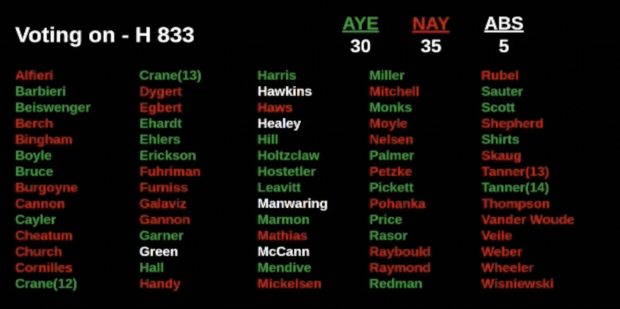 But the debate centered on one section of the bill: “(Recess) shall not be withheld for any disciplinary purposes, unless the cause for discipline occurred during a recess period.”
Rep. Soñia Galaviz, D-Boise, an elementary school teacher, said the wording would tie teachers’ hands. “It’s not about punishment. … It’s about accountability.”
Rep. Charlie Shepherd agreed. “Right now, that is one of the small tools that teachers have to discipline problem children,” said Shepherd, R-Pollock.
The bill’s sponsor, Rep. Jordan Redman, defended the bill and its compulsory language. “I think restricting (recess) will just produce more behaviors,” said Redman, R-Coeur d’Alene.
The 30-35 vote kills this bill. But after the vote, Redman told reporters he plans to bring back a different version of the bill.
During an afternoon floor session, the House quickly and unanimously passed two education-related bills, sending them to the Senate.
Inappropriate online behavior. House Bill 785 allows schools to discipline students who post obscene or threatening comments about school staff — during the school day, or outside the school day.
STEM Action Center. House Bill 761 would fold the state’s STEM Action Center under the umbrella of the Workforce Development Council. The STEM Action Center now operates as a separate agency, under the governor’s office.
Bill banning LGBTQ+ instruction stalls in Senate
A bill that would have banned K-12 instruction on gender identity and sexual orientation stalled in the Senate Education Committee.
Rep. Dale Hawkins said his bill would correct an error in a 2025 law. It prohibited LGBTQ+ instruction unless it’s “age appropriate or developmentally appropriate for students in accordance with state standards.”
This exception was “inadvertently” left in last year’s bill after it was amended, Hawkins said. This year’s proposal, House Bill 516, would have eliminated the age-appropriate language. “The subject of sexual orientation and gender identity is a subject for the home,” said Hawkins, R-Fernwood.
But the bill might’ve inadvertently banned content on heterosexuality as well, said Quinn Perry, deputy director of the Idaho School Boards Association. It didn’t define the terms sexual orientation or gender identity.
In addition, the “age-appropriate” language has been “in play” as public school leaders and their attorneys interpret last year’s law, Perry said. For instance, high school leaders in Idaho Falls read the law to allow a classroom discussion on recent U.S. Supreme Court cases dealing with sexual orientation and gender identity.
“There are discussions or instruction happening that may be indirectly related to these topics,” Perry said. “Where I don’t think there’s a loophole is that we’re teaching children about their gender and trying to convince them to transition … or things like that. I vehemently reject that that is happening in an Idaho public school.”
Sen. Van Burtenshaw said the committee should follow Perry’s advice before he made a successful motion to hold the bill in committee. “There’s enough confusion on this whole thing that, for me, I think it needs more discussion,” said Burtenshaw, R-Terreton.
Before the committee’s vote, six people testified against HB 516.
“This bill treats high school seniors like kindergartners,” said Scar Rulien of Twin Falls. “It says that they cannot possibly learn about LGBT people because it’s inappropriate. Straight, (cisgender) high school students are interacting with LGBT high school students every day of their lives, and erasing education about these identities won’t stop that.”
School improvement plans. Also Monday, Senate Education advanced a bill that would replace public schools’ required continuous improvement plans and eliminate other state reporting requirements.
Sponsoring Sen. Dave Lent said his proposal replaces “compliance-driven planning with results-driven strategy.”
“If our public system is going to move forward and be able to compete and become the school of choice in Idaho, we’re going to have to make some changes,” said Lent, R-Idaho Falls.
Senate Bill 1339 now heads to the full Senate.
Bill recognizing professional experience in school salary funding advances
A bill that would recognize professional experience outside the classroom on the career ladder is heading to the full House.
Currently, career-technical educators must receive four years of proficient evaluations before they can move up the career ladder, the state’s salary funding model. The bill would allow CTE instructors and professional support staff to move up the ladder with years of experience outside of schools.
“It’s going to help us retain these critical educators,” said Rep. Soñia Galaviz, D-Boise.

Galaviz is co-sponsoring the bill with Rep. Shawn Dygert, R-Melba.
The House Education Committee unanimously voted Monday to send the proposal to the full House. The committee advanced a replacement for the original bill, House Bill 816, after a “technical error” needed correcting.
The bill would apply to CTE instructors and licensed professional staff like school psychologists, therapists counselors, social workers and nurses.
Teresa Fritsch, a retired school psychologist and board member for the National Association of School Psychologists, told the committee that the bill would help pay and recruit psychologists amid a “critical shortage.”
“If there were more school psychologists in public schools, they would be able to provide more support to families and their students, particularly in our rural districts,” Fritsch said.
House Education took action on two other bills Monday:
Charter transportation. The committee unanimously approved a bill to make a narrow change to the state’s transportation funding program, allowing one charter school to collect an increased busing reimbursement.
Galaviz wants to close a funding loophole for Anser Charter School in Garden City. Anser’s share of state transportation funding is based on its first foray into busing, a small grant-funding program for physical education.
“Now they have a full busing system, and they are underfunded,” said Galaviz, who is sponsoring the bill.
Anser gets about a 50% funding match from the state. Most school districts and charter schools get 70% to 90%.
House Bill 815 now heads to the full House.
DOGE cleanup. The committee also approved a bill from the DOGE Task Force that would eliminate “obsolete, outdated and unnecessary” sections of state law.
The Senate unanimously approved Senate Bill 1291.
A bill to transfer funds — including $20 million from Launch — goes to Little
A far-ranging fund transfer bill — designed to balance 2026 and 2027 budgets — is on its way to Gov. Brad Little.
Senate Bill 1332 includes $20 million in transfers from the state’s in-demand careers fund: $10 million this year and $10 million next year.
Little has recommended this year’s transfer, which moves leftover funding from the Idaho Launch postsecondary aid program. Last year’s high school graduates didn’t apply for the full $75 million in Launch grants, leaving the leftover $10 million.
But next year’s transfers would affect this year’s high school graduates, who are still applying for Launch money. Since Launch graduates can receive up to $8,000 apiece, a $10 million transfer could affect some 1,250 applicants.
Little has not recommended the $10 million transfer for next year. However, SB 1332 has passed both houses with the two-thirds majorities needed to override a veto.
Monday’s House vote was 59-9, with Rep. Dan Garner, R-Clifton, joining Democrats in opposition.

