
Speakers spent almost two hours pointing to the warts in Idaho’s version of the One Big Beautiful Bill.
Then the bill received party-line support.
The House Revenue and Taxation Committee endorsed a plan to enact most tax cuts from President Donald Trump’s One Big Beautiful Bill, and allow Idahoans to get breaks on their 2025 taxes. The vote on House Bill 559 begins the fourth week of a legislative session dominated by budget and tax issues — and intensifies a Statehouse debate over cashflow and additional spending cuts.
HB 559 carries a projected, immediate $155 million price tag, for the budget year ending June 30. The estimated cost increases to $175 million next budget year.
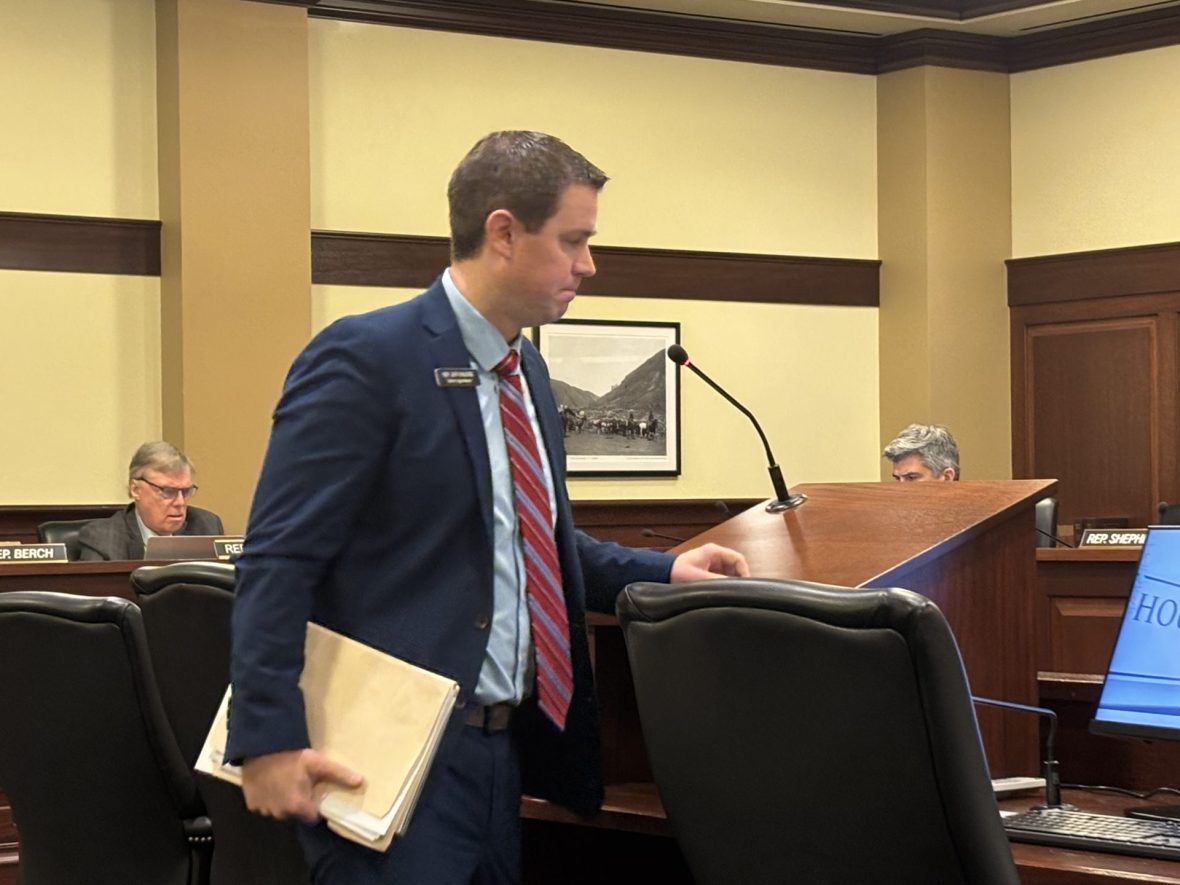
The bill’s sponsor, Rep. Jeff Ehlers, R-Meridian, sought to downplay concerns about the cost of conforming with the federal tax changes — and the potential budget impacts.
Sponsors made a “reasonable” attempt to estimate the cost, Ehlers said, factoring in wide-ranging estimates from the State Tax Commission and tax analysts. Ehlers said HB 559 is not a budget bill — even though legislative leaders are considering state agency spending cuts that would coincide with the tax cuts.
And Ehlers touted the benefits of the One Bill Beautiful Bill — such as cuts covering tips and overtime. “This bill is tax cuts for the people of Idaho.”
No one else seemed too enthusiastic, however.
The rewrite of the Idaho bill — which delays some corporate tax breaks for research — drew a lukewarm response from business advocates.
Miguel Legarreta, president of the Associated Taxpayers of Idaho, was asked twice to state a position on HB 559. Twice he declined.
“It’s not as pro-business as one might think,” he said of the bill.
Most speakers were opposed — saying the bill was rushed, and saying the tax breaks would come at the expense of schools and Medicaid.
“Education is bound to be cut, if this bill goes into effect,” said Georgia Boatman of Boise. “When you find yourself in a hole, quit digging.”
Emily Ballantyne of Boise discussed the impacts in personal terms. She said spending cuts could affect the school-based Medicaid services that helped her 7-year-old son learn to walk — and learn to read ahead of grade level.
The committee received about 200 emails on the bill, which were overwhelmingly opposed, said committee Chairman David Cannon, R-Blackfoot.
All committee Republicans voted for the bill, although some had reservations. Rep. Rick Cheatum of Pocatello at first said he was uneasy about voting for a bill that the business community was uneasy about. Moments later, he voted yes.
Rep. Britt Raybould of Rexburg opened the hearing with a question on the fiscal implications. “Do you anticipate additional cuts … in order to accommodate (tax) conformity?”
“That is going to be a policy debate that we will have in this body over time,” Ehlers said.
Ultimately, Raybould also voted yes.
Other Republicans were more enthusiastic. Rep. John Shirts, R-Weiser, said tax cuts would help blue-collar workers in his rural district, people living outside the “Boise bubble.”
The committee’s two Democrats, John Gannon and Steve Berch of Boise, voted against the bill.
HB 559 doesn’t just administer a stress test for the budget. It highlights one of several public splits between Republican Gov. Brad Little and the Legislature’s GOP leadership.
Little has recommended delaying the Trump tax cuts into effect until July 1, beginning in the 2026 tax year. That means the new tax changes would have no effect on Little’s budget for this year.
Pushing for an immediate tax cuts, going back to 2025, legislative leaders have also parted ways with Little on economic forecasts. Lawmakers say they expect this year’s tax collections to come in $152.7 million ahead of Little’s forecasts — essentially, enough money to cover the immediate tax cuts.
Legislative leaders have also split with Little on the idea of spending cuts — which could provide more cushion for immediate tax cuts. They have asked state agencies, including K-12 and higher education, to turn in plans for spending cuts of up to 2%, this year and next. In reports submitted Friday, college and university officials said these cuts would impact high-demand programs and force staff cuts and furloughs.
With Monday’s vote, HB 559 now goes to the House floor.
Tax Commission: Adopting federal codes will be a ‘heavy lift’
At the same time House Revenue and Taxation weighed the bill Monday, the budget-setting Joint Finance-Appropriations Committee heard a presentation from the Idaho State Tax Commission’s chairman that touched on conformity.
Typically, the Tax Commission has about nine months — from the time the Legislature passes a conformity bill to the start of the following tax year — to update its systems and educate the public about changes, said Chairman Jeff McCray.
But making tax code changes retroactive to the 2025 tax year will require “extraordinary efforts,” McCray said. The Tax Commission will have to implement dozens of code changes in a much shorter window. The filing deadline is April 15, and returns have already started rolling in. These will need to be updated.
Meanwhile, the Tax Commission is facing a $1.4 million budget cut and staffing is at a “tipping point,” McCray told JFAC. “I have a lot of faith in our team. It’s just a heavy lift.”
University president search bill easily clears Senate
A bill that would allow university president searches to be done mostly in secret sailed through the Senate with no opposition Monday.
During a short debate, two senators spoke in favor of Senate Bill 1225 before the Senate unanimously voted to approve it.
Senate Majority Leader Lori Den Hartog’s bill would allow president search committees to publicize a single finalist before the State Board of Education hires them. Currently, search committees have to reveal five finalists.
This requirement has deterred “quality” candidates, who fear “retribution” at their current jobs, from applying for Boise State University’s vacant president job, said Den Hartog, R-Meridian.
“Perhaps they would be putting their job at risk,” she said. “We have seen this play out in real time in this search for Boise State’s president.”
SB 1225 would require the State Board to wait 10 business days before hiring the search committee’s finalist. Otherwise, the search process could be done behind closed doors.
Boise State’s search to replace former president Marlene Tromp stalled in October. Den Hartog previously told EdNews that the State Board supports proposed changes to the search process and helped with the bill’s wording.
SB 1225 now heads to the House.
AI framework bill heads to House
A bill calling for a state framework guiding artificial intelligence in public schools cleared the Senate, but not without some opposition.
The Senate voted 26-8 to approve Senate Bill 1227. The proposal would direct the Idaho Department of Education to create a framework for the “responsible use of AI in K-12 education.” It also requires that public school districts and charter schools adopt policies on how students and staff use AI.
Sponsoring Sen. Kevin Cook emphasized Monday that the bill doesn’t allow schools to replace teachers with AI. “You still need to have human intervention,” said Cook, R-Idaho Falls.
Sens. Brian Lenney, R-Nampa, and Tammy Nichols, R-Middleton, debated against the bill before voting no. “I have some concerns on how the implementation might come to pass,” Nichols said.
SB 1227 now goes to the House.

