
We are firm believers in transparency of public funds. This is why we welcome the recent scrutiny regarding Idaho school “fund balances”. However, the raw numbers can be used to paint a misleading picture without context of what it actually looks like to fund operations of a school in Idaho. Let’s talk about the high-stakes guessing game that we are required to play when funding our schools.
Before a single student walks through our doors, we are legally committed to their education, while the state’s financial commitment to us is far more fluid.
The Attendance Gap: Staffing vs. Funding
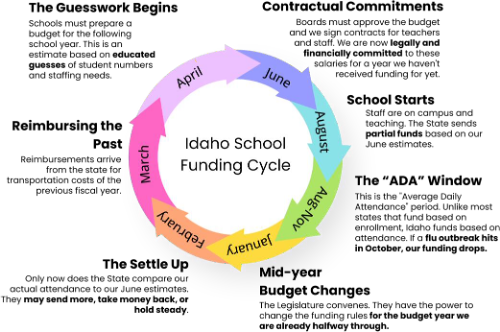
The most critical point in the timeline above is the distinction between enrollment and attendance. We must hire staff based on how many students are enrolled. If 100 students enroll, we need four teachers. However, if those students have a 92% attendance rate, the state only pays us for 92 students.
We cannot “un-hire” a teacher because five students are out sick. Operating reserves are the only thing that fills that gap.
The Charter School Conundrum
For Public Charter Schools, the pressure is even higher. Charter schools do not receive local tax funding and rely entirely on state and federal funding. Unlike school districts, they do not have the authority to run local levies to bridge funding gaps and inconsistencies. Furthermore, the Idaho Public Charter School Commission requires schools to keep 30 to 60 days of cash on hand.
There is also a hidden “Debt-to-Income” (DTI) conflict: if a charter school receives a bond for a facility, that bond often requires a higher reserve than the state commission does. In these cases, the school is forced to keep a high fund balance just to remain in legal compliance with its creditors.
What are Operating Reserves?
Let’s start with what they are not. Operating reserves are not “squirreling”.
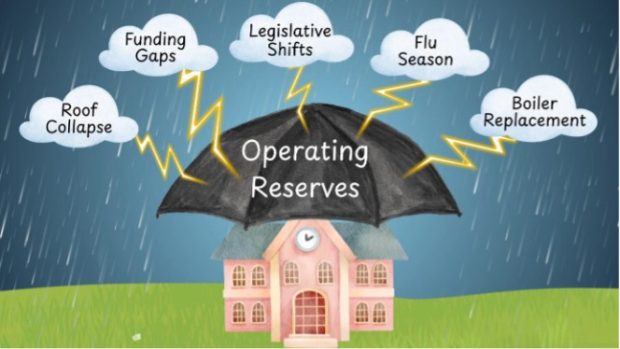
Operating funds are a necessary buffer to keep inconsistent cash flow from affecting the day-to-day operations of business, the business of educating our kids. Professional accountants recommend that any business with employees keep 3 to 6 months of operating expenses in reserve. Most Idaho schools are currently operating well below that threshold.
These funds serve three vital functions:
- Payroll Protection: Ensuring our teachers get paid even when the state “settles up” with less than we budgeted.
- Emergency Repairs: Replacing a roof or a failed HVAC system without needing a special election.
- Long-term Planning: Saving for renovations or new construction, much like a family saves for a down payment on a house.
Beyond the enrollment vs. attendance conundrum, operating funds are our only lifeline when disaster strikes. In some Idaho schools, a broken water main could deplete half of their savings overnight. We have seen Idaho districts rely on these reserves to replace boilers that failed in the dead of January, to repair roofs that collapsed by record snowfalls, and to keep classrooms staffed when the state ordered a 5% budget holdback mid-year during the pandemic. In these moments, “fund balances” aren’t numbers on a spreadsheet — they are the only thing keeping the lights on and the building safe for your kids.
A Challenge to our Leaders
Politics are currently failing our kids; our educators are not. Our schools are required to submit roughly 150 different state and federal forms annually—an administrative burden that consumes thousands of man-hours. Yet we are still “nickel-and-dimed” by a system that expects “uniform and thorough” results from inconsistent and volatile funding.
We issue this challenge to Idaho’s elected officials: Commit to fully funding the educational expenses incurred by public schools for four consecutive years. Stop the mid-year budget shifts and the attendance-based penalties.
Give us stability, and we will show you what Idaho’s kids can truly achieve. Until then, do not punish us for being fiscally responsible enough to save for the unfunded mandates your policies create.
Leslie Baker, Moscow Charter School Chair/ISBA Region 9 Chair and Janelle Hill Blackfoot Charter School Chair/ISBA Region 9 Vice-Chair

