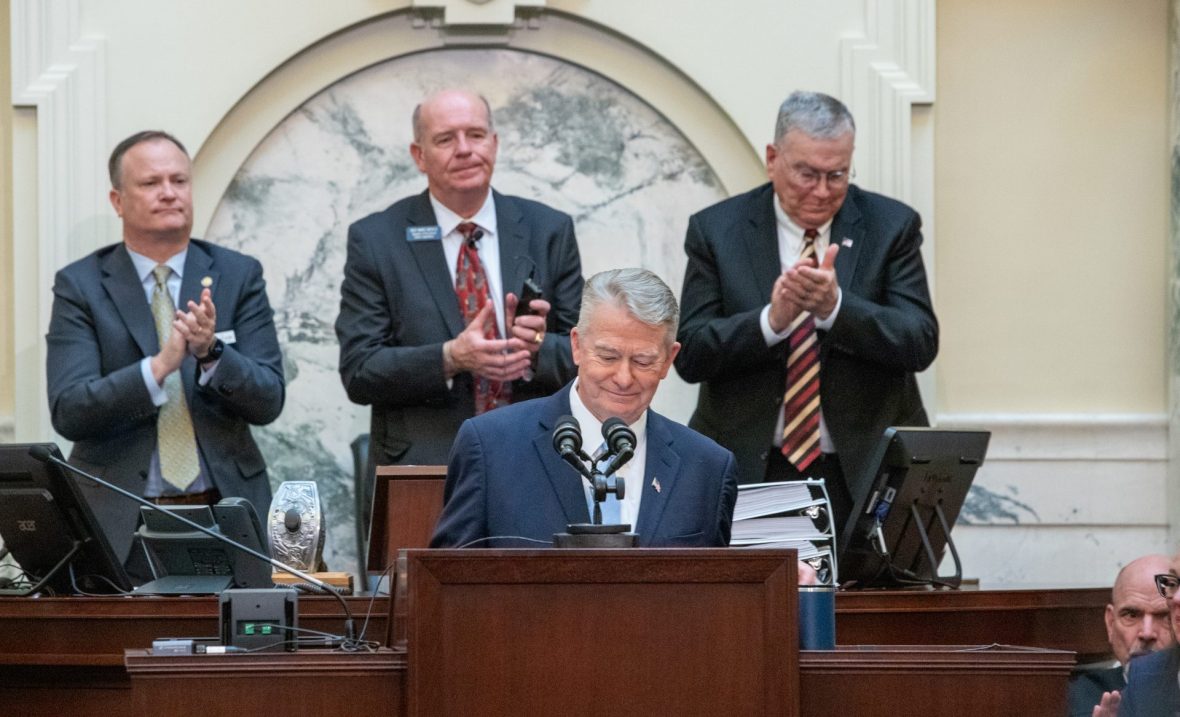
Legislative leaders are pointing a bulldozer at Gov. Brad Little’s Jenga budget.
Showdowns between the governor and the Legislature occur every year. But only 17 days ago, Little spelled out his plan in his 2026 State of the State address. It’s rare to see legislators try to dismantle so much of a governor’s agenda, so quickly.
Lawmakers are betting on $275 million in found money this year and next, replacing Little’s revenue forecasts with a rosier batch of numbers. Legislators want to use $155 million for immediate tax cuts that Little didn’t put in his budget. And legislators want agencies to plan for ASAP spending cuts that Little never suggested — up to $55 million for K-12 and up to $9 million for higher education.
In recent sessions, legislators have outmaneuvered and outlasted Little. But no matter who wins this year, education has millions of dollars hanging in the balance, starting right now.
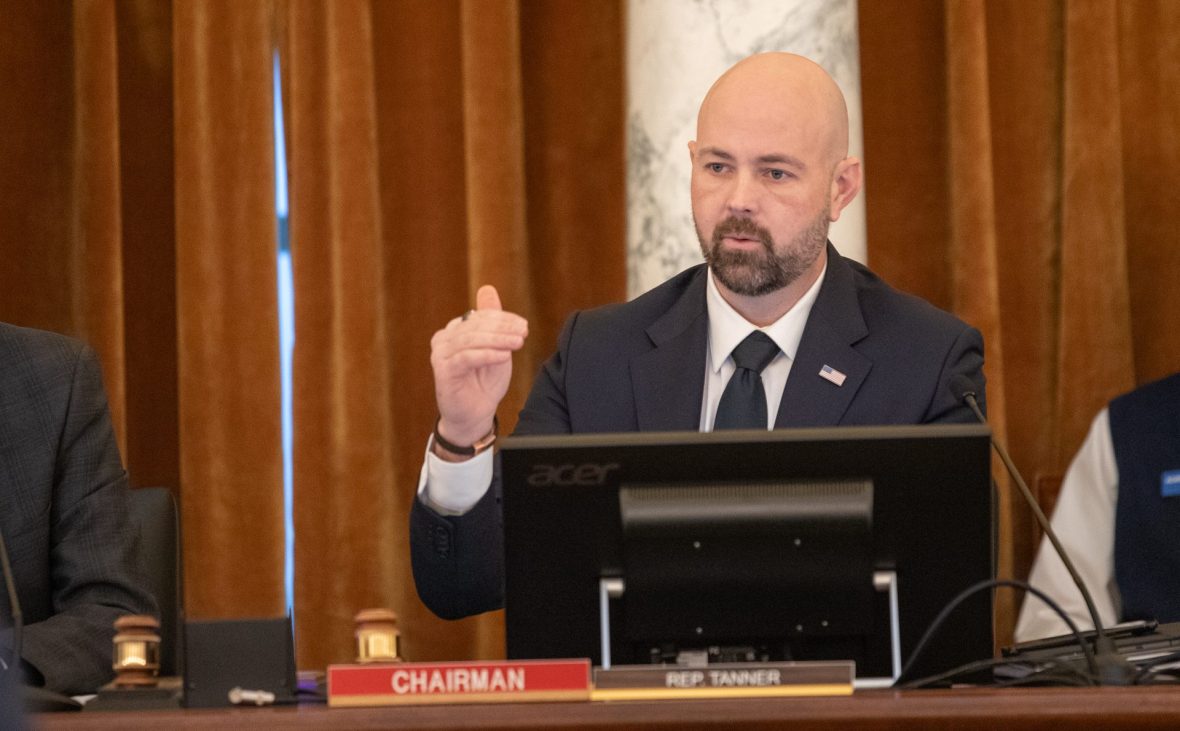
Education sits squarely on Idaho’s flimsy fiscal foundation. Little’s current-year budget leaves a scant $32.1 million cushion — a half a penny on the dollar, or “a sliver of a fraction,” as one of the Legislature’s chief budget-writers, Rep. Josh Tanner, R-Eagle, put it this week. However, the budget plan emerging from the Legislature is also held together by assumptions, and balances just barely.
The first big assumption centers on the amount of money coming in the door. The Legislature’s forecasts — the basis for every tax-and-budget decision to follow — exceed Little’s numbers by $152.7 million this year, and $135 million for next year. (Keep that first number in mind for a few more paragraphs; it’s important, and we’ll get back to it.)
Legislators based their more optimistic numbers, in part, on a recent surge in corporate tax collections. Tax revenues exceeded December forecasts by $102.4 million — according to a legislative staff report released a day after Little’s State of the State address, and after Little set his revenue forecast.
“If we were making that same decision back in December, I think that number would have looked different,” Tanner, the co-chair of the budget-writing Joint Finance-Appropriations Committee, told EdNews this week.
Little’s budget chief stands behind the governor’s numbers — saying they are not pessimistic, but careful. “We would rather be close on revenue and put a really tight budget together than predict things are going to get better and then not make it,” Division of Financial Management Administrator Lori Wolff said in an EdNews interview Wednesday.

More money — if it actually rolls in — gives the state’s decisionmakers more options.
Which tidily ties into tax cuts.
It’s obvious that one of the most Republican states in the nation — a state where President Donald Trump actually still enjoys high approval ratings — will adopt the tax cuts in his One Big Beautiful Bill act. It’s only a question of when — and that’s one big beautiful brawl in the making.
Little wants to adopt the tax cuts, but not until the new budget year that begins July 1. One reason is the uncertain bottom-line impact. Little floated his plan for a delay with “key legislative partners,” Wolff said, and she said lawmakers had similar questions.
But legislative leaders are now all in on adopting the cuts, and immediately, while guessing at the costs. A new bill — a second stab at tax code “conformity” — delays some corporate breaks, while focusing on tax cuts for everyday Idahoans.
“I believe it can give us … less heartburn in the current budget,” said Rep. Jeff Ehlers, R-Meridian, who is co-sponsoring the bill alongside House Speaker Mike Moyle, R-Star, JFAC co-chair Sen. C. Scott Grow, R-Eagle, among others.
But despite the changes, the new bill recycles the same old cost estimate. Lawmakers still figure the tax breaks would cost $155 million this budget year — a number that conveniently aligns with the $152.7 million of new, projected revenue. (See? We told you that number was important.)
If the Legislature’s revenue prediction pans out, the tax cuts pencil out — with a margin for error even narrower than Little’s.
Which helps explain the memos legislative staff sent out to state agency heads this week, on behalf of Tanner and Grow. The first, on Monday, told most state agencies to draw up scenarios for 1% and 2% budget cuts. That directive left K-12 and Medicaid untouched, but only for 48 hours. On Wednesday, a followup memo requested similar cost-cutting scenarios for public schools and Medicaid.
All of these cuts are over and above the 3% budget cut Little imposed in August, which affected all of state government, save for K-12. This week’s memos suggest cuts that do not appear in Little’s budgets for this year and next, proposals that more or less hold K-12 harmless.
Meanwhile, higher ed has already absorbed $20 million in cuts, even before JFAC chairs floated an additional $9 million haircut. “Further reductions would have real consequences for Idaho students and families, limiting access, increasing costs, and undermining the state’s workforce and economy,” State Board of Education Executive Director Jennifer White said Wednesday.
Timing makes the problem worse. With five months left in the current budget year, school administrators and agency heads would have few options. Furloughs and layoffs could be unavoidable.
Tanner said budget cuts are not a done deal. “We want to make sure all the options are on the table as we’re continually working through this,” he said Tuesday, a day before K-12 and Medicaid landed on the table.
So who wins if Idaho’s Republican governor and its GOP-dominated Legislature get into a full-blown stalemate? Recent history favors the Legislature.
In 2023, Little dug in. He vetoed a far-reaching property tax reform bill, mainly because it eliminated a March election date for school bonds and levies. On nearly a party-line vote, the Legislature overrode Little’s veto.
In 2025, Little gave in. He signed onto the Legislature’s $453 million buffet of tax cuts and tax credits into law — three times what he proposed at the start of the session. The tax cut binge certainly factors into this current budget crunch; Tanner, a fiscal hawk, said as much in a House Education Committee hearing Tuesday, before also placing the blame on a decade of spending increases.
How does Little approach 2026, after 2023 and 2025? Not surprisingly, his team isn’t really saying, although Wolff stands by Little’s budget. “We know (legislators) have a good plan in front of them, and we hope that’s the one that they end up using.”
But here’s one reason Little can settle in for the long haul. Legislators have much more to fear from the May GOP primary than Little does.
With no announced challenger and the ability to raise campaign cash on demand, Little can govern with little worry about a low-turnout closed primary. He can wait out legislators facing contested primaries at home. He can govern with an eye to what could well be the final campaign of his political career, the November general election.
If he chooses to.
Little’s next move doesn’t just have campaign implications. With the state’s budget teetering, it will have immediate and lasting effects on K-12 and higher ed.
Kevin Richert writes a weekly analysis on education policy and education politics. Look for his stories each Thursday.