State agency budget cuts could deepen to 5% for the current fiscal year and next fiscal year.
Leaders of the Legislature’s Joint Finance-Appropriations Committee (JFAC) told agency directors Monday to make plans for additional across-the-board spending cuts at 1% and 2%, according to a memo obtained by Idaho Education News.
These would be in addition to the 3% cuts that Gov. Brad Little made through an executive order last year.
Sen. C. Scott Grow and Rep. Josh Tanner — JFAC’s Republican co-chairs from Eagle — are “evaluating options to balance the statewide budget,” and “one of those options is to further reduce budgets,” the memo said. Keith Bybee, chief budget analyst for the Legislative Services Office, delivered the message on behalf of the co-chairs.
Like Little’s directive last year, the additional statewide cuts would apply to fiscal year 2026, which ends June 30, and fiscal year 2027, which starts July 1. The potential reductions would also exempt K-12 public schools, but not higher education.
A 5% cut would save the state $147.2 million in FY 2026, about $31 million more than the ongoing reductions recommended by the Republican governor, according to a spreadsheet attached to Monday’s memo. Click here to read it.
During his State of the State address Jan. 12, Little proposed a hodgepodge of one-time and ongoing cuts and fund transfers to address slowing tax revenue this fiscal year and a looming shortfall next fiscal year. But he didn’t recommend increasing his 3% across-the-board cuts to agency budgets.
Tanner, the newly appointed co-chair of the budget-setting committee, criticized the governor’s proposed budget for not making enough ongoing cuts and for relying on narrow margins on the bottom lines of two annual budgets that lawmakers must balance this legislative session. Little recommended ending balances of about $32 million in FY 2026 and $25 million for FY 2027.
Tanner told EdNews Monday that additional cuts would allow for larger carryover balances. They would also make room for the cost of conforming to federal tax changes in President Donald Trump’s One Big Beautiful Bill Act.
On Friday, Idaho lawmakers introduced a bill that pegs the cost of conformity at $155 million, a mid-range estimate from the Idaho State Tax Commission. While the governor used the same estimate, he recommended implementing the tax changes in FY 2027, and the new bill would enact them immediately, cutting into state revenue this fiscal year.
“There’s still a lot of unknowns,” Tanner said by phone.
A spokesperson for Little did not immediately respond to a request for comment Monday.
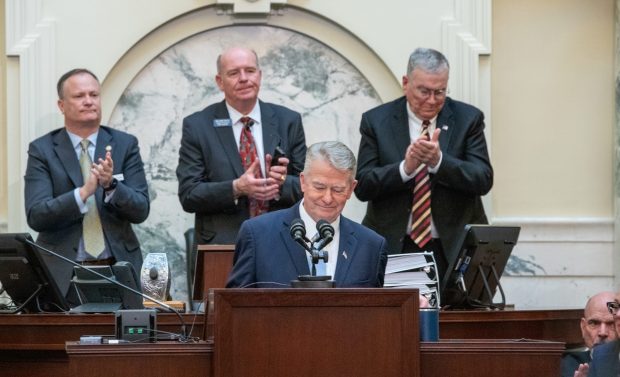
Grow and Tanner set a Friday deadline for the budget reduction plans. They told agency directors to:
- “Identify how budget reductions will affect the current workforce and whether additional reductions will necessitate formal reductions in force, furloughs, or both.
- Identity when affected programs were added to the budget.
- Identify if an essential service is affected.
- Identify efficiencies.”
Tanner confirmed that K-12 would be exempt. But colleges and universities, along with other education-related state agencies, would not be immune.
The memo shows that colleges and universities would altogether face up to $9 million in additional annual cuts — on top of the $13.5 million reduction from Little’s executive order.