Jeff Simmons, superintendent of the Idaho Digital Learning Alliance (IDLA), expected a budget cut this legislative session — 3% or 6%, maybe — but Gov. Brad Little took him by surprise.
Simmons learned, a week before the legislative session started Monday, that the governor’s budget proposal for next fiscal year would take a 39% bite out of the state’s online learning platform. Created by the Legislature in 2002, IDLA offers school districts and charter schools online courses to supplement their curriculum. Rural school leaders say it’s an “essential” resource.
“We understand that everybody has to tighten the belt a bit this year because of the budget situation, and we know we’re not immune to that,” Simmons told Idaho Education News by phone Tuesday. “I’m not sure that under a 40% reduction IDLA can be the resource that it has been.”

During his State of the State address Monday, Little said his budget would protect “classroom funding” for public schools amid a statewide revenue crunch.
But this didn’t apply to online education. The Republican’s recommendations include taking $23 million from online charter schools, such as the Idaho Home Learning Academy, and $10 million from IDLA.
The cuts would have a far-reaching impact. Almost every school district and charter school across Idaho, save a few elementary-only districts, use IDLA to some extent, Simmons said. Last school year, 28,593 students, or about 9% of all public school students in the state, took an IDLA course.
State leaders propose cuts to ‘right-size’ budget
IDLA received $26 million from state coffers this fiscal year, a 158% increase since 2019 and following an enrollment spike during the COVID-19 pandemic.
The agency collects $445 per course enrollment, and most students take more than one course in an academic year. During the 2024-25 school year, enrollment — which includes students who take multiple courses — reached 51,452.
On Tuesday, Lori Wolff, Little’s budget chief, told the Legislature’s Joint Finance-Appropriations Committee (JFAC) about a few policy changes that could “right-size” IDLA’s state funding, including:
- Ensuring that IDLA students aren’t funded twice — once through IDLA and once through their brick-and-mortar school.
- Eliminating state funding for courses that don’t satisfy state graduation requirements.
- Making private- and home-school students ineligible for state-funded courses, since they now qualify for the Parental Choice Tax Credit.
Asked this week for details on how these reforms would add up to $10 million, Little’s spokeswoman referred EdNews to state superintendent Debbie Critchfield’s office, which is spearheading the policy changes.
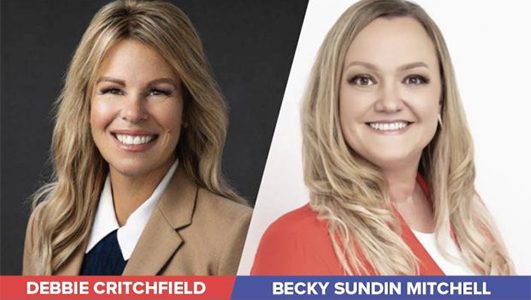
Critchfield said Wednesday that IDLA “plays a vital role for students across the state, particularly in rural areas,” but her office’s priority is ensuring that virtual education is funded “in the most responsible, transparent way.” Critchfield is one of eight members comprising IDLA’s board of directors. The board also includes three public school superintendents, two principals and two business community representatives.

“The details of the proposed funding adjustments are still being worked through, but the why is straightforward,” Critchfield said in an emailed statement. “Idaho students are accessing virtual options. We want that to continue while being confident every dollar is being used most appropriately.”
Online students counted twice in funding formulas
While the scale of the 39% cut surprised Simmons, there was a reason he anticipated additional scrutiny this session — and it wasn’t only because of the state’s budget crunch. Concerns about IDLA’s rising budget and funding model surfaced among lawmakers last year.
A July report from the Legislative Services Office (LSO) highlighted that a public school student who logs into an IDLA course during an instructional day is counted twice in state funding formulas. The student counts toward IDLA’s enrollment and toward the attendance-based formula that funds traditional public schools and charter schools, known as average daily attendance (ADA).
Here’s a hypothetical to illustrate how it works:
Johnny, a 9th-grader attending a traditional, brick-and-mortar public high school, has seven class periods throughout the instructional day. Six of Johnny’s class periods are in-person courses covering math, science, social studies, English, etc., and taught by a teacher employed by the school district.
For the seventh period, Johnny goes to a classroom — likely staffed by a district paraprofessional — and he logs into a computer to complete coursework for an online class in digital literacy that’s offered by IDLA and taught by a certified IDLA instructor.
State funding formulas pay for the in-person classes and the online class separately. IDLA receives $445 for the academic year covering Johnny’s enrollment in the digital literacy class, and Johnny’s attendance at school that day is counted toward the school district’s ADA calculation.
“Idaho Code does not provide for calculation adjustments when a student is enrolled in an IDLA class,” said LSO’s report from last year. “Because of this, a student can count towards a school district or charter school average daily attendance and as an enrollment for IDLA for the same class period.”

IDLA superintendent defends funding model
Simmons argues that this funding model makes sense. A student only counts toward a district’s ADA calculation if they attend school for four or more hours per day. This means the district would receive its ADA funding for the hypothetical Johnny regardless of whether he takes an IDLA class.
Districts also retain responsibility for students who are in virtual classes — responsibilities like school lunches, student safety, parent communication, academic recordkeeping, technology access and discipline.
“Any course that we deliver is in partnership with the school,” Simmons said. “We’re providing curriculum and a teacher, but a lot of the other support that is required to teach a kid is still needed on the face-to-face side.”
It’s unclear how these funding mechanisms would be changed under the governor’s budget. But it appears that changes would solely target IDLA’s budget — and not funding for the school districts that also benefit from the current model.
“Correcting the double funding at the Idaho Digital Learning (Alliance) will help ensure public school classrooms maintain their full funding,” said Joan Vargas, Little’s press secretary.
Members of the executive branch may not be the only ones pushing for reforms this legislative session. Sen. Brian Lenney, R-Nampa, last year floated completely defunding IDLA to make way for private providers of online classes.
IDLA’s largest expense is staff. Last school year, the platform spent $11.9 million on payroll for instructors and student supervisors. The second highest expense was technology — $4.7 million — followed by curriculum — $2.2 million.
The proposed cuts have already faced pushback from one member of the Legislature. During Tuesday’s JFAC meeting Rep. James Petzke, a member of the budget-setting committee, questioned the logic behind defunding an online resource that’s more “cost-efficient” than in-person learning.
“I’m just still confused as to why we’re shifting away from that,” said Petzke, R-Meridian.

Rural districts lean on IDLA
Rural school districts, in particular, rely on IDLA to fill gaps in course offerings limited by access to qualified teachers or geography.
One in five students in rural districts uses IDLA compared to one in nine students from urban districts, according to a report the agency submitted to the Legislature last year.
Rural schools often tap IDLA for dual credit, college-level courses that count toward an associate’s degree, Simmons said. “They’re not close enough to a college or university campus to take advantage of those programs,” he said. “So if they want to do something like that, they have to do it through our program.”
IDLA also offers advanced placement, driver’s education and unique classes not typically offered by a traditional school district. While IDLA is mostly geared toward students in middle school and high school, its “Elementary Launchpad” connects classroom teachers with virtual instructors, who provide additional literacy coaching.
School board trustees from the Butte County and Challis districts last week published a column arguing that IDLA is a “lifeline” and a “powerful, Idaho-built tool” that levels the playing field between rural districts and better-staffed and better-funded urban districts.
“When we say IDLA is essential, we aren’t exaggerating,” the trustees wrote. “Without it, our districts could not offer many of the courses our students depend on.”
The trustees also noted that online courses fulfill curriculum requirements handed down by state policymakers — mandatory instruction in financial literacy, career exploration and digital literacy.
“Those courses don’t just magically appear in small towns without certified teachers to teach them,” they wrote. “IDLA fills that gap.”