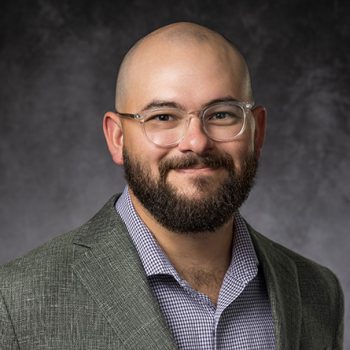
Relations between the governor’s office and the legislative budget committee’s new co-chair got off to a rocky start Tuesday.
After a testy exchange with Gov. Brad Little’s budget chief during the morning’s Joint Finance-Appropriations Committee (JFAC) meeting, Rep. Josh Tanner took the unusual step of issuing a news release slamming the governor’s budget recommendations.
“The Governor’s budget does not balance,” Tanner said in the release. “It relies on one-time gimmicks, spends more than the state takes in on an ongoing basis, and leaves Idaho with the lowest ending fund balances in nearly a decade.”
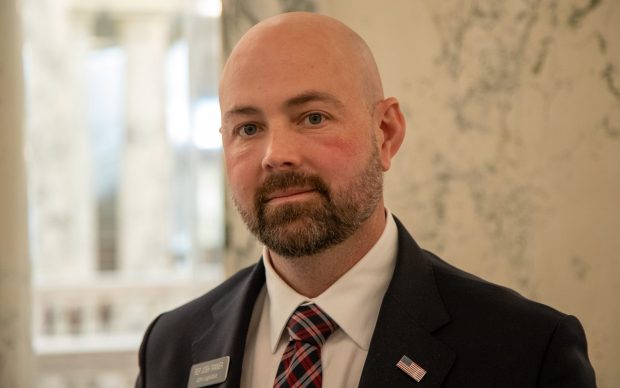
The release followed a presentation by Lori Wolff, administrator of the governor’s Division of Financial Management, on Little’s spending recommendations for fiscal years 2026 and 2027.
The governor’s budget includes an array of spending cuts, reversions and fund transfers aimed at resolving a looming deficit caused by last year’s massive tax cuts and underperforming state revenue.
“This is a balanced budget,” Wolff told JFAC. “It reflects early action, disciplined spending decisions and confidence in Idaho’s economic future.”
“Reversion” refers to the process of moving unspent money allocated for a specific purpose back to the general fund, the state’s primary operating account furnished by tax revenue.
Altogether, Little’s proposed cuts, reversions and transfers would shift $223.2 million and $642.5 million into the general fund in FY 2026 and FY 2027, respectively. These moves would cover the state’s projected shortfalls and balance spending increases required by law — hikes to Medicaid, prisons and employee health insurance, for instance.
But the margins are slim.
After the Legislature left about $420 million on the bottom line last session, Little is proposing a new carryover balance of just $30 million for the current fiscal year. Next fiscal year’s bottom line would be $25 million, a much smaller number than current lawmakers became accustomed to in recent surplus years.
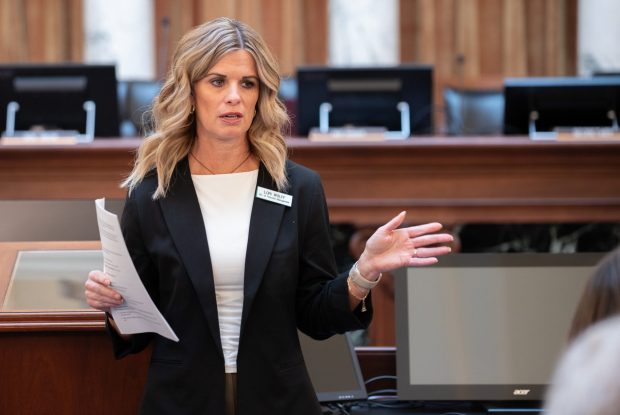
The governor’s budget also makes some assumptions.
It predicts that conforming to federal tax cuts in President Donald Trump’s “One Big Beautiful Bill Act” — as Little recommended and as GOP legislative leaders appear supportive of — will increase the state’s deficit by just $155 million. This is a mid-range estimate from the Idaho State Tax Commission, and it’s $129 million less than a projection from the Tax Foundation, a Washington, D.C.-based think tank.
And it assumes that state revenue will stabilize in 2026. The largest of the governor’s proposed cuts are one-time, filling gaps in the short-term and ensuring funding could be restored in future years.
“Rather than cutting too deep or cutting too much, we are betting that our revenues are going to be strong,” Wolff said.
Tanner didn’t hold back his skepticism during Tuesday’s meeting. The Republican from Eagle noted that the governor’s balanced-budget plan hinges on revenue uncertainty and on policy changes — such as a $23 million proposed cut to online schools — that lawmakers may not agree with.
“You can get a positive ending balance, but you’re balancing on hope,” he said. “I find it really interesting that you named it ‘Enduring Idaho,’ mostly because, to me, it looks like it’s a ‘balance-later budget.’”
Tanner replaced former Rep. Wendy Horman, who resigned last month for a role in the Trump administration, as co-chair of the powerful budget committee.
Tuesday’s JFAC meeting and Tanner’s press release set the stage for budget fights to come. While Little’s budget works on narrow margins to minimize the lasting impact of recent revenue shortfalls, Tanner signaled that he’ll push for deeper ongoing cuts — decreases that would rein in state spending more permanently.
Governor’s proposed cuts, reversions, transfers
FY 2026
- 3% holdback – $64.2 million
- Reversion of Idaho Department of Transportation’s Strategic Initiatives Fund – $45 million
- Canceled or delayed Permanent Building Fund projects – $34 million
- Reversion of Empowering Parents funding – $30 million
- Public school support-unit adjustment for declining enrollment – $22 million
- Reversion of Water Fund Pollution Control Fund – $15 million
- Reversion of unused Idaho Launch scholarships – $10 million
- Opportunity Scholarship balance – $3 million
Total: $223.2 million
FY 2027
- Reversion of Idaho Department of Transportation’s Strategic Initiatives Fund – $275 million (one-time)
- 3% spending reduction and carry-over holdbacks from FY 2026 – $120 million (ongoing)
- Transfer of interest earnings from Budget Stabilization Fund, Millennium Fund, Strategic Initiatives Fund, Water Pollution Control Fund – $100 million (one-time)
- Medicaid spending cuts – $45 million (ongoing)
- Reversion of Empowering Parents funding – $30 million (ongoing)
- Online public schools cuts – $23 million (ongoing)
- Reversion of funding for 100 vacant employee positions – $20 million (ongoing)
- Reversion of Water Pollution Control Fund – $10 million (ongoing)
- Idaho Digital Learning Academy cuts – $10 million (ongoing)
- College and university enrollment workload cuts – $9.5 million (one-time)
Total one-time: $384.5 million
Total ongoing: $258 million
JFAC members also probed a few specifics in the governor’s budget Tuesday, including:
Employee pay and insurance costs
Little did not recommend raises for state employees, including public school educators. The state also will have to contend with rising health care benefit costs, which are reflected in the governor’s budget.
Employee health care benefit costs are increasing 14.5%, or between $14,130 and $16,170 per person, next fiscal year, according to the governor’s office. This amounts to a $62.4 million hit on the general fund — $21.7 million for state employees and $40.7 million for public school educators.
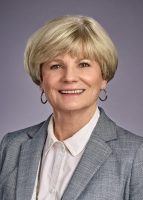
Senate Minority Caucus Chair Janie Ward-Engelking, a veteran member of the budget committee, noted Tuesday that the governor’s budget covers insurance increases for state agencies but not for their employees. In other words, workers face a benefit cut next year.
“They’re probably going to be looking at more money out of their pocket for health care,” said Ward-Engelking, D-Boise. “So (it’s) definitely a reduction in their pay.”
IDLA cuts
JFAC also signaled that the governor’s office will face pushback on a proposal to cut funding for the Idaho Digital Learning Alliance (IDLA).
Little’s budget recommended a $10 million cut to IDLA’s $26 million annual budget. The state’s online learning platform offers school districts and charter schools virtual courses to supplement their curriculum.
“That is a pretty significant cut, obviously, to a program that every single charter and district is using,” said Rep. James Petzke, R-Meridian. “There’s obviously big growth in these online programs, and the benefit to the state is that they’re in many ways more cost-efficient. I guess I’m just still confused as to why we’re shifting away from that.”
The governor’s budget proposes reining in instances where IDLA students are counted twice in state funding formulas — once for attendance at their brick-and-mortar school and once for taking an online course.
It would also eliminate the option for private- and home-schoolers to seek reimbursement for IDLA courses after the state enacted the Parental Choice Tax Credit last year.
“In some cases, I think we are not as efficient, and those are the areas we need to look at,” Wolff said.