
Gov. Brad Little packed plenty of shoutouts to President Donald Trump into a 29-minute speech Monday.
Little also worked in a raft of rosy remarks about the health of the Idaho economy.
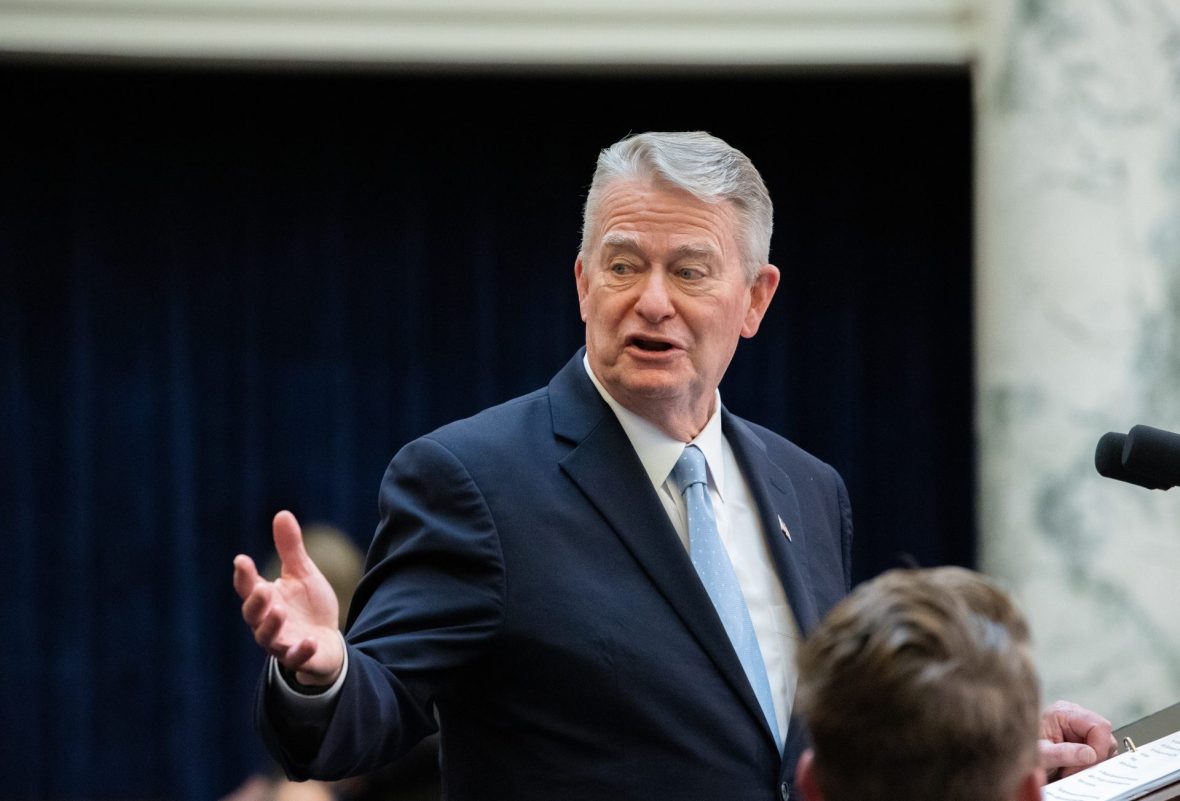
But he also talked a lot about the need for cuts — to “right-size spending to match the people needs.”
If you feel like you’re suffering from whiplash, it’s OK. It was a strange and mixed message, foreshadowing what could be a strange session. Despite what is a — just ask Little — thriving Idaho economy, Little and lawmakers will need to cut $40 million to balance this year’s budget, and could need to cut a staggering $555 million from spending requests for next year.
Every session is all about the budget. But this session more than most. Little’s eighth State of the State address set the stage for a few big budget battles, and sidestepped at least one.
Virtual schools: a big battle. Little is taking a hard line against Idaho’s growing — but also controversial — virtual school sector. He proposed taking a $23 million bite out of the virtual schools’ $169 million budget, including $20 million that now goes for taxpayer-funded payments to parents.
These payments are at the heart of a blistering legislative report from December, which revealed that parents of Idaho Home Learning Academy students put some public money for private education, and for non-education purchases such as water park admissions, paddleboards and a meat thermometer. Little wants to eliminate these payments, known as “supplemental learning funds.”
But these payments are at the heart of IHLA’s business model, which siphons state dollars away from teacher pay and benefits and into a parent-driven education approach. According to December’s report, more than 70% of parents say they would pull their kids from the statewide school if the state gets rid of the $1,700 to $1,800 payments.
IHLA serves 7,600 students from more than 70% of the state’s zip codes. And last session, the IHLA community rapidly mobilized to kill a virtual school bill. Don’t be surprised if virtual school funding emerges as the biggest K-12 fight of the session.
Special education: a big hole, and a modest proposal. On Monday, Little praised state superintendent Debbie Critchfield for “advancing new solutions for special education students.” Of course, those new solutions came after Critchfield tabled her more ambitious special education proposal: a $50 million block grant plan that would erase about half of a $100 million statewide shortfall.
Critchfield now wants to move money from two Idaho Department of Education accounts to create a $5 million program to serve high-needs students — students who require a full-time American Sign Language interpreter or other costly staff support. A $3 million proposal narrowly passed the House last year, but failed in the Senate by one vote.
House Speaker Mike Moyle, R-Star, was among last year’s opponents. On Monday, he was noncommittal. “I have no idea yet,” Moyle said after Little’s speech. “The devil’s in the details.”
Medical education: a big dodge. Last year’s big higher education fight centered on medical education — and an attack on Idaho’s five-decade affiliation with the University of Washington’s WWAMI medical school partnership.
Earlier this month, a task force recommended the state subsidize additional medical school seats at the University of Utah and the for-profit Idaho College of Osteopathic Medicine. Significantly, the task force recommended maintaining the status quo, subsidizing 10 seats annually at Utah and 40 seats per year at WWAMI, at a cost of $10.7 million.
Little is essentially doing nothing with the report. He isn’t recommending adding medical school seats — even though a 2025 law calls for exactly that. If a cash-strapped Legislature follows Little’s lead, Idaho might spend 2026 kicking the can on its chronic physicians’ shortage.
And that could be a theme for 2026, Senate Assistant Minority Leader James Ruchti said after Monday’s speech.
“I think what we’re going to see is a lot of hanging on to what we have,” said Ruchti, D-Pocatello. “We’re going to have real missed opportunities this year.”
One Big Beautiful Bill: a big gamble. Little’s 2026-27 budget blueprint spares K-12 from cuts and keeps Medicaid expansion intact, but the whole plan is dangling on threads and assumptions.
The biggest might involve the One Big Beautiful Bill, and conforming with the federal tax cuts in the new law. Little is banking on a $155 million price tag — a midpoint of projections from the State Tax Commission. But the nonprofit Tax Foundation has pegged the cost at $284 million.
“That was one of the hardest pieces to put into the budget this year,” Lori Wolff, Little’s budget chief, told reporters Monday morning.
But Wolff said she feels good about the Tax Commission projections, noting that the tax changes carried a $200 million pricetag in Utah, a neighboring and larger state.
But a $129 million gap between the Tax Commission and Tax Foundation projections is no small matter, especially when the state is trying to hold together a threadbare budget.
There’s no serious question about whether a GOP-dominated Legislature will adopt Trump’s centerpiece policy, especially a few months before Idaho’s Republican primary. The cost, however, is a big question, with education and all other state programs in the balance.
Launch: a big battle (again). Little started Round Four of his battle for the Idaho Launch program by heavily playing the Trump card. The $75 million-a-year postsecondary grant program fits nicely with the White House’s focus on expanding the working class.
“Launch remains one of my top priorities for one simple reason: it’s working,” said Little, saying the $8,000 grants are encouraging more high school graduates to continue their education, bucking national enrollment trends.
But skeptics like Moyle have been trying to kill or dismantle Launch since Little proposed it in 2023. Now, they have a fiscal crunch to put a sharper point on their case. “I think everything’s on the table this year.”
On Monday, the table was set.
Kevin Richert writes a weekly analysis on education policy and education politics. Look for his stories each Thursday. Due to the timeliness of the topic, this week’s analysis was published on Monday, Jan. 12.