
The message couldn’t have been more clear last Wednesday morning.
First, the Joint Finance-Appropriations Committee received a damning report from legislative staff, which concluded that the office of the State Board of Education had misspent $1.8 million earmarked for an overdue, and now delayed, K-12 data upgrade.
Minutes later, the Legislature’s staff attorney gave JFAC some legal advice about writing tighter and binding language into budget bills. It will be language that allows lawmakers to exert more power over the way state agencies spend money on education and other functions of governing.
Yes, it’s insider stuff, unless you’re a closet separation-of-powers aficionado. But it’s also important. When state dollars are more scarce than they’ve been in five years, legislative budget-writers want even more control over where that money goes.

Lawmakers have always coveted the power they hold over the public purse strings, so it’s no surprise that JFAC would want to yank the strings a little harder. Pushing for accountability during a cashflow crunch is just a matter of “fortuitous timing,” said Rep. Wendy Horman, JFAC’s House co-chair. “We started this three years ago.”
So its’ an ongoing push with some new lingo. When Legislative Services Office counsel Elizabeth Bowen was preaching to the receptive and the converted at JFAC last week, she focused on three bill-writing terms: conditions, limitations and restrictions. Or CLRs, for short.
It’s not as complicated as is sounds, thankfully. A condition tells an agency head how to spend money. A limitation or restriction tells an agency head when to spend it — generally during the next budget year.
But wait, it gets even simpler. Bowen gave lawmakers an innocuous office analogy. Say a friendly co-worker is going on a lunch run. When you give the co-worker $10 for soup, that’s a CLR. You’re not handing over $10 for cake, or $10 to put towards a costlier, bougie soup.
See, no big deal, right? Except a public officer must spend public dollars only as the law expressly allows. No exceptions, no wiggle room. If that doesn’t happen, it’s a felony.
Since a bungled lunch run doesn’t usually result in a felony arrest, we’re talking about more serious stuff here.
Horman, R-Idaho Falls, said she doesn’t have evidence to suggest the compliance issues are getting worse, or better. But she remains rankled by a $36 million pandemic-era child care grant program — and the Department of Health and Welfare’s denial of all allegations from an August 2023 legislative audit.
“We learned lessons from that experience,” Horman said in an interview Thursday.
In recent sessions, the most powerful committee in the Statehouse has flexed its muscle by injecting “intent language” into budget bills, spelling out where and how agencies should spend money.
But courts don’t always consider intent language binding, Bowen said last week. CLRs leave no doubt. “We’re going to call these things what they are,” she told JFAC.
Horman believes intent language is binding — since it appears in state budget law. But CLRs, which courts consider binding, should eliminate any confusion.
Either way, JFAC is staking out its turf, heading into a tense year of triage on agency requests. This committee isn’t going to be content to just match sluggish revenue collections to the bottom line on spending. JFAC will certainly need to cut agency budgets, and it wants and expects to direct where the remaining dollars go.
Which isn’t to say JFAC couldn’t overplay its hand.
There is a historic tension between the budget committee and the Legislature’s policy committees — such as the House and Senate education committees. The line between budget writing and policymaking is a blurry one.
While spending review is a “classic oversight function” of the Legislature, Bowen said, lawmakers could still run afoul of the courts if their oversight drifts into micromanagement.
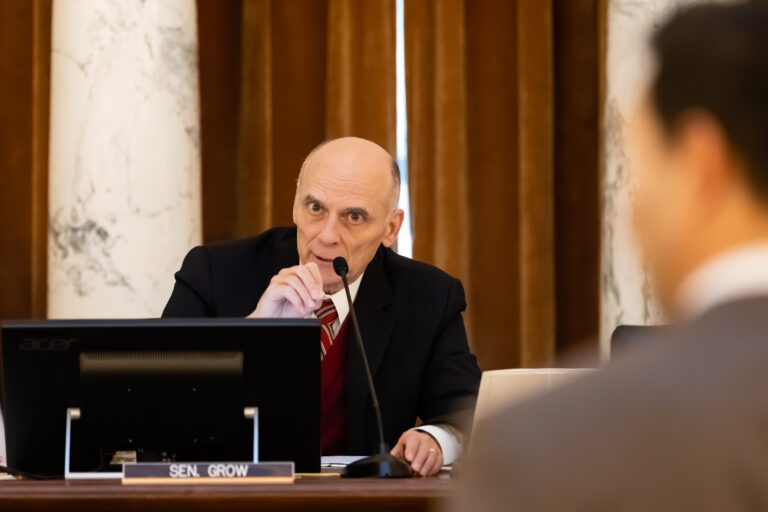
But the smart bet here is that JFAC is more likely to push the boundaries than to retreat from them. JFAC’s Senate co-chair, C. Scott Grow, reminded colleagues last week that this committee held the first hearing on the University of Idaho’s proposed purchase of the University of Phoenix — a rare and illuminating oversight hearing in June 2023, less than a month after the news of the $685 million deal went public.
“We have all the oversight we need,” he said. “We have plenty of tools.”
And, with full knowledge of the tools and the committee’s disposal, Horman took a measured tone to JFAC’s oversight issue of the moment, the $1.8 million in misspent money on the State Board’s Idaho System for Educational Excellence project. While Horman said legislative staff will perform an audit, she also took pains to say the ISEE mess predates new State Board Executive Director Jennifer White, and praised White as “a willing partner” who helped uncover the misspending.
And Horman tried to soften the message about legislative language — and simplify the job for agency heads.
“Just read the bill, and make sure you follow it.”
Next year’s bills could have no shortage of reading material.
Kevin Richert writes a weekly analysis on education policy and education politics. Look for his stories each Thursday.