Gov. Brad Little’s office said this month that a May 29 memo directing state agencies to prepare for “holdbacks” — midyear spending cuts — was never intended for public schools.
State superintendent Debbie Critchfield received a “courtesy copy” of the memo from Little’s budget division along with other constitutional officers, said Joan Varsek, spokeswoman for the Republican governor. But the Division of Financial Management (DFM) “did not ask” public schools or the Idaho Department of Education (IDE) to prepare for holdbacks.
Critchfield, also a Republican, later confirmed that it was her decision to plan for cuts affecting $3 billion in K-12 spending, roughly half the state’s budget. While IDE was “not explicitly asked to run the numbers for the public schools budget,” crafting budget scenarios is “always a sound business practice,” she told Idaho Education News.
“It was a general exercise and response to the memo, as we fielded numerous questions on what it might look like if education was impacted by revenue shortfalls,” she said by email.
Ultimately, public schools are exempt from the holdbacks, which were prompted by state revenue shortfalls and the looming effects of $453 million in tax cuts. In an executive order Friday, Little told state-funded agencies and institutions to trim 3% from general fund spending for the current fiscal year, with the exception of public schools.
But IDE officials had sent mixed signals to local public school leaders — about whether Little’s office was considering holdbacks for K-12 or it was Critchfield’s own “exercise.” In the meantime, the potential for holdbacks kicked a hornets’ nest of frustrations about education funding — much of it aimed at Little — before public schools were finally spared.
It’s unclear what will happen with Critchfield’s holdback plans now. The Legislature’s DOGE Task Force has requested copies of each agency’s plans, and directors must send their 2026-27 budget proposals to Little’s office by the end of August. Asked whether she planned to share the holdback scenarios, Critchfield gave a vague response Monday.
“The department is working up what various scenarios might look like,” she said.

Who said schools should plan for cuts? Critchfield made contradictory statements
On June 18, EdNews reported that DFM circulated a memo telling agency directors, including Critchfield, to prepare internal plans for 2%, 4% and 6% holdbacks, citing lagging state sales tax revenue and the sweeping tax cuts enacted this year.
Two days later, and three weeks after receiving a copy of the DFM memo, Critchfield sent an email to public school administrators explaining the upcoming budget process.
“The Division of Financial Management has asked us to work on scenarios to include a reduction,” Critchfield wrote. “I want to reassure you that we are working through the budget, and … giving it our full attention, like we do every year.”
In a followup letter — which EdNews and the Twin Falls Times-News published — Gideon Tolman, IDE’s chief financial office, said the holdback plans were “not necessarily expected,” but the department is “being asked to plan for them out of an abundance of caution.”
Then, two months after circulating the memo, the governor’s office clarified to EdNews that DFM had not asked IDE or public schools to prepare holdback plans.
As a “courtesy,” the memo was shared with all constitutional officers, who “prepare their own office budget recommendations separate from the governor’s office and DFM,” Varsek said on Aug. 4.
She also shared a list of agencies and institutions that were required to make the holdback plans. It included the State Board of Education, colleges and universities and smaller education-related agencies, like the STEM Action Center, but not IDE.
Critchfield backed this explanation from the governor’s office: The DFM memo “was not explicit to public schools,” she said. But she didn’t directly address apparent contradictions with her June 20 email.
IDE “thought it was appropriate to run through various scenarios for both public schools and the department,” Critchfield said Monday. That decision was based on “the information received from DFM” along with “numerous questions” from school districts and charter schools and the “fact that we also submit an agency budget.”

Talk of state cuts amplified frustrations around school funding
In the meantime, talk of holdbacks ramped up anxieties about public school funding.
For some local school leaders, already reeling this summer from delays and uncertainty around federal funding, it was a pile-on.
Critchfield said the holdback exercise spurred some “great conversations” with local leaders, and it “was an opportunity to listen and learn.” But not all of the dialogue was as amiable, according to emails obtained by EdNews.
A North Idaho superintendent, for instance, took offense when IDE recommended exploring “other funding streams” to plug a hole left by the Trump administration’s temporary freeze of $33 million earmarked for Idaho. On top of the federal freeze, state discretionary funding has been flat, said Boundary County superintendent Jan Bayer, and now districts are being asked to plan for holdbacks.
“A statement that tells us to ‘explore opportunities to supplement support using other funding streams’ assumes we have other funding streams,” Bayer wrote to the department. “We do not and it’s insulting to think we do.”
At the same time, Little’s constituents questioned his longstanding commitment to public schools.
On social media and in emails to the governor’s office, critics honed in on his approval of the tax cuts, including House Bill 93’s tax credit program for non-public school families. Cutting taxes amid a revenue shortfall is “not just bad forecasting,” one constituent wrote to the governor’s office. “It’s reckless governance.”
“Idaho schools — already stretched thin — now face the very real threat of cuts, all while dealing with rising operational costs and mandatory salary increases,” wrote Bryce Oldemeyer of Challis.
The new tax credit program only trims a fraction of the state’s total tax revenue, which was nearly $5.9 billion last fiscal year. But some people saw potential holdbacks as a sign that Little was bending his promise to protect public schools while also investing in private education.
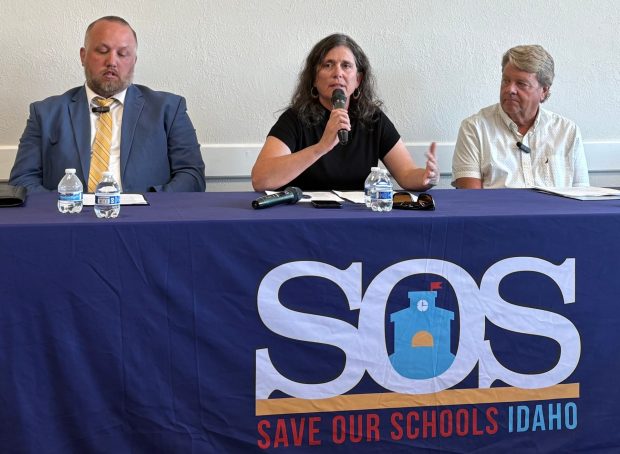
Gable Roth of Ammon asked the governor for reassurance after attending a meeting hosted by Save Our Schools. The group, founded by retired public school administrators, is traveling the state to highlight the pitfalls of private school choice in other states. Arizona last year faced a $1.4 billion deficit after slashing taxes during surplus years and more recently unlocking private education benefits for all students.
“We were promised in the campaigning for HB 93 that this bill would not take money from public schools,” Roth wrote to Little’s office. “I understand that it isn’t directly taking it from the public school funds but, effectively, it is causing the public schools to have fewer funds available.”
Balancing the state budget ‘will support public schools,’ Little says
Little’s executive order, “The Idaho Act,” ultimately held K-12 public schools harmless.
The 3% spending cuts will apply to public colleges and universities, which stand to lose about $13.3 million. Little also told agency, department and institution leaders to consolidate services, revert funding for unfilled positions, identify cost reductions in contracts and reduce travel spending.
But the executive order will balance the state’s budget “while supporting public schools,” said a news release from the governor’s office. The release didn’t identify new K-12 investments, though it touted $1 billion in past public school increases under Little’s administration.
Still, the K-12 exemption drew praise — with some qualifiers — across the political spectrum, from GOP leaders in the Legislature to the teachers’ union.
The holdbacks are “very unfortunate” and were “completely predictable” after “massive” tax cuts, said Layne McInelly, president of the Idaho Education Association. “However, Gov. Little’s exclusion of public schools in these budgetary clawbacks highlights the crucial role he must play as a defender of Idaho public schools.”
Senate President Pro Tem Kelly Anthon, R-Rupert, said the executive order reinforces Idaho’s “strong track record of living within the people’s means and making government as efficient as possible so we can continue to prioritize education.”

The Legislature has the final say on public school spending, however, and whether the governor’s efficiency efforts will be enough to appease lawmakers in “DOGE-mode” remains to be seen. The holdback plans will likely play a role in budget considerations moving forward.
A legislative DOGE Task Force has asked for copies of the plans, according to Rep. Josh Tanner, R-Eagle, a hardline conservative member of the interim committee and the budget-setting Joint Finance-Appropriations Committee.
During an inaugural DOGE meeting last month, Tanner called each agency’s holdback scenario a “roadmap” for the task force’s cost-cutting mission. He later told EdNews that there will be a “correlation” between the plans and spending that the task force investigates.